

Automated strategy management tools handle backtesting, optimization, execution, and monitoring for algorithmic trading systems, and their value lives or dies on the data feeding them. For intraday work, the right stack needs four things: clean minute-bar data with point-in-time integrity, a backtest engine that supports walk-forward validation, a replay or forward-testing mode, and execution APIs that model realistic fills. A dataset like S&P 500 Back Adjusted 1mo illustrates what "clean" should actually mean before you build anything on top of it.
TL;DR:
- Event-driven backtesting is essential for intraday strategies because it accurately captures the sequence of trades and orders, unlike vectorized engines.
- Data quality issues, such as silent gaps or inconsistent adjustments, often cause backtest bias and can lead to strategy failures in live trading.
- Walk-forward validation with multiple out-of-sample windows and realistic execution modeling is crucial to prevent overfitting and ensure strategy robustness.
- Reliable intraday data should be thoroughly audited for timestamp alignment, corporate actions, missing bars, and outliers before use.
- Choosing a tool depends on the bottleneck in data quality or backtest capability; fix data issues first before upgrading to more advanced platforms.
Table of Contents
- What Makes a Tool Suitable for Intraday Strategy Automation?
- Where Do These Tools Fit in a Research-to-Production Pipeline?
- How Do You Audit Minute-Bar Data for Backtest Bias?
- How Do You Implement and Operate an Intraday Strategy Step by Step?
- Why Clean Minute-Bar Data and Engineer Support Reduce Execution Risk
- What Criteria Actually Separate Good Tools From Mediocre Ones?
- Common Implementation Pitfalls in Automated Trading Systems
- How Do Vendor Platforms for Strategy Automation Compare?
- How Do You Select and Acquire Reliable Intraday Datasets?
- What Do These Tools Cost, and How Are They Licensed?
- The Overlooked Variable in Backtest Reliability
- Get Started With Backtestmarket's Data and Tools
- Sources
- FAQ
What Makes a Tool Suitable for Intraday Strategy Automation?
Every intraday system depends on how honestly it simulates the past. That starts with the backtest engine itself.
Event-driven engines beat vectorized ones for intraday work. Vectorized backtesting applies signals across an entire price array at once, which is fast, but blind to sequencing. It cannot tell you whether your stop-loss triggered before or after a fill on the same bar. Event-driven engines process ticks or bars one at a time, respecting the order in which information actually arrived. For anything trading on minute bars, that sequencing difference is often the gap between a strategy that looks profitable and one that actually is.
A workable evaluation checklist looks like this:
- Walk-forward support: the engine re-optimizes on rolling windows and tests on unseen segments, which is the standard defense against overfitting in intraday systems, as Algovantis lays out for parameter stability testing.
- Replay or forward-testing mode: a simulated live feed that lets you trade the strategy in near-real time without capital at risk, useful for catching execution-logic bugs before deployment.
- Execution modeling: market, limit, and stop order types, partial fill logic, and a configurable slippage model, not a flat percentage bolted on as an afterthought.
- Data granularity: true minute bars (not resampled from daily data), point-in-time timestamps, and documented corporate-action and back-adjustment handling.
A platform that nails three of four and fumbles data quality still produces biased results. That is usually the piece traders underestimate.
Where Do These Tools Fit in a Research-to-Production Pipeline?
Automated strategy management tools are not a single step. They form a chain, and each link needs its own pass/fail gate before the strategy moves forward.
- Research and hypothesis formation. Build the rule set on a clean historical sample, ideally including a full market cycle rather than a single trending stretch.
- Automated backtest. Run the strategy through an event-driven engine with realistic transaction costs. Reject anything that only works with zero slippage.
- Walk-forward validation. Split the sample into sequential in-sample and out-of-sample windows. On an instrument like the S&P 500, a common approach uses several months of in-sample optimization followed by a shorter out-of-sample test, repeated on a rolling basis. Consistency across windows matters more than peak performance in anyone.
- Replay and forward testing. Trade the strategy against a simulated live feed. FX Replay notes that intraday validation needs minute-level data and metrics like time-of-day performance, not just an aggregate P&L curve.
- Staged live deployment. Start with minimum size, log every fill against the backtest's expected fill, and only scale up once the execution gap stays small across multiple sessions.
Roll a strategy back to research if walk-forward consistency breaks down or if live slippage consistently exceeds the backtest's assumption. Deactivate it outright if the edge disappears across two or more consecutive out-of-sample windows.
How Do You Audit Minute-Bar Data for Backtest Bias?
Bad data does not usually announce itself. It shows up as a strategy that backtests beautifully and then quietly loses money live, and by the time you notice, you have already wasted weeks chasing a phantom edge.
Run these checks before trusting any intraday dataset:
- Timestamp and session alignment: confirm bars align to the exchange's actual session hours and time zone, with no silent gaps around open, close, or holidays.
- Corporate action and back-adjustment verification: for a series like the S&P 500 Back Adjusted 1mo, check that roll adjustments are applied consistently across the full history, not just recent contracts, so historical price levels stay comparable.
- Missing and duplicate bar detection: scan for repeated timestamps or silent gaps, both of which distort volatility calculations and indicator values.
- Outlier audits: flag bars with implausible ranges or volume spikes, then verify against a second source rather than deleting them blindly.
- Replay sanity checks: run a short replay session and compare fills against what the raw data implies. If your slippage model needs constant correction, the underlying data is probably the real problem.
- Provenance documentation: ask any vendor for an adjustment log. Practitioners have long noted that inconsistent aggregation rules and unhandled corporate actions can quietly bias opening-range volatility and skew intraday results.
Pro Tip: Run the same walk-forward test on two different data vendors' feeds for the same instrument. If your Sharpe ratio swings by more than a small margin between them, the problem is your data, not your strategy.
A closer look at MT5 backtesting data audits walks through gap and timestamp checks in more detail.
How Do You Implement and Operate an Intraday Strategy Step by Step?
Moving from a promising backtest to a live strategy is an engineering process, not a leap of faith.
- Import and verify. Load the dataset into MT4 or MT5, then run a short baseline replay on something like the S&P 500 Back Adjusted 1mo series to confirm bar counts and timestamps match expectations.
- Configure realistic costs. Set commission, spread, and a slippage model that reflects your actual broker, then run the walk-forward sweep across multiple parameter sets.
- Forward test with journaling. Track every simulated trade against the backtest's predicted entry and exit. Guidance from TraderNest suggests forward testing for at least 30 trades or four to eight weeks, whichever runs longer, before drawing conclusions.
- Stage live sizing. Deploy at minimum size first, with automated alerts if live slippage or fill rate drifts meaningfully from backtest assumptions.
- Monitor and refresh. Track profit factor, maximum drawdown, and time-of-day performance weekly, and re-run walk-forward optimization on a fixed schedule rather than only when performance dips.
Platforms that link automated backtests directly to a live trade journal make execution-gap analysis far faster, since you can compare expected and actual fills in one view instead of reconciling two separate systems, a point TradeZella makes about integrated journaling.
Why Clean Minute-Bar Data and Engineer Support Reduce Execution Risk
Most backtest bias does not come from a flawed strategy. It comes from data nobody audited.
A dataset is only as trustworthy as its adjustment log. If a vendor cannot tell you exactly how and when back-adjustments were applied, you are backtesting against a series nobody can fully explain.
Some vendors provide clean minute-bar historical intraday data across various asset classes with documented adjustments rather than silent application. That documentation matters more than it sounds. Small back-adjustment or timestamp errors compound across thousands of intraday bars, and Nurp's platform-feature guide lists point-in-time data integrity as a baseline requirement for any serious quant platform, not an optional extra.
Ready-to-import formats for MT4 and MT5 remove a common failure point: manual reformatting that introduces timestamp misalignment before a single backtest even runs. Direct access to engineers who collected the data, rather than a support queue reading from a script, can shorten the time it takes to resolve data questions that might otherwise stall a validation cycle. For a walkthrough of what that support should look like in practice, see this breakdown of vendor support standards.
What Criteria Actually Separate Good Tools From Mediocre Ones?
Feature lists look similar across vendors. The differences that matter show up under load.
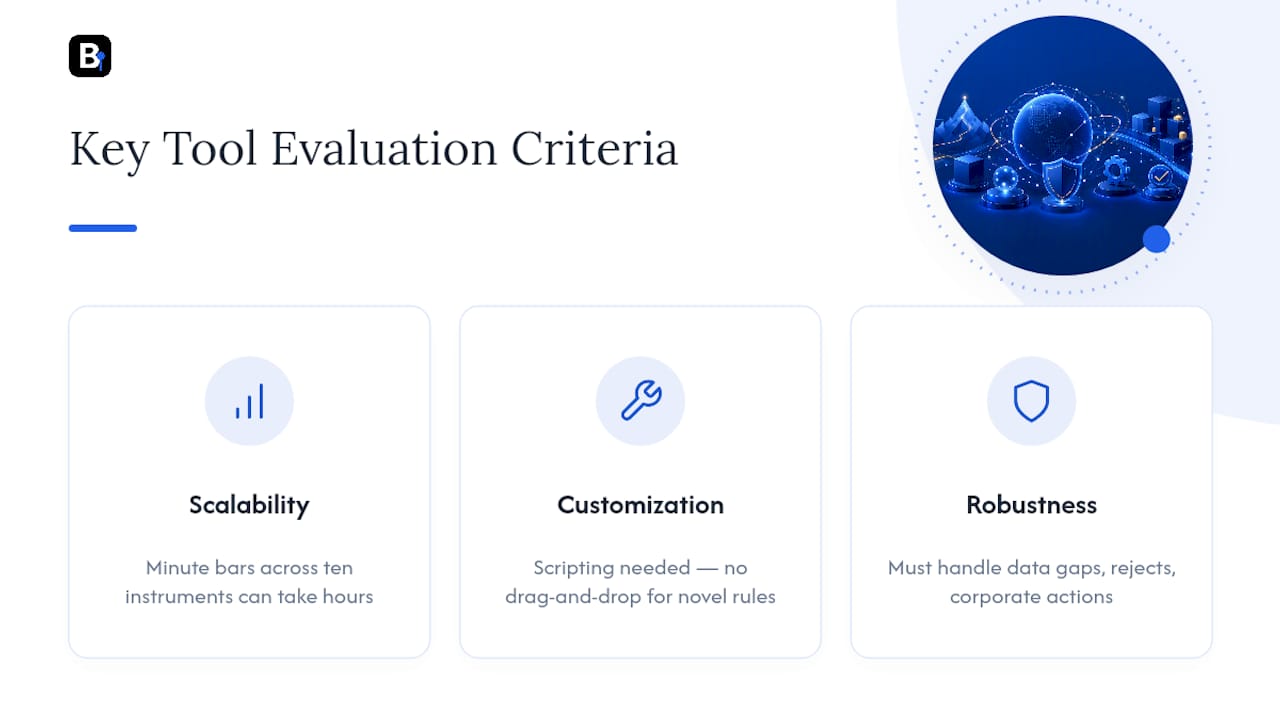
Scalability is about whether the engine holds up when you go from testing one strategy on one instrument to running a portfolio of correlated systems across multiple markets simultaneously. A backtest engine that takes twenty minutes for one strategy on daily data can take hours on minute bars across ten instruments, and some tools simply were not built for that volume.
Customization determines whether you can encode a genuinely novel rule or whether you are stuck picking from preset indicator combinations. Quant developers writing custom entry logic, multi-timeframe filters, or portfolio-level position sizing need a scripting environment, not a drag-and-drop rule builder.
Robustness is the hardest to evaluate and the most important. It shows up in how the tool handles edge cases: a data gap mid-session, a broker rejection on an order, a corporate action that hits mid-backtest. A tool that silently skips a bad bar instead of flagging it will hand you a clean-looking equity curve built on a corrupted foundation.
Weigh these three against your actual trading style. A single-instrument swing trader can tolerate a less scalable tool. A quant running twenty correlated intraday systems cannot, and a fragile engine will eventually cost more in debugging time than any subscription fee saves.
Common Implementation Pitfalls in Automated Trading Systems
System architecture decisions made early tend to cause the most expensive problems later.
The most frequent mistake is building a monolithic script that handles data ingestion, signal generation, and order execution in one undifferentiated block. When something breaks, and something always breaks, isolating the failure means reading the entire codebase instead of checking one module. Separating data ingestion, strategy logic, and execution into distinct components with clear handoffs makes debugging dramatically faster and lets you swap a data vendor without touching your signal code.
Fault tolerance deserves more attention than most retail-focused guides give it. What happens when your broker connection drops mid-session? Does the system attempt to reconnect and resume, or does it silently stop logging while still holding an open position? A production system needs a watchdog process that flags silence, not just errors, since a system that stops sending signals looks identical to one that is calmly waiting for the next setup.
Error handling around bad data is equally underrated. A single malformed tick or a duplicate bar can crash a naive script or, worse, generate a phantom signal. Wrapping every data ingestion point in validation logic that rejects malformed bars, rather than trying to interpret them, prevents an entire class of live-trading incidents that never show up in backtesting because clean historical data does not carry the same corruption a live feed occasionally will.
How Do Vendor Platforms for Strategy Automation Compare?
The market splits roughly into three categories, and knowing which one you actually need saves months of wasted evaluation.
Entry-level retail platforms bundle basic backtesting, a simple strategy builder, and limited data history, usually daily bars with intraday as a paid add-on. They work for hobbyist testing but rarely offer walk-forward analysis or genuine execution modeling.
Enterprise quant platforms provide institutional-grade infrastructure: colocation, direct market access, and full API control. They also come with enterprise pricing and onboarding timelines that make no sense for an individual developer or a small trading team testing one or two strategies.
Specialized data and tooling vendors sit in between, focusing on one part of the pipeline done well rather than trying to be an all-in-one platform. This is where a dataset provider supplying clean, ready-to-import minute bars fits, paired with whatever backtest engine or execution platform you already run in MT4, MT5, or a custom Python stack.
The right choice depends on what you are actually missing. If your backtest engine works fine but your data has gaps and undocumented adjustments, an enterprise platform migration solves nothing. If your data is clean but your engine cannot run walk-forward sweeps, no dataset fixes that. Match the tool to the actual bottleneck in your pipeline rather than replacing the whole stack because one piece is weak.
How Do You Select and Acquire Reliable Intraday Datasets?
Data selection comes down to three checks: completeness, format compatibility, and adjustment transparency.
Completeness means the history covers enough market regimes to stress-test a strategy, not just a recent bull run. A dataset spanning back to 2014, like the sets Backtestmarket maintains across historical data for forex, metals, bonds, and stock indices, gives you multiple volatility regimes to validate against instead of one convenient stretch.
Format compatibility determines how much engineering time you burn before a single backtest runs. A dataset delivered in a proprietary format that needs custom parsing costs you days. One built for direct import into MT4 or MT5, like the S&P 500 Back Adjusted 1mo set, gets you to your first backtest the same afternoon.
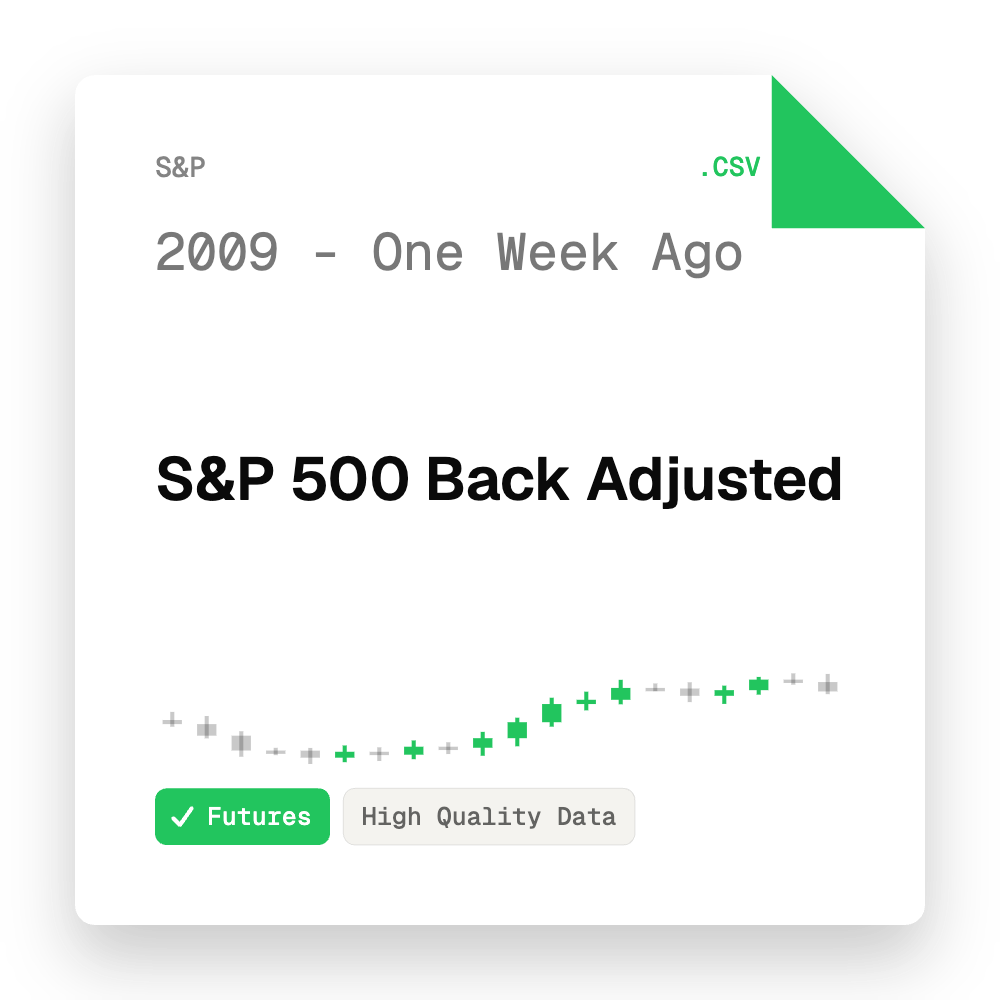
Adjustment transparency is the one most traders skip checking until something goes wrong. Ask any vendor, before buying, whether back-adjustments are documented per contract roll or applied as a single blended series. The former lets you audit specific periods; the latter is a black box you are trusting blind.
One overlooked angle: calendar and reporting conventions vary by data source, and a discussion of portfolio reporting patterns touches on how inconsistent calendar handling can distort comparative results, a subtler version of the same corporate-action problem intraday traders face directly.
What Do These Tools Cost, and How Are They Licensed?
Pricing in this space splits into two models: one-time data purchases and recurring access plans, and mixing them up leads to budgeting mistakes.
One-time dataset purchases work well if you need a fixed historical window for a single research project. You buy the data once, own the file, and use it indefinitely for backtesting, with no ongoing dependency on a vendor's platform staying online.
Subscription or annual plans make more sense for traders who need continuously updated data and periodic access to new instrument coverage. Backtestmarket's Annual Plan runs €119 per year and fits a trader running live strategies that need refreshed data on an ongoing basis rather than a single historical download.
Execution and backtesting software licensing is usually separate from data licensing entirely. MT4 and MT5 are free from most brokers; the cost sits in data quality, any custom expert advisors or indicators you buy, and the engineering time to wire everything together. Budget for data and tooling as distinct line items, because bundling them into one number makes it hard to tell which piece is actually driving your costs when you scale up to more instruments or higher tick frequency.
The Overlooked Variable in Backtest Reliability
Most guidance on automated strategy management fixates on the algorithm: better indicators, smarter position sizing, more clever exit logic. That focus is not wrong, but it is incomplete, and the gap it leaves is exactly where good strategies quietly fail in live trading.
The evidence throughout this piece points somewhere less glamorous: data integrity and validation discipline explain more backtest-to-live performance gaps than strategy design does. A walk-forward process run on corrupted minute bars still produces a confident-looking equity curve. It just does not mean anything.
If there is one priority to fix before optimizing another parameter, it is this: know exactly how your data was adjusted, timestamped, and audited before you trust a single backtest result built on it. That is not the exciting part of quant development. It is the part that determines whether the exciting part, the strategy itself, ever survives contact with a live market.
— Start
Get Started With Backtestmarket's Data and Tools
Backtestmarket is a direct route to the one input every automated strategy actually depends on: clean, documented, ready-to-import intraday data, sold outright rather than locked behind a black-box platform.
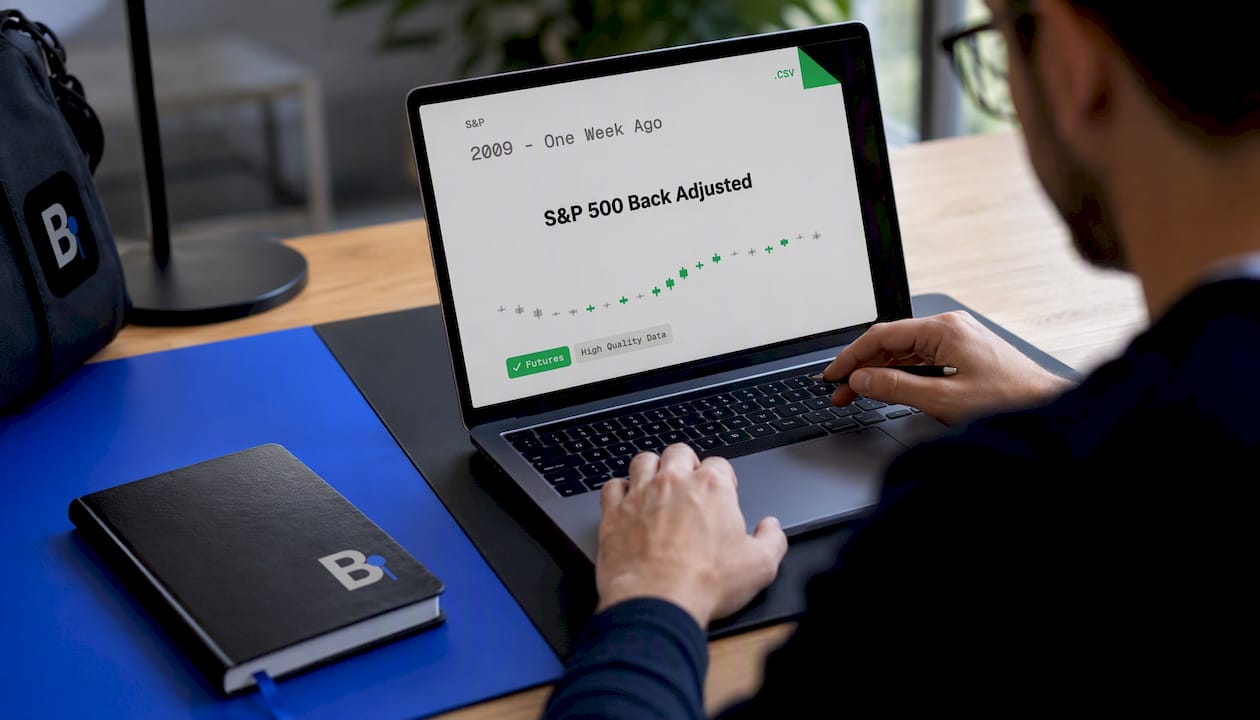
For a single research project, start with the S&P 500 Back Adjusted 1mo dataset as a concrete example of what documented back-adjustment looks like in practice. If you are running live strategies that need continuously refreshed data across market cycles, the Annual Plan at €119 per year covers ongoing access instead of a one-off download. Browse the full range of asset classes under Historical Data if you are comparing coverage across forex, metals, bonds, and indices, and check the expert advisors and indicators available if you want tooling to pair with the raw data. Every dataset ships ready for MT4 and MT5 import, and engineers who collected the data are available directly if a validation question comes up mid-project. Head to the product page for your instrument of choice and download the sample data before committing to a full purchase.
Sources
For more on validation methodology, see Algovantis on walk-forward analysis and FX Replay on intraday backtesting setups. For data audits, review outlier handling on minute-1 data.
- How to Choose Backtesting Software: 8 Key Factors (2026)
- Backtesting intraday strategies with walk forward analysis: A practical approach | Algovantis
- Intraday Backtesting: Building fast, reliable day trading setups | FX Replay
- Quant Trading Platform Features: Complete 2026 Guide | Nurp
FAQ
What Are Automated Strategy Management Tools?
They are software systems that handle backtesting, optimization, execution, and monitoring for algorithmic trading strategies. For intraday work, the essential components are clean minute-bar data, an event-driven backtest engine, walk-forward validation, and execution APIs with realistic fill modeling.
Why Is Walk-Forward Analysis Necessary for Intraday Strategies?
Walk-forward analysis tests optimized parameters on sequential out-of-sample windows, which catches overfitting that a single in-sample backtest would miss. Algovantis notes that intraday systems need shorter out-of-sample windows than swing or position strategies because market regimes shift faster on shorter timeframes.
How Long Should Forward Testing Run Before Going Live?
Forward testing should run for at least 30 trades or four to eight weeks, whichever takes longer, according to guidance from TraderNest. That window gives enough sample size to compare expected versus actual fills across different market conditions.
What Should I Check Before Trusting a Minute-Bar Dataset?
Verify timestamp alignment, corporate-action and back-adjustment documentation, and check for missing or duplicate bars before running any backtest. Ask the vendor for an adjustment log. Backtestmarket documents adjustments on datasets like the S&P 500 Back Adjusted 1mo rather than applying them silently.
How Much Does Backtestmarket's Data Cost?
Backtestmarket's Annual Plan is priced at €119 per year for ongoing access to datasets and updates. Individual historical datasets, including specific instrument bundles, are also available as one-time purchases with pricing listed on each product page.
Recommended
- Fixing MT4 Missing Data: A Complete Recovery Guide
- Audit First MT5 Backtesting Data: Gap, Timestamp, Ready to Import
- 5 Audits Quants Must Run on Outlier Handled M1 Data Before MT4/MT5
- Minute Bar Data: What Quants Need for Reliable Backtests
Related resources
Explore BacktestMarket's Expert Advisor robots to put the ideas in this article into practice.