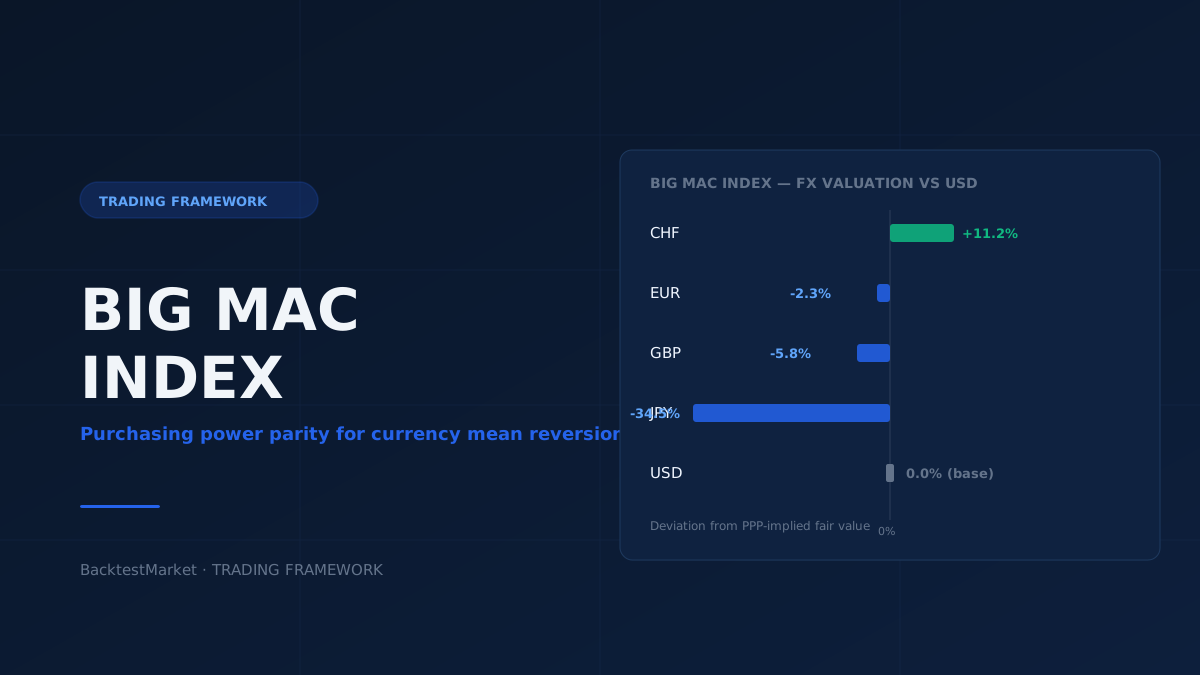
Every few months, a conversation about the "Big Mac Index" resurfaces online — most recently gaining traction again in trading and economics forums. On the surface it looks like a novelty: comparing the price of a McDonald's Big Mac in different countries to estimate whether a currency is "cheap" or "expensive." But underneath the fast-food branding is a genuine economic concept — purchasing power parity (PPP) — that has influenced decades of currency research and, indirectly, a whole category of long-term mean-reversion trading frameworks.
For algorithmic traders building systems in MT4 or MT5, the Big Mac Index itself isn't something you can code into an Expert Advisor. There's no live feed of burger prices, and the index updates infrequently. But the logic behind it — that exchange rates tend to drift away from and back toward a "fair value" anchor over long time horizons — is exactly the kind of structural idea that disciplined backtesting can help you evaluate, refine, or reject.
This article breaks down what the Big Mac Index actually measures, how its underlying theory maps onto real algorithmic trading frameworks, and what a rigorous backtesting approach to PPP-style currency mean reversion looks like in practice.
What the Big Mac Index Actually Measures
The Big Mac Index was created by The Economist in 1986 as a lighthearted way to explain purchasing power parity to a general audience. The theory behind PPP is straightforward: in a frictionless world, identical goods should cost the same amount everywhere once you convert prices into a common currency. If a Big Mac costs $5.50 in the United States and the equivalent of $4.00 in another country at current exchange rates, PPP theory suggests that country's currency is undervalued relative to the dollar — and that, over the long run, exchange rates should adjust to close that gap.
In reality, PPP is a long-horizon, structural concept, not a short-term trading signal. Prices differ across countries for reasons that have nothing to do with currency misalignment: labor costs, rent, local taxes, tariffs on beef or wheat, and consumer demand patterns all distort the comparison. That's precisely why the index is a teaching tool rather than a forecasting model economists rely on for precision. Still, academic researchers have found that Big Mac–style PPP deviations show statistically meaningful correlation with currency movements over multi-year periods, even if the relationship is noisy and slow to resolve.
For algorithmic traders, the lesson isn't "trade the burger index." It's that valuation-anchored mean reversion is a real, researchable phenomenon in currency markets, and it operates on a completely different timescale than the intraday or swing strategies most retail EAs are built around.
From Theory to Trading Framework: Where PPP Fits
If you're used to building or testing EAs around moving averages, breakout logic, or short-term momentum, a PPP-style framework requires a mental shift. Instead of asking "what will price do in the next few hours or days," you're asking "is this currency pair structurally overextended relative to a long-run fair value estimate, and is there evidence that it tends to revert?"
A few ways this concept has historically been operationalized by quant researchers and retail algo traders alike:
- Real effective exchange rate (REER) models — comparing a currency's trade-weighted value against a basket of trading partners, adjusted for inflation differentials. This is a more rigorous cousin of the Big Mac Index.
- Interest rate differential and carry-adjusted PPP models — blending PPP deviation with rate differentials to account for why currencies can stay "misvalued" for years when yield incentives offset the valuation gap.
- Long-horizon mean-reversion filters — using multi-year moving averages or regression channels on a currency pair to flag when price has drifted unusually far from its historical median, then backtesting whether reversion toward that median has historically been statistically reliable.
None of these approaches generate a clean, instant buy/sell signal the way a crossover strategy might. They're context layers — filters you apply on top of a shorter-term execution strategy to avoid fighting a multi-year structural trend, or to bias a system toward mean-reversion setups when a pair looks historically stretched.
This is also where the limits of retail EA design become obvious. Most off-the-shelf Expert Advisors are built and optimized on a few years of recent price data, which is far too short a window to say anything meaningful about PPP-style reversion. If you want to explore this kind of framework seriously, you need deep historical datasets — ideally spanning multiple full economic and interest-rate cycles — which is one reason traders researching long-horizon currency behavior often turn to dedicated forex historical data sets rather than relying on whatever history their broker happens to provide.
Backtesting a PPP-Inspired Mean-Reversion Concept
Suppose you wanted to test — purely for research purposes — whether a currency pair exhibits mean-reverting behavior consistent with a PPP-style framework. Here's a disciplined approach:
1. Define your "fair value" proxy.
You won't have access to Big Mac pricing data in a usable time series, so you'd substitute a proxy such as a long-term moving average (e.g., 100-week or 200-week), a regression-based fair value channel, or a REER-style composite if you can source the inflation and trade-weight data. Document the exact formula before you touch any price history — this avoids the temptation to curve-fit later.
2. Use a long, clean historical dataset.
Multi-year PPP reversion claims need multi-decade data to test credibly. A five-year backtest tells you almost nothing about a phenomenon that plays out over 7–15 year cycles. Make sure your historical data is tick-accurate or at minimum reliable OHLC data, properly adjusted for any symbol or feed changes, and correctly imported into your platform — the MetaTrader data import guide walks through how to avoid common formatting errors that silently corrupt backtest results.
3. Separate signal from execution.
A PPP-style deviation might tell you a currency is "cheap," but it says nothing about timing. Pair the valuation filter with a separate, shorter-term execution rule (trend confirmation, volatility breakout, etc.) and test the combination, not the valuation filter in isolation.
4. Walk-forward test across multiple regimes.
Currency valuation gaps behave very differently during floating-rate stability versus central bank intervention periods, pegged-currency episodes, or high-inflation shocks. A proper walk-forward test — segmenting your data into distinct macro regimes — will expose whether your "mean reversion" is a durable statistical property or an artifact of one unusually calm decade.
5. Stress-test transaction costs and holding periods.
Long-horizon mean-reversion strategies often imply holding periods measured in months or years, which changes your cost assumptions entirely. Spread and commission erosion matters less here than rollover/swap costs compounding over time — model those explicitly rather than ignoring them.
If building this kind of system from scratch isn't practical, browsing existing Expert Advisor robots built around longer-horizon or macro-filtered logic can at least give you a reference point for how other developers have structured entry/exit rules around slower-moving fundamental signals — useful as a benchmark even if you ultimately build your own.
Why This Matters More Than the Headline Suggests
The resurgence of "Big Mac" chatter in trading communities is a useful reminder of something easy to forget amid high-frequency EA development: currency prices are not purely technical phenomena. They sit on top of real economic relationships — trade flows, inflation differentials, and yes, the relative cost of a fast-food lunch — that assert themselves over long enough time horizons.
That doesn't mean you should abandon technical systems for a spreadsheet of burger prices. It means that a well-rounded algorithmic trading framework treats valuation context as one input among several, tested with the same rigor you'd apply to any entry signal: clearly defined rules, sufficiently long and clean historical data, out-of-sample validation, and honest accounting for costs.
Practical Takeaway
The Big Mac Index won't become a line of MQL code, and it shouldn't be mistaken for a trading signal. But the purchasing power parity logic behind it is a legitimate, well-documented driver of long-run currency behavior — and it's worth incorporating as a contextual filter rather than a trading mechanism. If you want to explore this seriously: source long-horizon historical data, define your valuation proxy in writing before testing, separate your fundamental filter from your execution logic, and walk-forward test across multiple macro regimes before drawing any conclusions. That discipline — not the novelty of the burger comparison — is what separates a researched framework from a forum anecdote.