

Cross asset data normalization is a contract that guarantees identical field names, types, and timestamps across venues and asset classes, no matter where the raw data came from. Enforce a canonical schema and unify every timestamp to ISO-8601 UTC before anything else. From there, apply standard scalers such as Z-score or RobustScaler depending on how each feature is distributed.
TL;DR:
- Normalization should happen upstream to avoid duplicated adapter maintenance and ensure consistent, auditable data processing across all asset classes.
- Proper schema mapping must address common traps such as implicit currency conversions, stringified numbers, negative prices, and schema drift, which can cause subtle errors.
- The best scaling methods depend on feature distribution, with Z-score for symmetric series, RobustScaler for outliers, and Min-Max for bounded inputs, applied within rolling windows for intraday data.
- Validating normalization requires both unit and integration tests, ongoing statistical monitoring, and detailed, version-controlled documentation for audit and compliance purposes.
- Using pre-processed data, like BacktestMarket's clean minute bars, enables faster, more reliable integration into trading models while reducing the risk of schema and timestamp errors.
Table of Contents
- What a normalized schema must guarantee
- A practical normalization pipeline for multi-asset data
- Choosing the right scaler for each feature
- Upstream versus downstream normalization
- Canonical schema examples and common mapping traps
- Tests and monitors that catch normalization regressions
- How BacktestMarket shortens the normalization work
- What normalization means for portfolio analytics and risk
- Tools and platforms for building normalization pipelines
- What real deployments show about normalization
- Governance and compliance in cross-asset normalization
- Common mistakes engineers make with normalization
- Where BacktestMarket fits in your normalization project
- Sources
- FAQ
What a normalized schema must guarantee
A normalized feed is a promise between the data provider and every downstream consumer: a model, a backtester, a risk engine. That promise has five layers, and skipping any one of them creates a specific, predictable class of bug. A developer-focused breakdown of normalized market data lays out these layers as the core contract every clean schema needs.
- Field naming: one name per concept (
close, neverc,Close, andlast_pxin different feeds). - Type consistency: prices are floats, not strings that sometimes arrive quoted from a CSV export.
- Timestamp format: every timestamp is ISO-8601 UTC, which removes the daylight saving time bugs that hit feeds mixing exchange-local and UTC clocks.
- Response envelope: every payload, whether from a REST pull or a WebSocket push, wraps data in the same structure with the same metadata fields.
- Null handling: a missing value is always represented the same way, never sometimes
null, sometimes0, sometimes an empty string.
Aligning field types to something like the FIX data type specification helps here too, since FIX already defines string, price, and quantity types with edge cases like negative price support for certain instruments built in. Treat that spec as a reference point when your mapping registry has to decide how strict a numeric type should be.
A practical normalization pipeline for multi-asset data
Most production pipelines converge on the same shape, regardless of whether the source is a CSV drop, a WebSocket JSON stream, or raw FIX messages.
- Ingest and validate: accept the raw payload and check only structural validity (is it parseable JSON, does the CSV have the expected column count) before touching business logic.
- Parse and map: run the payload through a per-vendor, per-asset mapping registry that translates vendor field names into canonical ones.
- Coerce types and enforce schema: cast strings to floats, validate enums (order side, asset class), and reject anything that fails the canonical schema outright.
- Harmonize timestamps and resample: convert every timestamp to ISO-8601 UTC, then apply your resampling rule, intraday bars aggregate on fixed windows while daily bars align to exchange close.
- Handle outliers, scale, enrich, and store: flag or clip extreme values, apply the appropriate scaler per series, attach metadata (venue, adjustment history), then write to your canonical store.
Pro Tip: Keep the mapping registry in version control as data, not code, so a new vendor integration is a pull request against a table rather than a redeploy.
This pipeline shape holds whether you are unifying equities and FX or bolting on commodities data later. Our guide to holiday gaps in market data covers the resampling edge cases around exchange closures in more detail.
Choosing the right scaler for each feature
Not every numeric feature should be scaled the same way, and the wrong choice quietly degrades model performance long before anyone notices. The Northeastern data normalization guide treats Z-score as the default for continuous variables feeding linear models, reserves Min-Max scaling for inputs with known, fixed bounds, and recommends RobustScaler whenever outliers would otherwise distort a Z-score.
- Z-score (standardization): default choice for returns and other roughly symmetric continuous features feeding linear or distance-based models.
- Min-Max scaling: best for bounded inputs, like a feature already constrained between 0 and 1, or normalized order-book depth.
- RobustScaler: the right call whenever a series has significant outliers, such as trading volume during a news spike.
- Log and quantile transforms: volumes typically get a log transform before scaling, since raw volume is heavily right-skewed.
Rolling, per-series standardization is standard for intraday windows, and the same guide warns explicitly that computing mean and standard deviation across the full dataset before splitting into train and test windows leaks future information into the past. Scale within each rolling window, per instrument, and recompute those statistics as new data arrives rather than freezing them at training time.
The scikit-learn preprocessing module offers a ready implementation path here: its Normalizer and transformer classes support l1, l2, and max norms and slot directly into a pipeline, including for sparse inputs common in order-book data.
Upstream versus downstream normalization
The industry is moving normalization closer to the source. A Quod Financial analysis of upstream normalization describes how normalizing at the point of capture, as its UNITY architecture does, cuts duplicated adapter work and creates a shared foundation that surveillance, reporting, and execution systems can all consume without bespoke translation layers.
- Upstream normalization removes the need for every downstream team to write and maintain its own adapter for the same raw feed.
- It reduces operational risk because a single, audited normalization layer is easier to monitor than a dozen team-specific ones.
- Downstream normalization still has a place in research environments, where a quant team prototyping a new signal needs fast, flexible reshaping that a shared upstream layer would slow down.
Teams running production strategies should push toward the upstream model; teams still exploring ideas can keep normalizing downstream a while longer.
Canonical schema examples and common mapping traps
A minimal canonical candle schema needs just a handful of fields: symbol (string), ts (ISO-8601 UTC string), open, high, low, close (floats), volume (float or integer depending on asset class), venue (string), and via (the specific feed or adapter that produced the record). Mapping a vendor's UTCTimestamp field to ts and a venue-specific ticker like EURUSD.FX1 to a canonical symbol are the two most common transformations any adapter performs.
The traps that break these mappings in production are well documented and recur across vendors:
- Vehicle-currency conversion done implicitly: a market-data-normalizer project note warns that an unstated conversion path can quietly multiply spreads and staleness, and that converted returns are not a simple additive adjustment, they need to be decomposed correctly.
- Negative prices: some instruments, and some FIX-supported products, legitimately trade negative, so a naive "reject if negative" validation breaks real data.
- Stringified numbers: a price arriving as
"1.2345"instead of a float passes a naive null check but fails downstream math silently. - Missing-volume semantics: a zero volume and a missing volume mean different things and should never collapse to the same value.
- Schema drift: a vendor adds a field or renames one without notice, and an unmonitored mapping registry keeps working until it quietly produces wrong output.
Tests and monitors that catch normalization regressions
Validation has to run at two levels: before code ships, and continuously once it is live.
- Unit tests on each adapter and mapping table, checking that known vendor payloads map to the exact expected canonical record.
- Integration tests that run a full raw-to-canonical pass and assert the output matches the canonical schema, field by field.
- Statistical monitors watching for mean and standard deviation drift, rising null rates, duplicate tick rates, and feeds going stale past an expected window.
- Operational audits that reconcile daily volume totals against the exchange, and specifically check holiday calendars and daylight saving transitions, since those are the two conditions most likely to silently misalign timestamps.
Pro Tip: Run your DST and holiday-calendar checks as their own scheduled job, separate from routine schema tests, since they only surface a few times a year and get forgotten otherwise.
How BacktestMarket shortens the normalization work
BacktestMarket supplies clean, minute-bar intraday data across forex, metals, bonds, stock indices, and commodities, already formatted for direct import into MT4 and MT5. Consistent timestamps and documented adjustments mean less adapter maintenance, and support comes directly from the engineers who collect the data rather than a generic help desk.
What normalization means for portfolio analytics and risk
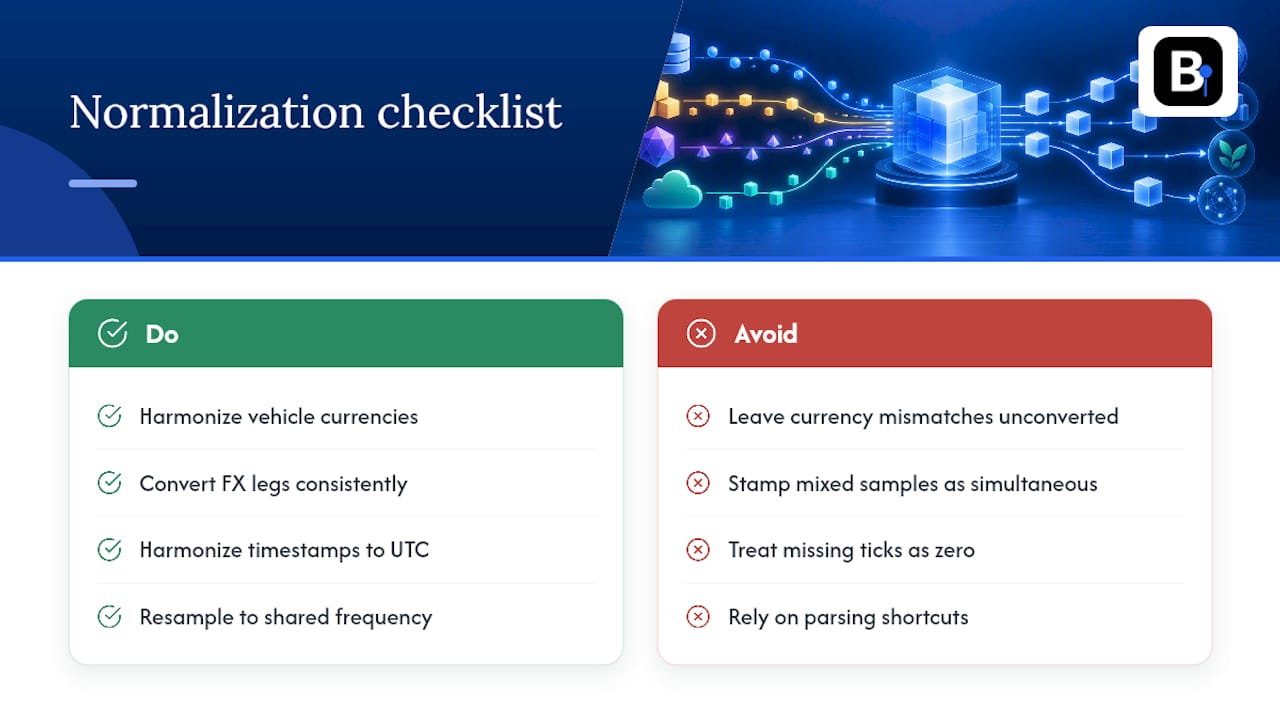
Portfolio analytics and risk models are only as trustworthy as the inputs feeding them, and cross-asset strategies multiply that dependency because a single position can touch equities, FX, and rates at once. A currency mismatch that slips through unnormalized vehicle-currency handling does not just distort one number, it propagates into every downstream calculation that depends on it: value-at-risk, correlation matrices, factor exposures.
Misaligned timestamps across asset classes are a particularly common source of quiet risk-model error. A bond price sampled at end of day and an FX rate sampled intraday, both stamped as though they occurred at the same moment, produce a correlation estimate that reflects nothing real. Once timestamps are harmonized to a single UTC standard and resampled to a shared frequency, cross-asset correlation and beta estimates become comparable in a way they simply cannot be otherwise.
Normalized null handling matters here too. A risk engine that silently treats a missing tick as zero return will understate volatility for a thinly traded instrument, which then understates portfolio-level risk exactly where it matters most, in the tail. Consistent, well-documented null semantics let a risk model make an explicit choice, carry forward the last price, exclude the period, flag it, rather than an accidental one baked in by a parsing shortcut.
The practical payoff of normalization at this stage is less about elegance and more about trust: a risk report that a portfolio manager can act on without first asking whether the FX leg was converted correctly.
Tools and platforms for building normalization pipelines
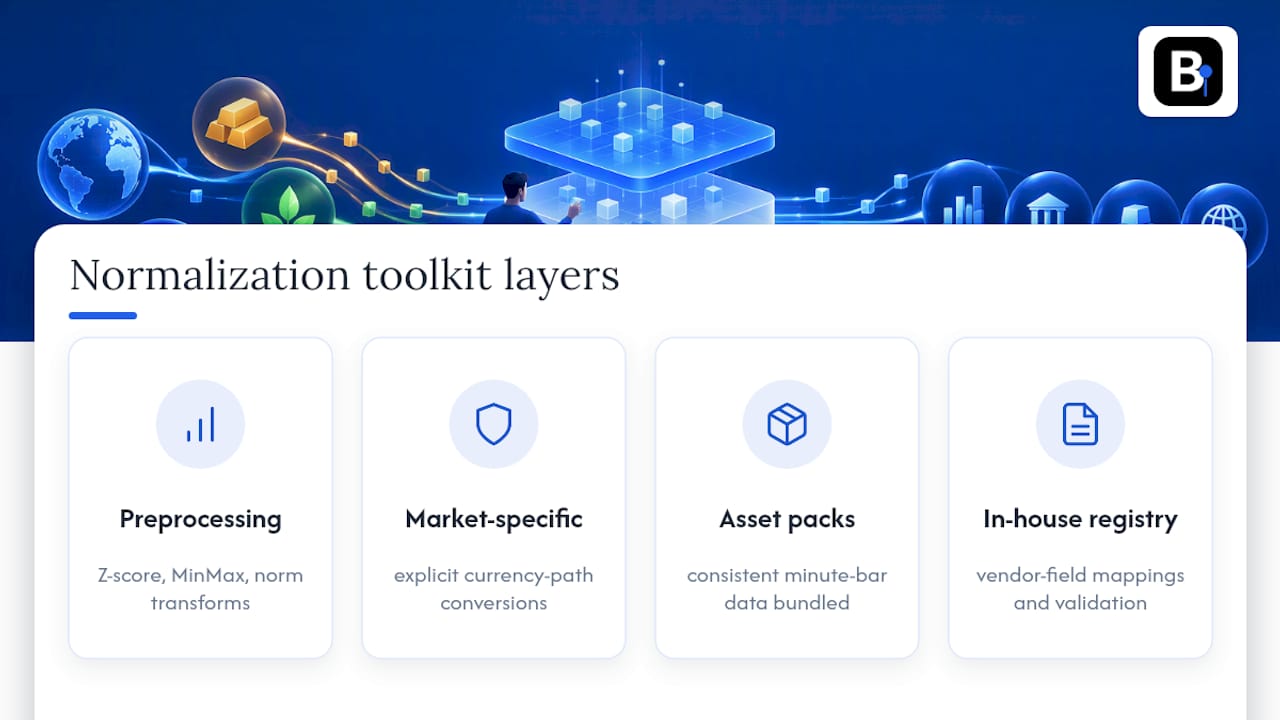
Most teams assemble their normalization stack from a mix of general-purpose libraries and purpose-built market data tools rather than a single product. On the scaling and transformation side, the scikit-learn preprocessing module remains the default toolkit for Z-score, Min-Max, and norm-based transforms, and it integrates cleanly with the pandas-based pipelines most quant teams already run.
For the market-data-specific layer, purpose-built normalization libraries exist specifically to handle vehicle-currency conversion and multi-venue schema mapping, an area general ML libraries do not address. The market-data-normalizer package is one example, built to enforce explicit currency-path declarations rather than letting a conversion happen implicitly inside a transformation function.
On the data acquisition side, a full asset-class package like BacktestMarket's INDICES SuperPack removes a chunk of the mapping work entirely by delivering already-consistent minute-bar data across a set of instruments in one download, rather than requiring a separate adapter per index provider.
Beyond that, most teams still write their own thin mapping and validation layer in-house, since no off-the-shelf tool fully anticipates every vendor's field-naming quirks. The realistic toolkit is a combination: a general preprocessing library for the math, a normalization-aware package for currency and schema handling, and a maintained internal registry for the vendor-specific mapping rules that never quite generalize.
What real deployments show about normalization
The clearest real-world signal comes from trade surveillance and execution systems, where the Quod Financial UNITY example shows operational efficiency improving once normalization happens at the point of capture rather than being reimplemented by each downstream consumer. Surveillance, reporting, and execution teams that previously maintained separate translation logic for the same raw feed converge on one shared, audited layer instead.
The failure mode shows up just as consistently on the other side, in teams that skip upstream investment and normalize downstream, per team, per project. The predictable result is duplicated adapter code, inconsistent handling of the same vendor quirk across teams, and schema drift that goes unnoticed because no single team owns the full mapping surface. A vendor renaming a field breaks one team's pipeline quietly while another team's slightly different mapping logic happens to survive, and nobody realizes the two teams are now working from subtly different versions of the same underlying data.
The practical lesson from both patterns is the same: normalization work done once, upstream, and treated as shared infrastructure tends to hold up. Normalization work done repeatedly, downstream, by whichever team needs it that quarter, tends to drift.
Governance and compliance in cross-asset normalization
Normalization decisions are not purely technical, they are also audit decisions. A firm that cannot reconstruct exactly how a raw FIX message or vendor CSV became a canonical record has a gap that surfaces at the worst possible time, during a regulatory inquiry or a trade dispute.
Documentation matters as much as the code itself. Every mapping rule, every scaler choice, every adjustment applied to a price series should be traceable to a version-controlled record, not a comment buried in a script. That traceability is what lets a compliance team answer a specific question, why does this historical bar differ from the vendor's raw feed, with a concrete answer rather than a guess.
Retention and reproducibility follow from the same discipline. If a canonical schema changes, the change itself needs a record: what changed, when, and why, so that a backtest run last year can still be explained today even if the pipeline has since evolved. Governance in this context is less about a separate compliance layer bolted on top and more about treating the mapping registry, the scaler configuration, and the schema version as first-class, auditable artifacts alongside the code that uses them.
Common mistakes engineers make with normalization
Teams routinely underestimate adapter maintenance. A mapping that works on day one breaks quietly six months later when a vendor adds a field, and nobody notices until a downstream number looks wrong. The fix is a versioned mapping registry, automated schema diffing against each new vendor payload, and a staged rollout for any new source before it touches production. Paying for clean, pre-normalized upstream data often costs less than the engineering hours spent maintaining a brittle in-house adapter.
— Start
Where BacktestMarket fits in your normalization project
Building a mapping registry from scratch for equities, bonds, FX, and commodities takes real engineering time, and every vendor quirk you have to reverse-engineer is time not spent on your models. BacktestMarket's minute-bar datasets arrive already clean and consistently timestamped, so the schema and timestamp harmonization work described above is largely done before the file reaches your pipeline.

For teams covering index instruments specifically, the INDICES SuperPack bundles a full asset class into one ready-to-import download rather than requiring a separate integration per instrument. The Annual Plan at 119 EUR per year gives ongoing access across the catalog, and the broader Historical Data library covers additional asset classes if your pipeline needs to expand. Check the current datasets and start your next backtest with a feed that skips the adapter work.
Sources
- Normalization in Machine Learning: When to Use
- Preprocessing data — scikit-learn documentation
- Why Upstream Data Normalization Is Changing Trade Surveillance - Quod Financial
- What is normalized market data? A developer's guide to clean financial schemas
- market-data-normalizer 1.35.0 (project notes)
FAQ
What does cross asset data normalization mean in practice?
It means every instrument, regardless of asset class or source venue, arrives in your system with the same field names, types, timestamp format, and null handling. That consistency is what lets a single pipeline process equities, FX, and bonds without separate logic for each.
Which scaler should I use for financial time series?
Z-score standardization is the common default for returns and other roughly symmetric features, while RobustScaler is the better choice when a series has significant outliers, such as volume spikes. Min-Max scaling fits inputs with known fixed bounds.
Should normalization happen upstream or downstream?
Normalizing upstream, at the point of data capture, reduces duplicated adapter work and gives every downstream system a shared, consistent foundation, as Quod Financial's UNITY example shows in trade surveillance. Downstream normalization still suits fast research prototyping where flexibility matters more than shared infrastructure.
What timestamp format should normalized market data use?
ISO-8601 UTC is the standard format referenced across developer guides on normalized market data, since it removes the ambiguity that causes daylight saving and timezone bugs. Every timestamp should convert to this format before entering your canonical store.
Does BacktestMarket provide pre-normalized data?
BacktestMarket delivers clean, minute-bar historical data with consistent timestamps and documented adjustments, ready for direct import into MT4 and MT5. That reduces, though does not fully eliminate, the mapping and validation work needed to bring the data into a fully canonical cross-asset schema.
Recommended
- Data Snooping Bias: How Researchers and Quants Catch It
- What Good Data Vendor Support Actually Looks Like
- Audit First MT5 Backtesting Data: Gap, Timestamp, Ready to Import
- Holiday Gaps in Market Data: A Quant's Handling Guide
Related resources
Explore BacktestMarket's Forex historical data to put the ideas in this article into practice.