Every few weeks, EURUSD spikes back into trending searches and forum threads. It happened again this week, with retail traders on Reddit and elsewhere asking variations of the same question: "what's the EURUSD trade right now?" The honest answer is that there isn't a single trade — there's a framework, and the pair's structure changes how that framework should be built. This article walks through how algorithmic traders typically approach EURUSD from a backtesting perspective, without pretending to hand you a signal.
Why EURUSD Keeps Dominating Retail Attention
EURUSD is the most liquid instrument in the global forex market, and that liquidity profile matters more than most retail traders give it credit for. Tight spreads, deep order books, and near-continuous trading hours (barring the weekend gap) make it a natural testing ground for algorithmic strategies. It's often the first pair EA developers validate a new strategy against, simply because slippage and spread costs are comparatively low relative to exotic pairs.
That popularity, though, cuts both ways. Because so much retail and institutional flow concentrates on EURUSD, the pair tends to be efficient — price action reflects a huge amount of information very quickly. Strategies that look strong on paper often compress in performance once transaction costs, spread widening around news events, and broker-specific execution quirks are factored in. This is precisely why a structured backtesting process matters more here than on thinly traded instruments where inefficiencies might persist longer.
When engagement around "EURUSD strategy" spikes on search trends or social platforms, it's usually a reaction to volatility — a central bank meeting, a shift in rate differentials, or a technical level being tested. The lesson for algorithmic traders isn't to chase that attention with a discretionary trade, but to use it as a prompt to revisit and stress-test the systems already sitting in an MT4/MT5 terminal.
A Backtesting Framework for EURUSD Strategies
A repeatable framework matters more than any single indicator combination. Below is a structure that's broadly consistent with how experienced systematic traders approach a major pair like EURUSD.
1. Define the regime, not just the setup. EURUSD alternates between extended trending phases (often tied to diverging monetary policy between the Fed and ECB) and long, choppy ranges. A strategy built and optimized during a trending period will often underperform — sometimes materially — once the regime shifts. Before backtesting a specific entry rule, it's worth segmenting historical data by volatility regime (e.g., using ATR percentile bands or a simple trend/range classifier) and testing performance separately in each.
2. Use sufficiently long and clean historical data. Testing over six months of recent data will almost always look better than it should, because it's fit to one regime. A more rigorous approach uses multi-year tick or minute-level history that spans multiple rate cycles. This is where quality historical data becomes the bottleneck for most retail testers — free data feeds from brokers are often incomplete or inconsistent across timeframes. Sourcing a clean forex historical data set that matches your platform's format removes one of the most common (and least discussed) sources of backtest error.
3. Separate in-sample and out-of-sample windows explicitly. A common mistake is optimizing parameters across the entire dataset and then reporting that same period's results as if they were a forecast. Standard practice is to reserve at least 25–30% of the data as a true out-of-sample test, untouched during parameter selection, and to walk-forward validate wherever possible.
4. Model costs realistically. EURUSD spreads are tight under normal conditions but widen sharply around high-impact news (NFP, CPI, ECB/FOMC decisions). A backtest that assumes constant spread will systematically overstate performance for any strategy that trades through news windows. Include commission, typical slippage, and swap costs for any positions held overnight.
5. Stress test with adverse conditions. Run the same logic through known high-volatility events in EURUSD's history — the 2015 SNB de-pegging aftermath (which spilled into broader EUR volatility), the 2020 COVID liquidity shock, and various ECB policy surprise days. A strategy that survives these without catastrophic drawdown tells you more than one that simply has a high Sharpe ratio over a calm period.
Translating a Backtest Into an EA Without Losing the Edge
Once a EURUSD approach holds up across regimes and passes out-of-sample testing, the next challenge is implementation — and this is where a surprising amount of edge gets lost in practice.
Execution logic must match backtest assumptions. If your backtest assumes market orders filled at the next tick, but your live EA uses pending orders with a different fill model, results will diverge. Before deploying, it's worth running the compiled EA in MT4/MT5's Strategy Tester using the same historical data used for the original analysis, to confirm the platform's execution model produces comparable statistics.
Parameter sensitivity matters as much as the headline result. If a EURUSD strategy's performance collapses when you nudge a moving average period from 20 to 22, that's a red flag for overfitting, not a sign of precision. Robust systems tend to show a plateau of "good enough" parameter values rather than a single sharp peak.
Data consistency between testing and live trading is non-negotiable. Many discrepancies between backtested and live results trace back to mismatched historical data — different brokers, different bar timestamps, gaps around rollovers. If you're building or validating an EA, importing a verified, broker-agnostic dataset into your terminal removes this variable. BacktestMarket's guide to importing historical data into MetaTrader walks through the process of aligning tick data with your platform's Strategy Tester so that backtest and forward-test conditions line up. Traders working in NinjaTrader can follow the equivalent NinjaTrader data import guide.
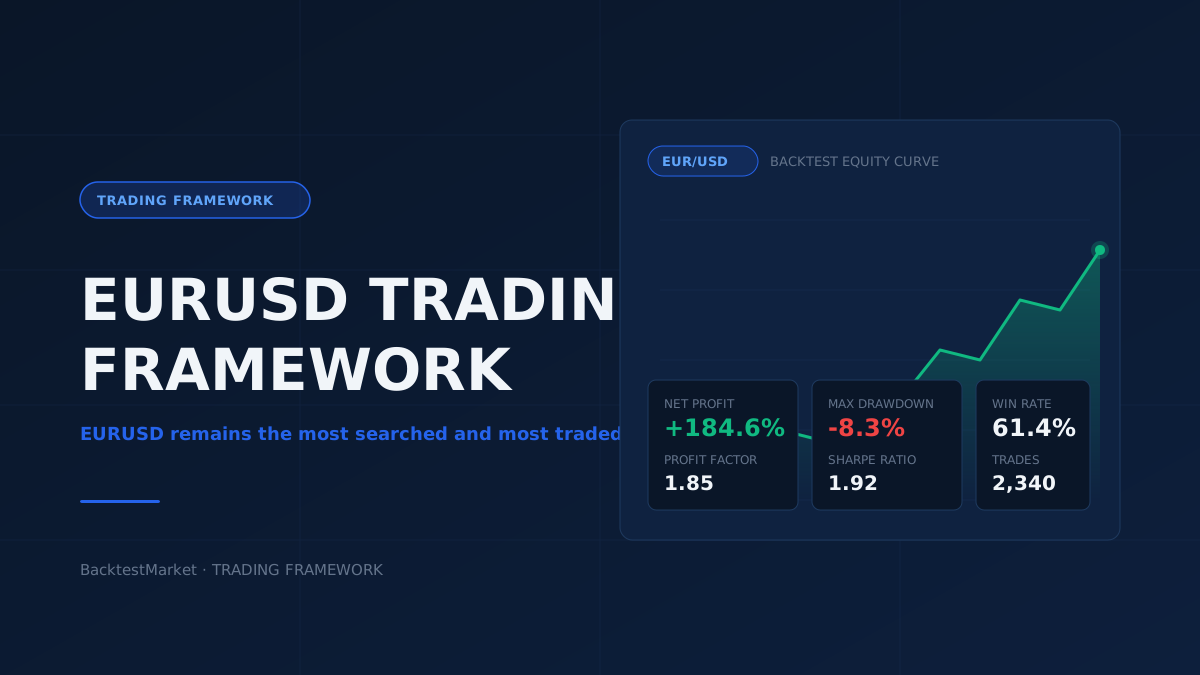
For traders who prefer not to build a system from scratch, reviewing pre-built Expert Advisor robots with published backtest methodology can serve as a useful benchmark — not as a plug-and-play solution, but as a reference point for what a properly validated EURUSD system's equity curve, drawdown profile, and trade distribution should look like before you trust your own strategy's numbers.
What "The EURUSD Trade" Actually Means for Systematic Traders
The framing of a single "EURUSD trade" is understandably appealing — it's simple, and it matches how the pair gets discussed in forums and comment sections. But systematic traders tend to think in terms of conditional logic rather than a singular call: under what volatility regime, session, and cost structure does a given entry rule have a statistically defensible edge, and how does that edge decay as conditions shift?
This is also why EURUSD is a poor pair to build overconfidence around. Its efficiency means that simple, publicly known patterns (round-number reactions, session-open breakouts, basic moving average crossovers) tend to get arbitraged down quickly by the volume of participants watching the same pair. Any framework built on it benefits from continuous re-validation — not because the underlying logic is wrong, but because the market's cost and liquidity structure evolves, and a strategy validated on 2019–2021 data may need re-testing against 2024–2026 conditions before being trusted again.
Practically, that means treating a EURUSD system less like a finished product and more like a living hypothesis: backtested, walk-forward validated, deployed with realistic cost assumptions, and periodically re-checked against fresh out-of-sample data as new market regimes emerge.
Practical Takeaway
There's no shortcut around the process: define the regime, use clean multi-year data, separate in-sample from out-of-sample testing, model realistic costs, and stress test against known volatility events before trusting any EURUSD strategy with live capital. If you're currently reviewing or building a EURUSD system, start by auditing the historical data feeding your backtests — mismatched or incomplete data is one of the most common, and most fixable, sources of misleading results. Explore BacktestMarket's historical data packs and import guides to make sure your next backtest is standing on solid ground before you draw any conclusions from it.