

Exotic forex pairs data is historical price history for a major currency paired with a currency from an emerging or smaller economy, such as USD/TRY, USD/ZAR or USD/MXN. It is harder to work with than major-pair data: liquidity is thinner, spreads are wider, and gaps, stale quotes and bad ticks are more common. If you backtest on it, you need to know what each record really represents and audit the file before you trust a single result.
TL;DR
- Exotic pairs combine a major currency with an emerging-market or less-liquid one. There is no single official list, so providers classify them differently.
- Thinner liquidity and wider spreads mean a backtest that ignores variable costs will look better than live trading will.
- Audit every file for gaps, duplicates, bad prices, timezone consistency and weekend bars before running any test.
- Minute bars are enough for most swing and intraday systems, but only if the bars are clean and the adjustments are documented.
- Keep a record of every cleaning step so you can reproduce a result later.
Table of Contents
- What counts as an exotic pair
- What forex data is, and which fields matter
- Why exotic-pair data behaves differently
- How to tell if exotic-pair data is good enough
- Cleaning and testing steps that prevent misleading results
- Our perspective on exotic-pair data
- Getting data you can import and test the same day
- FAQ
- Sources
What counts as an exotic pair
A currency pair is the exchange rate between two currencies: the first is the base and the second is the quote. Trading the pair means buying one and selling the other, as Investopedia explains. Pairs are usually sorted into three groups:
| Group | What it contains | Typical examples |
|---|---|---|
| Majors | The U.S. dollar against another heavily traded currency | EUR/USD, USD/JPY, GBP/USD |
| Minors (crosses) | Two major currencies, no U.S. dollar | EUR/GBP, GBP/JPY, EUR/CHF |
| Exotics | One major currency against an emerging-market or smaller-economy currency | USD/TRY, USD/ZAR, USD/MXN, EUR/PLN, USD/THB |
The minor examples come from Investopedia's currency pair guide, and the exotic examples from FXStreet's December 2025 explainer. FXStreet also notes that exotics normally show thinner liquidity, wider spreads and more sensitivity to local political, economic and central-bank developments than majors and minors.
Why the list changes depending on who you ask
The terms are market conventions, not a formal standard. A retail education page may call the Scandinavian currencies exotic because their turnover is lower, while an institutional desk may treat them as minors because the market is deep. The Turkish lira, Mexican peso, South African rand and Brazilian real appear on almost every list. Singapore dollar, Norwegian krone, Hungarian forint and Polish zloty move between lists.
For data work, this has a practical consequence. Do not rely on a vendor's label. Decide for yourself which pairs you consider exotic for your strategy, and ask what the real trading conditions of each pair look like: spread, session hours, and how much of the day it actually trades.
What forex data is, and which fields matter
Forex data is the recorded history of prices for a currency pair. Because forex is an over-the-counter market, there is no single central tape. Every dataset is a view built from some set of quotes, and two vendors can legitimately show slightly different prices for the same minute.
For backtesting exotic pairs, these are the fields worth having:
- Timestamp with a stated timezone. Without it you cannot align a session, a news release or a rollover.
- Open, high, low, close. The standard minute-bar fields. Check whether they are built from bid quotes, ask quotes or mid prices.
- Volume. In forex this is usually tick count, not traded amount. It is useful as an activity proxy, not as a measure of size.
- Spread. The single most important field for exotics. A fixed spread assumption can wipe out the edge of a strategy that appears profitable.
- Swap or rollover rates. Exotics often carry large carry differentials, so overnight holding costs change the result of any multi-day system.
If a file does not include a spread column, your platform's test will apply one for you, usually a fixed value. For a pair whose cost changes sharply between the Asian night and the London open, that is a serious approximation.
Granularity: why minute bars are the sensible default
Tick data is heavy and often not needed. Daily bars hide the intraday path, so you cannot tell whether a stop or a target was hit first. Minute bars sit in the middle. They are small enough to handle, detailed enough to resolve most intraday sequences, and they import directly into platforms such as MT4 and MT5. Short-term strategies with tight stops may still need finer data, while swing tests rarely do.
Why exotic-pair data behaves differently
Three forces shape the data, and each one can distort a backtest.
Liquidity and spreads
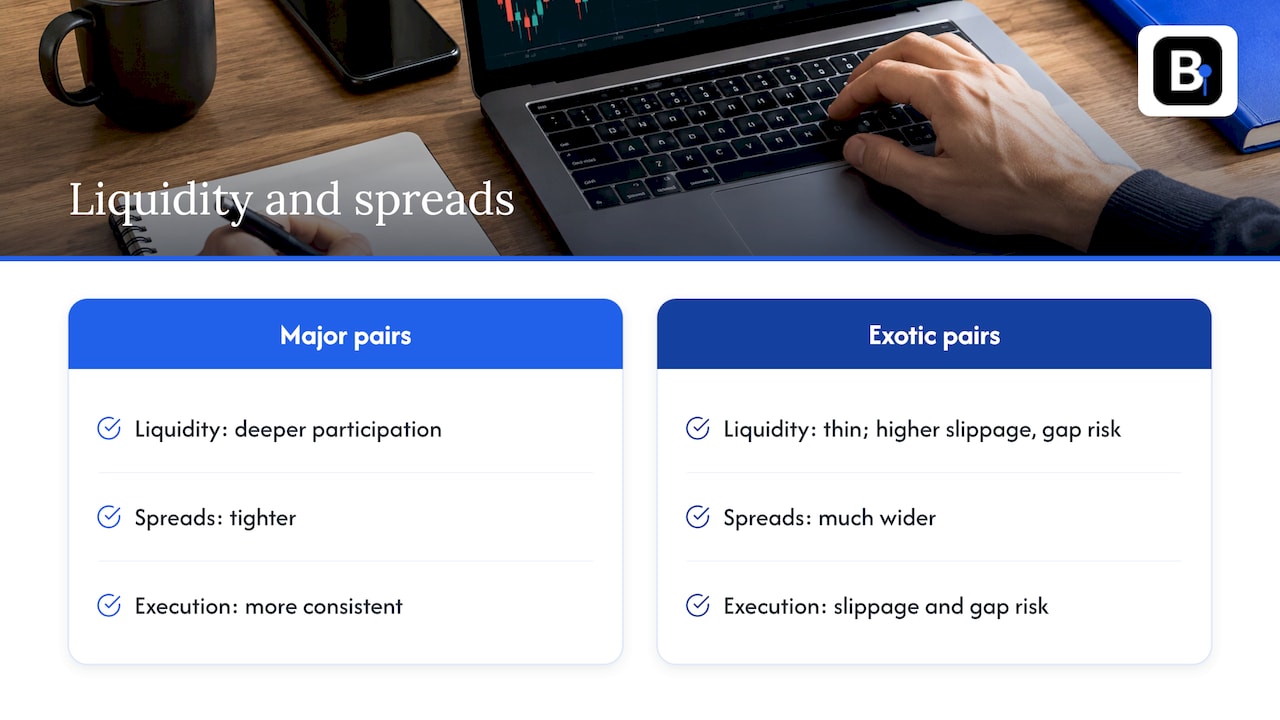
Investopedia states that exotic pairs generally have lower liquidity and much wider spreads than majors. FXStreet's market-structure view is that liquidity is the main practical divider: deeper participation in majors means tighter spreads and more consistent execution, while thin exotic liquidity increases slippage and gap risk.
In data terms, this shows up as larger bar ranges on quiet minutes, more minutes with no ticks at all, and sudden jumps when the market reopens. A strategy that trades the open or relies on tight stops is the first to suffer.
Funding conditions matter too. A Bank for International Settlements working paper finds that bid-ask spreads in spot and FX swap markets are highly correlated, and that deteriorating funding liquidity often appears as wider spreads in both. If your test period includes stress episodes, expect the cost of trading exotics to rise exactly when your system is most active.
Political and structural risk
FXStreet reports that exotics are more exposed than majors and minors to capital controls, political instability, commodity dependence and central-bank intervention. These show up in data as abrupt one-way moves, repricing after a policy announcement, or a long flat stretch followed by a gap. They are real events, not errors, so a cleaning script that removes every large jump will delete genuine history. Separate the bad tick from the real shock before you filter anything.
An economic calendar helps here. Matching the largest bar-to-bar moves against known releases is a quick way to decide which jumps are events. A calendar of economic events for traders gives you the dates to compare against your data.
Offshore trading and price discovery
Much exotic trading happens outside the home country. The BIS reports that offshore markets drive trading of emerging-market currencies, and that during global stress offshore markets tend to drive onshore prices. Offshore trading can lift liquidity and cut transaction costs, but it can also influence price discovery. For you, the question is which price your data reflects: the offshore quote available to a retail broker, or an onshore rate. Check this against the instrument specifications and trading conditions of the account you will actually trade on. A reference page such as instruments and trading conditions shows the kind of detail to look for, including which symbols exist on a given MT5 platform.
How to tell if exotic-pair data is good enough
Accuracy asks whether each record reflects what happened. Completeness asks how much relevant history is present, across time ranges, sessions and chosen granularity. A file can be accurate and incomplete, or complete and full of bad prices. You need both.
Run these checks on every file before your first test:
| Check | What to look for | Why it matters for exotics |
|---|---|---|
| Continuity | Missing minutes inside the trading week | Thin markets produce legitimate quiet minutes, so you must tell them from real gaps |
| Expected gaps | Weekend and holiday closures | Local holidays can close an exotic's home market while majors keep trading |
| Duplicates | Repeated timestamps | Merged files often double the boundary bars |
| Bad prices | Spikes that retrace in one bar, zero or negative values | A single bad high can trigger a stop that never existed |
| Timezone | One consistent offset, including daylight saving shifts | Session logic breaks if the offset moves twice a year |
| Cross-source comparison | Close prices against an independent source | The only way to catch a systematic error |
| Spread realism | Spread by hour compared with your broker's | Fixed spreads understate cost on exotics |
We cover the audit in more detail in our guides on five audit checks before backtesting and a seven-step data quality audit for MT4 and MT5.
Cleaning and testing steps that prevent misleading results
A clean file is the starting point, not the end. These steps keep an exotic-pair backtest honest.
- Freeze the raw file. Keep an untouched copy and work only on duplicates of it. Every later change should be reproducible from the original.
- Normalize the timezone. Convert everything to one reference and write down the offset and its daylight-saving rule.
- Remove non-trading bars. Weekend bars distort moving averages and volatility measures. There are several safe methods, and we describe three in our guide to removing weekend bars from forex data.
- Deduplicate and sort. Make sure timestamps are strictly increasing.
- Flag, do not silently fix, outliers. Mark any bar that moves several times the typical range, then check it against the calendar and a second source. Delete only the confirmed errors.
- Audit year by year. A gap that sits in one year can lower your modeling quality for the whole test. Our per-year gap audit for MQL4 shows how to find it.
- Model costs by time of day. Use realistic spread and swap for each session. If you cannot, add a cost buffer that is larger for exotics than for majors.
- Split the sample. Develop on an in-sample period, validate with walk-forward analysis, then confirm on out-of-sample data you never touched. The workflow is laid out in our MT5 data guide covering IS, WFA and OOS.
- Stress the regime changes. Exotic currencies often have one or two devaluation or intervention episodes. A system that only survives because it missed them is fragile. Test with and without those windows and note the difference.
- Log everything. Record file versions, filters applied and cost assumptions next to each result.
Common mistakes with exotic data
The most frequent error is treating a quiet exotic like a major and applying a tight stop. In thin markets, a few ticks can touch a level that never traded in size. The second is mixing sources mid-test, for example older history from one vendor and recent history from another, with different quote types and timezones. The third is trusting the platform's reported modeling quality without looking at where the missing minutes are.
Our perspective on exotic-pair data
We build datasets for people who test strategies for a living, and the pattern we see most often is simple: traders spend weeks tuning a system and minutes checking the data under it. With exotic pairs that balance is the wrong way around, because every weakness of the market shows up in the file.
Our position is that a dataset should arrive ready to use. That means clean minute bars, verified bar by bar, with adjustments documented so you can see what was changed and why. It means the same standard whether a human or an AI-driven process runs the test. A model will happily learn a bad tick as if it were a pattern, and it will never complain.
It also helps to talk to the people who collect the data. Our support comes directly from the engineers behind the datasets, so a question about a timestamp, a gap or an import setting goes to someone who can open the file and look. We think that is how data work should be done: collected carefully, checked openly, and imported without conversion steps.
Start
Getting data you can import and test the same day
If you would rather spend your time on strategy than on repairing files, our Historical Data page lists the complete, clean minute-bar datasets we sell as one-time downloads, with history since 2014 across forex, metals, bonds and stock indices, ready to import into MT4 and MT5. Check the catalog there for the instruments currently covered. For a broader subscription, the Annual Plan is listed at €119 per year.
If you are still choosing a source, our overview of four minute-data sources for MT4 and MT5 compares the main types. For portfolio work, the MT4 portfolio backtesting guide explains how to find realistic drawdowns across several systems.
FAQ
What are exotic currencies?
Exotic currencies come from emerging markets or smaller, less-liquid economies. An exotic pair combines one of them with a major currency, for example the U.S. dollar and the Turkish lira. Lists differ between providers, so treat any single list as a convention rather than a rule.
What are the 28 currency pairs?
The figure usually refers to the combinations of the eight most traded currencies: the U.S. dollar, euro, yen, pound, Swiss franc, and the Canadian, Australian and New Zealand dollars. That produces 28 pairs, covering the majors and minors. Exotic pairs are not part of that set.
Is minute-bar data enough for backtesting exotic pairs?
For swing and most intraday systems, yes, provided the bars are complete and the spread is modeled realistically. Systems that depend on exact tick order, very tight stops or news-second execution may need tick-level data. Whatever the granularity, quality matters more than volume of history.
Why do my MT4 or MT5 results differ from live trading on exotics?
The usual causes are fixed spreads in the test versus variable live spreads, missing minutes that lower modeling quality, and ignored swap costs. Slippage and gap risk are higher in thinner markets too. Auditing the file and modeling costs by session closes most of the difference. Our guide to fixing missing data in MT4 walks through the recovery steps.
Sources
- Investopedia: Understanding Currency Pairs, Major, Minor, and Exotic
- FXStreet: Currency pairs explained, majors, minors, and exotics
- BIS Working Paper: FX spot and swap market liquidity spillovers
- BIS: Offshore markets drive trading of emerging market currencies
- Economic calendar for traders
- Instruments and trading conditions
Recommended
- Clean Forex Data: 5 Audit Checks Quants Run Before Backtesting
- 3 Ways to Remove Weekend Bars From Forex Data for Backtesting
- Stop False Backtests: 3 QA Checks for MT4/MT5 Import Ready Datasets
- Quants: Run This 7 Step Data Audit Before Backtesting on MT4/MT5
Related resources
Explore BacktestMarket's Forex historical data to put the ideas in this article into practice.