

Reliable 1-minute FX data comes from four practical sources: institutional vendors and APIs, broker-matched feeds, curated free archives, and purpose-built datasets engineered for import. Minute bars work fine for most swing and intraday strategies; execution-sensitive models (spread arbitrage, latency-based fills) need tick data instead. For quants who want a clean, ready-to-load dataset without building a pipeline, Backtestmarket's EURUSD 1mo is a workable starting point.
TL;DR:
- Most reliable sources like institutional vendors and APIs offer high-cost, enterprise-grade minute data suitable for systematic trading infrastructure.
- Free archives and public repositories are affordable but require significant manual cleaning to address gaps, timestamp inconsistencies, and outliers.
- Broker-matched feeds provide the most accurate slippage modeling by originating directly from broker execution streams, which is crucial for execution-sensitive strategies.
- Format expectations and timestamp conventions vary; confirming UTC alignment and correct column order prevents silent backtest errors.
- Backtestmarket supplies verified, ready-to-import datasets in formats compatible with MT4/MT5, saving engineering time and reducing the risk of data bugs.
Table of Contents
- Where Can You Get Minute-Level Forex Data?
- What File Formats and Delivery Methods Should You Expect?
- Why Does Minute Data Have Gaps and Spikes, and How Do You Fix Them?
- How Much History and Pair Coverage Do You Actually Need?
- How Backtestmarket Solves the Minute Data Problem for Quants
- An Implementation-Minded Checklist Before You Trust Any Dataset
- Get Started With Backtestmarket's Minute-Bar Datasets
- Where to Verify These Sources Yourself
- Sources
- FAQ
Where Can You Get Minute-Level Forex Data?
Every forex minute data source falls into one of four buckets, and each one trades reliability against cost and control.
Institutional vendors and APIs. Firms like ICE and Parameta Solutions aggregate quotes from dozens of market makers and platforms, then normalize timestamps and attribute pricing before delivery. ICE's consolidated FX feed alone processes more than 120 million updates a day across thousands of spot rates and forwards. These feeds arrive through SFTP, cloud connectors, or Snowflake, and they're built for teams running production infrastructure, not a solo quant testing a mean-reversion idea over the weekend.
Broker-matched feeds. Services such as PipData pull directly from broker execution streams, which matters if you're trying to model slippage the way it actually happened on a specific broker. That broker attribution buys you execution parity between backtest and live trading, something generic aggregated data can't replicate.
Free and public archives. Repositories like Philippe Remy's FX-1-Minute-Data project on GitHub pull from HistData and cover more than 66 pairs back to 2000. The price is right, but expect gaps, inconsistent timestamp conventions, and zero support if something looks wrong at 2 a.m.
Self-built pipelines. Scraping broker terminals or stitching together multiple free sources gives you full control, but it also means you own every bug. Most teams underestimate how many engineering hours go into a pipeline that just handles daylight saving time correctly.
- Institutional vendors: highest reliability, highest cost, enterprise delivery
- Broker feeds: best for execution-repeatable slippage modeling
- Free archives: cheapest, but require real cleaning work
- Self-built: full control, real engineering overhead
What File Formats and Delivery Methods Should You Expect?
Minute data shows up in a handful of predictable shapes, and knowing which one you're getting saves hours of ingestion work later.
- File formats. CSV or plain-text OHLC(V) rows dominate retail-facing datasets. Parquet shows up when volume gets large, since it compresses better and reads faster into pandas or a data warehouse. REST APIs typically return JSON, which is fine for small pulls but clumsy for bulk historical loads.
- Access method. APIs give you flexibility and freshness but add latency and, often, a per-call cost. TraderMade offers minute data back to 2013 and tick data back to 2016 through both a REST API and bulk downloads, letting you choose based on whether you need one symbol or the whole book. Bulk ZIP downloads are cheaper for a one-time backtest; streaming makes sense only if you're also running the strategy live.
- Timestamp conventions. Confirm whether bars are UTC or broker-local time, and whether the timestamp marks bar open or bar close. Getting this wrong silently shifts every signal in your backtest by one bar.
- MT4/MT5 import. Both platforms expect a specific column order and encoding for historical CSV files; a mismatched delimiter or an extra header row is the most common reason imports fail. Check the import steps for MetaTrader before assuming your file is broken.
Why Does Minute Data Have Gaps and Spikes, and How Do You Fix Them?
Every forex minute data source has quirks, and the ones that catch quants off guard are almost always timestamp and gap issues, not the headline numbers.
Missing bars happen during low-liquidity windows, holidays, and broker maintenance. The fix isn't to blindly forward-fill: check whether the gap falls inside normal trading hours first, then decide between a forward-fill (safe for short gaps) or exclusion (safer for anything longer than a few minutes). Outliers are trickier, because a real 40-pip spike during a Non-Farm Payrolls release looks identical to a bad tick in raw data. Cross-reference against a second source or a known volatility calendar before you delete anything that might be genuine price action.
- Flag gaps longer than 2 to 3 bars and review them individually, not by automated deletion
- Compare suspected outliers against a second data source or economic calendar before removing them
- Reconstruct bid/ask spread estimates when only one side is provided, using a rolling average spread for that pair and session
- Normalize every timestamp to UTC and log the original source timezone for every conversion
Pro Tip: Keep a change log every time you patch a gap or remove an outlier. Six months from now, when a backtest result looks too good, that log is the only way to prove your data wasn't quietly cleaned into a better result than reality.
Daylight saving time misalignment deserves its own mention here, since it's one of the most common silent errors in minute-level forex data for trading systems, especially when a dataset mixes broker-server time with exchange time across the March and November transitions in the US and Europe.
How Much History and Pair Coverage Do You Actually Need?
Free archives tend to run deep on major pairs. EUR/USD and USD/JPY histories going back to 2000 are common in public datasets, which is more than enough for regime testing across multiple rate cycles. Commercial vendors trade some of that depth for consistency: they update daily, cover more crosses, and rarely have the multi-day dropouts that plague free sources.
How much history do you actually need? A rough rule: walk-forward testing across at least two full volatility regimes (a trending year and a range-bound year) requires several years of clean minute data at minimum, and longer if your strategy trades infrequently. A strategy that fires five times a day needs far less history than one that fires five times a year.
- Major pairs (EUR/USD, GBP/USD, USD/JPY): long, generally reliable history from most sources
- Minor crosses (EUR/GBP, AUD/JPY): decent coverage from commercial vendors, spotty from free archives
- Exotic pairs (USD/TRY, USD/ZAR): often thin, gap-prone, and better excluded or synthesized from majors than trusted outright
When exotic pair data looks unreliable, don't force it into a backtest. Either synthesize a proxy from correlated major pairs or scope your strategy to pairs where the data actually holds up.
How Backtestmarket Solves the Minute Data Problem for Quants
Backtestmarket has published clean minute-bar intraday data since 2014, covering forex, metals, bonds, and stock indices, packaged as all-in-one downloads ready for direct MT4/MT5 import. That "ready to import" framing matters more than it sounds: it removes the format-wrangling step that eats hours out of every backtest project built on raw vendor exports.
The company positions its data on bar-by-bar verification and documented adjustments, backed by support from the engineers who actually collect the data, not a generic help desk. The flagship starter dataset, EURUSD 1mo, ships as verified minute bars in an MT4/MT5-ready format, giving quants a known-clean benchmark to test their own pipeline against.
Before trusting any dataset, run this checklist:
- Compare a sample file against the checksum provided
- Spot-check a week of bars against a second source
- Confirm timestamp alignment matches your platform's expected convention
- Import a small sample into MT5 before committing to a full backtest run
An Implementation-Minded Checklist Before You Trust Any Dataset
Run this in the first 15 minutes with any new dataset: confirm timestamps are UTC or clearly labeled otherwise, scan for gaps longer than a few bars, sample-import into MT5 to catch format errors early, and verify bid/ask or spread data actually exists before assuming you can model slippage. Skipping this step is how bad backtests get built on good strategies.
— Start
Get Started With Backtestmarket's Minute-Bar Datasets
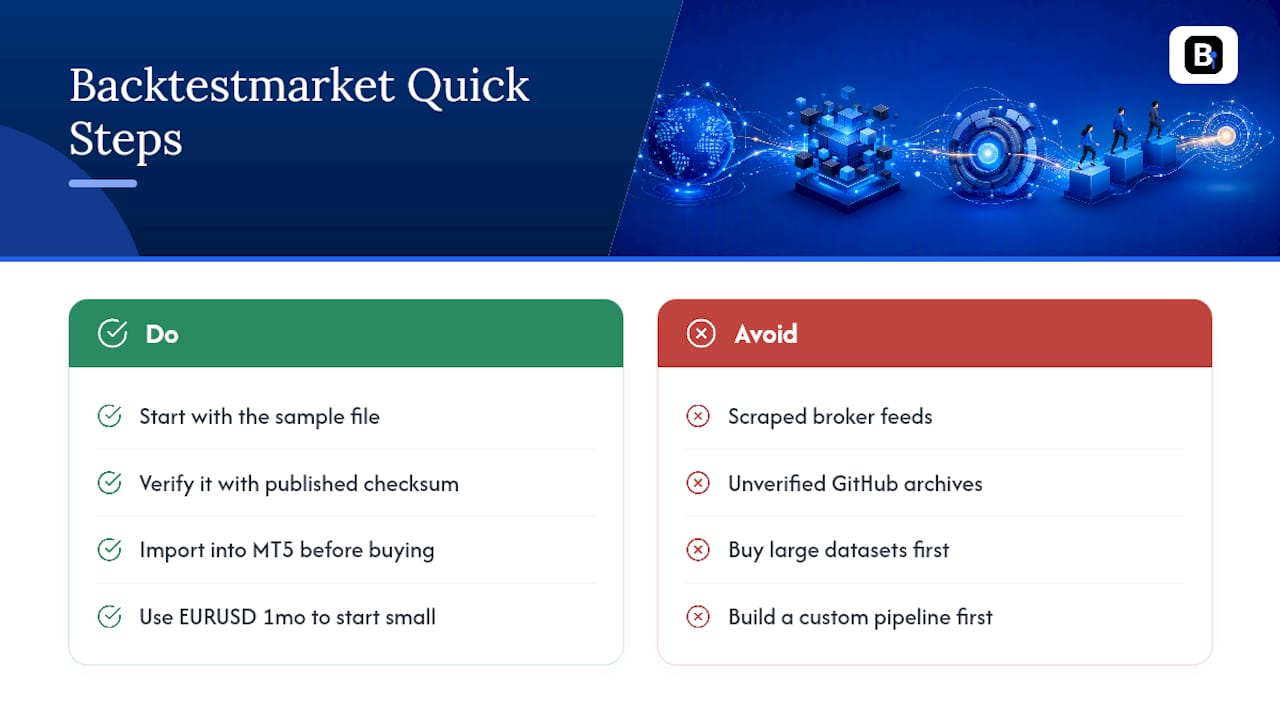
Backtestmarket is the practical alternative to piecing together a data pipeline from scraped broker feeds or unverified GitHub archives: every dataset ships pre-cleaned, checksum-verified, and formatted for direct MT4/MT5 import, so you skip the weeks of engineering work a self-built pipeline usually demands.

If you're starting small, EURUSD 1mo is built for exactly that: a single major pair, a manageable file size, and enough history to run a real walk-forward test without committing to a bigger purchase first. Traders who need broader coverage across multiple instruments should look at the full Historical Data catalog, which spans forex, metals, bonds, and indices in the same ready-to-import format. Anyone pulling datasets on a recurring basis, rather than as a one-time purchase, can check the Annual Plan for current pricing and ongoing access.
Start with the sample file, verify it against the published checksum, and import it into MT5 before you buy anything larger. That fifteen-minute check tells you more about a dataset's real quality than any product description can.
Where to Verify These Sources Yourself
For direct access: HistData's free archive and the FX-1-Minute-Data GitHub repository both offer minute bars at no cost, while TraderMade's API documentation and PipData's broker-matched feeds show what commercial minute and tick delivery actually looks like.
Sources
- philipperemy/FX-1-Minute-Data: HISTDATA - Dataset ...
- Pipdata
- High Quality Intraday Forex Data | TraderMade
- ICE OTC Data Services - Foreign Exchange (FX) | ICE Developer Portal
FAQ
Where Can I Get Forex Data?
Forex data comes from institutional vendors, broker-matched feeds, free public archives, and engineered datasets built specifically for backtesting. For minute-bar data ready to import into MT4 or MT5 without extra cleanup, Backtestmarket's Historical Data catalog covers forex alongside metals, bonds, and stock indices.
Is There a Free Forex Data API Available?
Free options exist, mainly through archives like HistData and the FX-1-Minute-Data GitHub project, which covers more than 66 pairs back to 2000. They require manual cleaning for gaps and timestamp inconsistencies before use in a serious backtest.
Where Can I Find Free Historical 1-Minute Forex Data?
Public GitHub repositories and sites like HistData are the most common free sources for 1-minute forex data, with some archives dating back to 2000. Expect to spend real time validating gaps and outliers, since free sources rarely include verification tools or support.
Should I Use Minute Data or Tick Data for My Backtest?
Minute bars work for most intraday and swing strategies, since they capture enough intraday structure to test entries, exits, and risk rules accurately. Tick data becomes necessary only when your model depends on execution-level detail like spread dynamics or sub-second timing.
Recommended
- Minute Bar Data: What Quants Need for Reliable Backtests
- 5 Audits Quants Must Run on Outlier Handled M1 Data Before MT4/MT5
- Fixing MT4 Missing Data: A Complete Recovery Guide
- How to Import Historical Data in MetaTrader 4 & 5
Related resources
Explore BacktestMarket's Forex historical data to put the ideas in this article into practice.