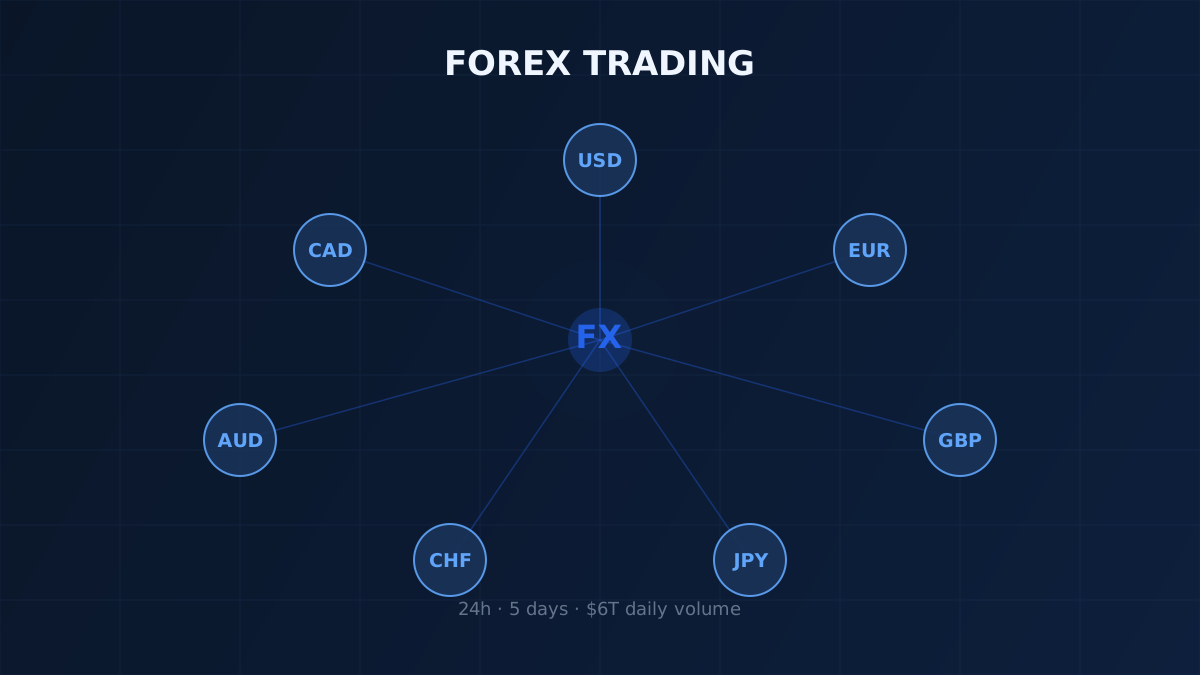
Every time you travel abroad and exchange your home currency for the local one, you are participating — however briefly — in the foreign exchange market. The rate you receive at the counter is determined by the same supply and demand forces that drive professional traders operating billions of dollars a day.
What Is the Forex Market?
The forex market (also called FX or foreign exchange) is the global marketplace where currencies are bought and sold. It is the largest and most liquid financial market in the world, with daily trading volumes exceeding $6 trillion.
Unlike stock exchanges, the forex market has no central physical location. It operates over-the-counter (OTC) through an electronic network of banks, brokers, institutions, and retail traders. Because it spans multiple time zones — London, New York, Tokyo, Sydney — it runs 24 hours a day, five days a week.
How Currency Trading Works
Currencies are always traded in pairs. When you trade EUR/USD, you are simultaneously buying euros and selling US dollars (or vice versa). The first currency in the pair is the base currency, and the second is the quote currency.
If EUR/USD is quoted at 1.1750, it means one euro buys 1.1750 US dollars. If you believe the euro will strengthen against the dollar, you buy the pair. If you expect the dollar to strengthen, you sell.
The difference between the buy price and the sell price is called the spread, measured in pips. This is effectively the broker's commission on each trade.
What Moves Exchange Rates?
Exchange rates fluctuate continuously based on:
- Economic data — GDP growth, employment figures, inflation reports
- Interest rate decisions — central banks raising or cutting rates affect capital flows
- Political events — elections, policy changes, geopolitical tensions
- Market sentiment — risk appetite drives flows between safe-haven and high-yield currencies
- Supply and demand — at the most fundamental level, a currency rises when more people want it
The Role of MetaTrader 4
For retail traders, MetaTrader 4 (MT4) has become the industry-standard platform for accessing the forex market. It provides:
- Real-time price quotes for hundreds of currency pairs, commodities, and indices
- Charting tools with dozens of built-in technical indicators
- Order management — market orders, limit orders, stop orders, and trailing stops
- Strategy Tester — for backtesting automated systems on historical data
- Expert Advisors — automated trading programs written in MQL4
MT4 is available as a desktop application (Windows and Mac via compatibility layers), as a mobile app for iOS and Android, and through many brokers' web-based versions.
Getting Started
To begin trading forex, you need:
- A broker account — choose a regulated broker in your jurisdiction
- MT4 or MT5 — download from your broker or directly from MetaQuotes
- A demo account — always practice with simulated money before risking real capital
- A strategy — never trade without defined entry, exit, and risk management rules
The forex market offers genuine opportunity, but it also carries real risk. Leverage amplifies both gains and losses. Understanding how currency pairs move, how to read charts, and how to manage your risk are all prerequisites before putting real capital to work.