

A forex weekend gap is the difference between Friday's last price and the first price after the market reopens on Sunday. Weekend news gets priced in at once, and the chart jumps instead of drifting. Gaps are real, they can slip past your stop, and they are easy to mismeasure in historical data. That last point decides whether a gap strategy backtests honestly.
TL;DR
- A weekend gap is the distance between Friday's close and the Sunday reopen. Spot forex runs from Sunday evening to Friday afternoon, New York time, so the gap is built into the weekly cycle.
- Gap size depends heavily on the pair. In one published study, cross pairs gapped more than 25 pips on 34% to 45% of weekends, against 9% to 11% for major pairs.
- Gaps do not fill on a schedule. Academic evidence is mixed, and stop orders can fill past your level when the market opens beyond it.
- Your measurement rules (quote side, timestamps, session boundaries) change the result. Define them before you test anything.
- Clean minute data with weekend breaks handled consistently is the base of any credible gap backtest.
Table of Contents
- What a forex weekend gap is
- Why price gaps at the Sunday open
- How often gaps happen and how big they get
- Do weekend gaps fill?
- What gaps do to your positions
- Measuring weekend gaps correctly in historical data
- Perspective
- Test gap ideas on ready-to-import data
- FAQ
- Sources
What a forex weekend gap is
Forex is a 24-hour market only on weekdays. Investopedia's explainer puts the U.S. close at 5 p.m. Eastern on Friday and the reopen at 5 p.m. Eastern on Sunday. Retail platforms vary slightly: one large broker lists FX trading from Sunday 17:05 to Friday 16:59 New York time, with a short break at the weekly boundary.
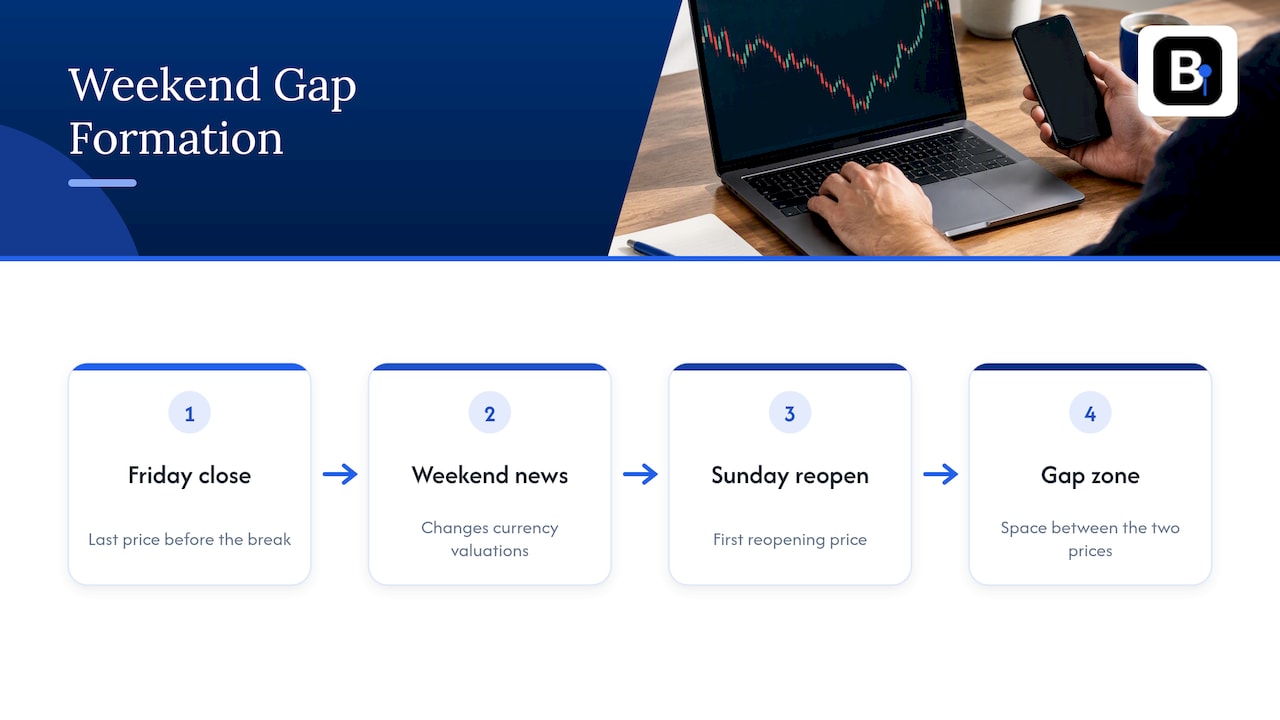
During those roughly 48 hours, news keeps arriving. Elections, central bank remarks, geopolitical events and weekend announcements all change what traders think a currency is worth. When trading resumes, the first prices reflect all of it. A broker education piece on price gaps defines a gap as price skipping levels, which shows up as an empty area on the chart, or opening at a different level from the previous session's close. In forex, it notes, gaps commonly appear when trading restarts after the weekend.
Traders also use a weekend-specific label, the New Week Opening Gap (NWOG). You mark Friday's close and the first reopening price, and the space between them is the gap zone. The name comes from chart-pattern communities rather than any official standard, so treat it as shorthand and always state exactly which two prices you used.
Gap-ups, gap-downs and the other labels
The basic labels describe direction only. A gap-up opens above the prior reference price and a gap-down opens below it. Neither tells you whether price will continue or reverse.
Chart traders add context labels. A breakaway gap appears when price leaves a pattern or breaks a key level. A continuation gap appears mid-trend. An exhaustion gap appears near the end of a move. A trading tutorial describes these three. They are judgment calls made after the fact, so they are poor inputs for an automated rule unless you define them in numbers.
Why price gaps at the Sunday open
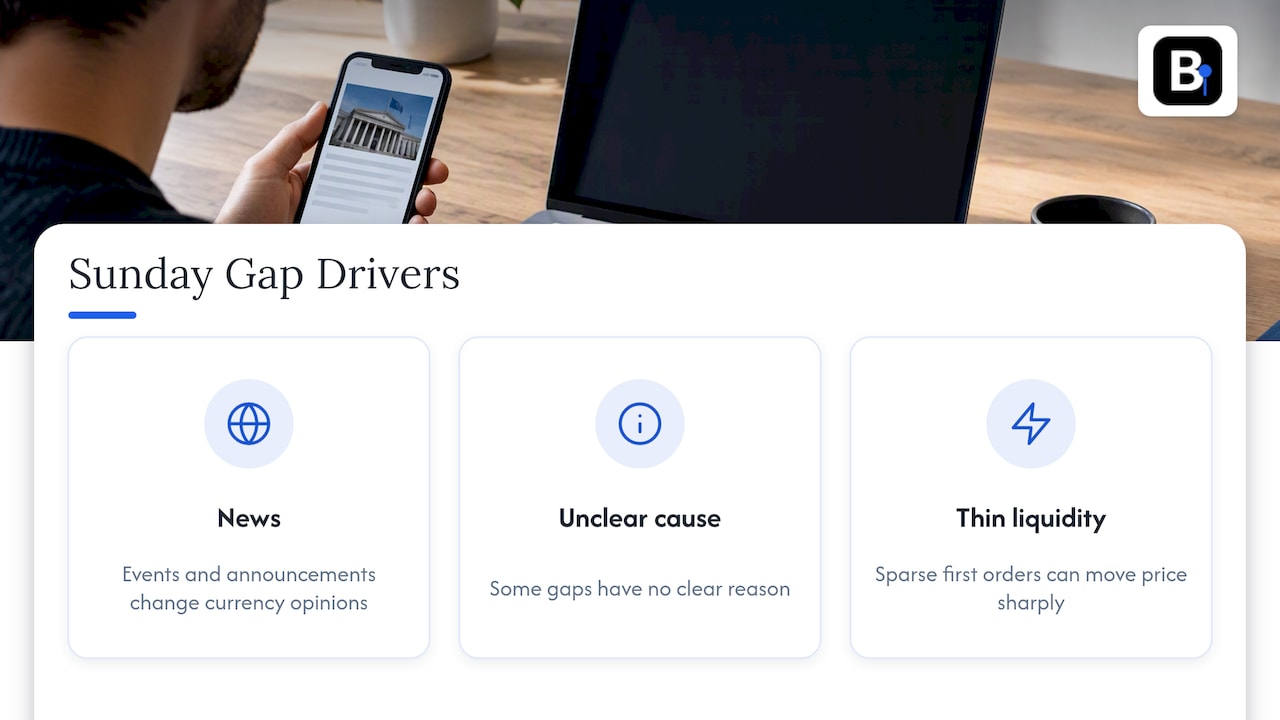
The cause is usually simple: information arrived while the market was shut. Broker research on weekend order execution says weekend news, economic events and announcements can change opinions about currency values and produce a gap. The same piece notes that weekend prices can gap even when volume is not large.
Sometimes there is no obvious story. The price gap guide lists economic releases and geopolitical events as typical triggers, and admits that some gaps have no clear reason.
Liquidity makes it worse. The Sunday open is among the thinnest periods of the week, and a forex education site explains that sparse first orders can move price sharply before deeper liquidity arrives. A thin book exaggerates the first quotes, which is why the first minutes of the week often look messier than the rest of Monday's session.
For more on how the weekly sessions line up and shift with daylight saving, see our guide to forex session times and DST shifts.
How often gaps happen and how big they get
There is no single answer, because pair choice dominates. A Nasdaq analysis of price gaps, covering 2013 to 2016, found that cross pairs had gaps above 25 pips on 34% to 45% of weekends. Major pairs did so on only 9% to 11%.
That gives you a practical rule of thumb:
| Pair type | Share of weekends with a gap above 25 pips | Practical meaning |
|---|---|---|
| Major pairs | 9% to 11% | Most weekends open close to Friday's close |
| Cross pairs | 34% to 45% | A sizable gap is a regular event |
The study period ended in 2016, and spreads, liquidity and broker hours have changed since. Use the figures as an order of magnitude and measure your own pairs on your own data.
An example of measuring a gap
Say a pair closes Friday at 1.0850 and the first Sunday quote is 1.0872. On a pair quoted to four decimals with a 0.0001 pip, that is a 22-pip gap-up. This is a made-up illustration, not a real quote. It shows why you need to name the two prices, because a bid-to-bid gap and an ask-to-ask gap can differ by the spread, and the spread on the Sunday open is typically wider than on a Wednesday afternoon.
Do weekend gaps fill?
The popular claim is that gaps always close. The evidence is more cautious.
- A 2013 to 2023 study of the DJIA, NASDAQ and DAX found no strong, universal tendency for gaps to close at short distances. Directional patterns appeared at medium to large distances. Larger gaps also coincided with higher volatility in the DJIA and NASDAQ.
- An academic paper on weekend effects in currencies studied 16 currency pairs. After large weekend gaps, most pairs were likely to reverse during the following week, which the authors read as consistent with overreaction.
Take from this that large gaps may carry a reversal tendency, while small gaps are mostly noise. Neither result is a guarantee, and neither tells you how a specific strategy with specific stops would have performed. Only a test on clean data does.
What gaps do to your positions
The risk is mechanical. A stop order is not a guaranteed price. According to broker guidance, stop and stop-entry orders may be filled at the next available price, which can mean negative slippage when the market opens past your level. If you place a stop at 1.0800 and the market reopens at 1.0760, you are generally exposed to a fill near the new price rather than your level.
Some practical habits follow from that:
- Size for the gap, not for the stop. If your stop is 30 pips away but crosses on a 25-pip typical gap, plan the position as if the stop could be missed.
- Check the pair type. Crosses gap more often than majors, so the same position size carries more weekend risk.
- Reduce exposure when conditions are extreme. The Nasdaq analysis warns that in highly volatile markets, weekend gap risk can become unlimited, so flat over the weekend is a legitimate choice.
- Check your broker's weekend rules. Margin, hours and order handling differ by provider, and your account terms are the authority.
This is general education, not personal advice. If you trade with borrowed money, read your broker's margin and stop-order terms before you carry positions over a weekend.
Measuring weekend gaps correctly in historical data
Most gap backtests fail on data, not on logic. Three decisions change your numbers.
1. Which prices define the gap. A measurement-focused write-up argues that a robust measurement fixes the instrument, price source, time zone, quote side and session boundary. It then uses the last valid quote before the break and the first valid quote after. It also warns that bid-to-bid, ask-to-ask and mid-to-mid gaps can differ, and that a gap on a chart does not by itself prove nobody traded. Treat it as one practitioner's view, and write your own definition down.
2. Where the weekend break starts. One programmatic approach, described in an MQL5 article, compares adjacent bar timestamps. A break of at least 172,800 seconds, which is 48 hours, counts as a weekend discontinuity. It then compares Friday's last close with the reopening bar's open and converts the difference to pips. A threshold like that is simple to code, but you must confirm it fits your data's time zone and its Sunday opening time.
3. Which missing bars are normal. Another data-quality article suggests building the expected bar grid, treating weekend, rollover and holiday gaps as benign, and treating omissions during active sessions as defects. It also suggests reporting missingness per pair and year. This matters because a missing Tuesday bar can look like a gap and fake a signal.
Our own guides go deeper on each part:
- 3 ways to remove weekend bars from forex data for when you want to strip flat or stray weekend bars.
- Holiday gaps in market data for telling closures from defects.
- A five-step audit for missing bars before you trust a result.
- Why minute charts need cleaner data if you test on lower timeframes.
A short checklist before you test a gap strategy
- Fix the definition: Friday's last valid quote versus Sunday's first valid quote, same quote side.
- Convert everything to one time zone and confirm how daylight saving is handled.
- Separate weekend and holiday breaks from true missing bars.
- Report gap counts and sizes per pair and year, so one odd year does not drive the average.
- Model the Sunday spread and possible slippage on stops, not only the close-to-open distance.
- Test on pairs you will actually trade, since majors and crosses behave differently.
Perspective
Weekend gaps are a good example of why we collect and verify data the way we do. A gap is a single number between two bars. If either bar is wrong, shifted by a time zone, or sitting beside a quietly filled hole, the number is wrong, and so is the strategy built on it.
We design our minute-bar sets to be checked bar by bar, with adjustments documented, so the weekend break in your file is a real break and not an artifact. We think that is the standard a quant should expect, whether the backtest is run by a person or by an AI-driven workflow.
Because our engineers collect the data themselves, they can answer questions about how a specific weekend or session boundary is treated. If you are about to bet real capital on a gap edge, we believe it is worth testing on data you can trust before you do.
Start
Test gap ideas on ready-to-import data
If you want to study weekend gaps on minute bars, our historical data sets are built for direct import into MT4 and MT5, with intraday data since 2014 across forex, metals, stock indices and bonds. You can also look at the Forex Minors pack if cross pairs, where gaps show up most often, are your focus. The Annual Plan is listed at €119 per year.

If you want a view of session structure while you work, our Forex World main sessions indicator marks the main sessions on your chart. For a map of where minute data can come from, see four forex minute data sources for quants.
FAQ
Does forex trade on weekends?
Not for spot retail trading. The market closes Friday at about 5 p.m. New York time and reopens Sunday at about 5 p.m., according to Investopedia. Exact hours differ slightly by broker, so check your own platform's schedule.
Why does the market gap up or down?
Because news or a change in sentiment arrives while trading is closed. When the market reopens, the first trades happen at a new level, and thin early liquidity can stretch the move. Some gaps have no clear cause at all.
Do forex weekend gaps always fill?
No. Research on indices found no universal tendency for short-distance gaps to close. A study of 16 currency pairs found that most were likely to reverse after large weekend gaps. Treat gap filling as a hypothesis to test on your own data, not a rule.
How do I find weekend gaps in my backtest data?
Look for a break in bar timestamps of about 48 hours or more, then compare Friday's last close with the reopening bar's open and convert the difference to pips. Use the same quote side and time zone on both bars. Then check that the break is a real weekend closure and not a missing-data defect.
Sources
- Can I Trade a Currency When Its Main Market Is Closed? (Investopedia)
- Hours of operation (OANDA)
- Price gaps in forex: types, causes, and how to trade them (OANDA)
- How Do Orders Execute Over The Weekend? (FXCM Markets)
- Weekend Gaps and Gap Strategies (FX Foundations)
- Trading in Volatile Market Conditions: Price Gaps (Nasdaq)
- Price Gaps and Volatility: Do Weekend Gaps Tend to Close? (MDPI)
- Weekend effect and overreaction in currency pairs (Nottingham Trent University)
- Forex Weekend Trading tutorial (DayTrading.com)
- Forex weekend gaps: the weekly cycle (Forex Mechanics)
- Price Action Analysis Toolkit Development, Part 72 (MQL5)
- Trust Your Backtest Data First (MQL5)
Recommended
- Forex Session Times: Hours, Overlaps and DST Shifts
- 3 Ways to Remove Weekend Bars From Forex Data for Backtesting
- Holiday Gaps in Market Data: A Quant's Handling Guide
Related resources
Explore BacktestMarket's historical data packs to put the ideas in this article into practice.