

Daylight saving time (DST) does not change what a futures contract is, but it moves the clock the contract is quoted against. Exchanges that follow US time shift with the US. Venues and traders in Europe shift on different dates. For a few weeks each spring and fall, the same session sits at two different UTC times, and a backtest that ignores this misplaces bars by an hour. The fix is to store every bar in one fixed reference such as UTC, keep the exchange's local session rules in a separate layer, and use a data set whose timestamps follow one documented convention all year.
TL;DR
- US clocks and European clocks change on different dates, so the gap between New York or Chicago and London or Frankfurt is off by one hour for roughly three weeks in spring and one week in fall.
- Exchanges publish temporary schedule changes for those weeks. ICE Futures Europe did so for March 8 to 27 and October 25 to 30, 2026.
- In local wall-clock timestamps, one hour disappears in spring and one hour repeats in fall. Bars in that hour can be dropped, duplicated or merged.
- Store bars in UTC, apply session logic separately, and test your strategy on the transition weeks specifically.
- Clean minute-bar data with documented timestamps removes the most common source of DST errors before the backtest starts.
Table of Contents
- Why futures hours move when the clocks change
- Futures hours versus the stock market open
- What happens to timestamps on transition days
- How to handle DST in a futures backtest
- Why the data itself decides the outcome
- A worked example: the same open in three weeks
- Our perspective
- Starting from clean minute data
- FAQ
- Sources
Why futures hours move when the clocks change
Most US futures are tied to US exchange time. CME Globex, for example, is described in one open-source calendar project as running from Sunday 17:00 to Friday 16:00 Chicago time, with a daily halt from 16:00 to 17:00 (qkt trading calendars). That schedule is fixed in Chicago local time. When Chicago moves between standard and daylight time, the session stays at 17:00 locally, but its UTC equivalent moves by one hour.
That is the whole mechanism. Nothing about the contract changes. What changes is the offset between the exchange's local time and everyone else's.
The complication is that countries do not switch together. According to the ICE Endex 2026 schedule, US Eastern time moved to EDT (UTC−4) on March 8 and back to EST (UTC−5) on November 1, while Central Europe moved to CEST (UTC+2) on March 29 and back to CET (UTC+1) on October 25 (ICE Endex, DST trading hours 2026). Between March 8 and March 29, New York was on summer time while Frankfurt was still on winter time. Between October 25 and November 1, the reverse happened.
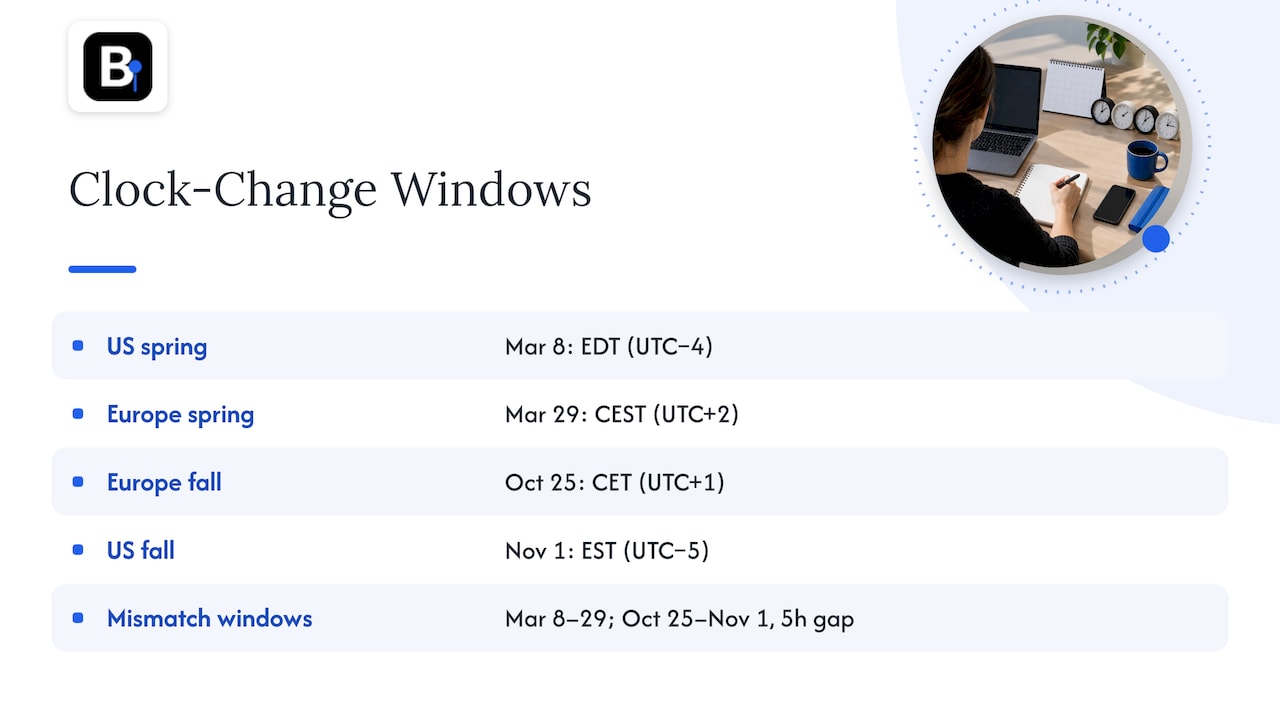
During those windows, the gap between New York and Frankfurt is 5 hours instead of the usual 6. A 9:30 a.m. New York open lands at 14:30 in Berlin instead of 15:30. Backtrader's documentation uses this exact example: a 09:30 US/Eastern open usually corresponds to 15:30 in Berlin, but can fall at 16:30 or 14:30 when the two regions are out of step (Backtrader datetime management).
Exchanges publish temporary schedule changes
Exchanges do not leave this to traders. ICE Futures Europe issued Circular 26/022 on February 20, 2026, announcing temporary changes to trading hours, designated settlement periods and expiry times for some contracts, because US daylight saving and British Summer Time diverge. The affected periods were March 8 to 27 and October 25 to 30, 2026, after which times revert to the normal schedule (ICE Futures Europe Circular 26/022).
The pattern repeats every year, though the exact dates move. US daylight saving runs from the second Sunday in March to the first Sunday in November, and Europe's runs from the last Sunday in March to the last Sunday in October. Check each exchange's circular for the current year before you trust a schedule from a previous one.
Not every venue follows the US clock
Some exchanges tied to US time are in countries that do not observe DST at all. The Gulf Mercantile Exchange states that Singapore is 14 hours ahead of US Central Standard Time and Dubai is 10 hours ahead, with each difference shrinking by one hour while Central Daylight Time applies, because neither Singapore nor Dubai observes daylight saving (GME trading hours). The ASX tells users that ASX 24 schedule timings vary slightly as US daylight saving changes occur, and points to contract specifications for product-level confirmation (ASX schedule timings).
So a futures session can move relative to your own clock for two separate reasons: its home exchange changes clocks, or your location does. A multi-market portfolio runs into both.
Futures hours versus the stock market open
The cash stock market is simpler. NYSE and Nasdaq regular trading is defined in Eastern time, 9:30 a.m. local, so it always opens at 9:30 in New York. What moves is the same thing as in futures: the UTC or London or Frankfurt equivalent. The Backtrader example above shows how a 9:30 New York open maps to different Berlin times depending on which side has switched.
Futures differ because they trade nearly around the clock, with a daily maintenance break, and many contracts have settlement windows and expiry times tied to a particular local clock. When the exchange publishes a temporary change to a settlement period, as ICE did in 2026, it affects the daily price your strategy may be using. If you backtest equity index futures against cash index sessions, the offset also matters. Our guide on cash versus futures index sessions lays out how the two schedules relate.
What happens to timestamps on transition days
This is where backtests break. Local wall-clock time has two flaws on transition days: an hour that never happens, and an hour that happens twice.
The Cboe Futures Exchange documents this directly. In its PITCH specification, the Time field counts seconds from the start of the Central Time calendar day, calculated from Central wall-clock time. On a spring-forward day, the values for 02:00:00 to 02:59:59 never appear. On a fall-back day, the values for 01:00:00 to 01:59:59 appear twice (Cboe futures PITCH specification). The specification points to Epoch Time or the feed's Midnight Reference as the way to tell repeated values apart. That behavior belongs to that feed, not to every futures venue, so each source's convention has to be read on its own.
The practical consequences for a minute-bar file are easy to predict:
| Transition | What local time does | What goes wrong in a data file |
|---|---|---|
| Spring forward | One hour is skipped | A gap in the series that code may read as missing data, or bars shifted so the session looks an hour short |
| Fall back | One hour occurs twice | Duplicate timestamps, bars overwritten or merged, volume doubled in one bar |
| Mismatch weeks (US and Europe out of step) | Offset between regions changes by one hour | Session-based indicators, such as daily opens or range-of-the-morning logic, fire an hour early or late |
None of this shows up in a summary statistic. A strategy's equity curve can look fine overall while a handful of trades in the transition weeks are entered at the wrong time. For strategies that trade a specific window, such as the first 30 minutes after the cash open, those trades are exactly the ones that matter.
How to handle DST in a futures backtest
The approach is the same whatever platform you use. Separate three questions: what moment a bar represents, what the exchange's session rules say, and how you want times displayed.
1. Pick one reference time for the bars
Store and process bars in UTC, or in another fixed offset. UTC never repeats or skips an hour, so a minute bar has exactly one possible timestamp. CME's own STP FIX specification takes the same approach: it requires UTC for its LastUpdateTime, StartTime and EndTime request fields, in YYYYMMDD-HH:MM:SS.ns format, and does not accept timezone offsets (CME STP FIX Trade Capture Report Request).
If your data arrives in a local time, convert it once at the ingestion step. Backtrader's documentation notes that by default it does not alter the datetimes the data source supplies, and lets you pass a timezone so source timestamps are converted to its internal UTC-like representation. It treats output time zone as a separate, explicit presentation choice (Backtrader datetime management). The lesson generalizes: normalize on the way in, localize on the way out.
We walk through this in more detail in three parts to normalize time zones.
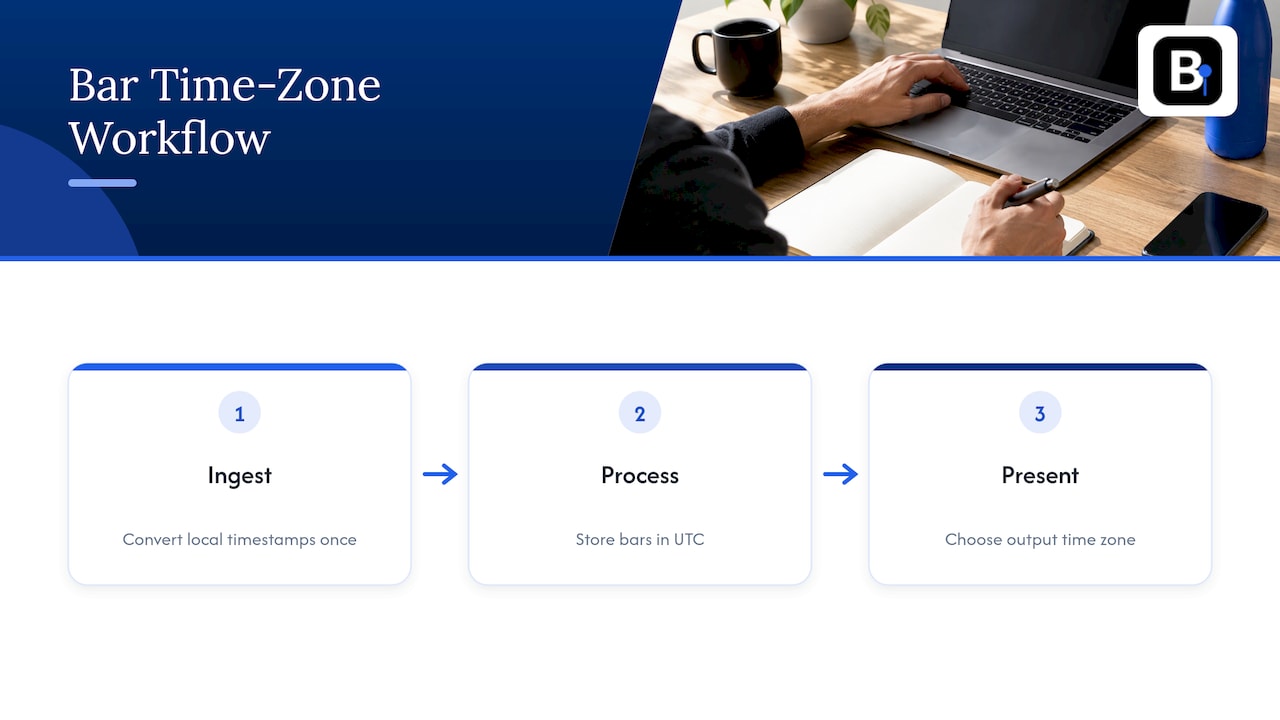
2. Keep session logic separate from the bar grid
A daily session open is a rule about exchange local time, not about a UTC hour. The qkt documentation draws the same line: bars sit on a fixed UTC grid, while session indicators use the UTC hours configured in the strategy (qkt trading calendars). That means a strategy keyed to "the Chicago open" needs a rule that moves by one hour in UTC when Chicago changes clocks. A hard-coded UTC hour works for half the year and is wrong for the other half.
Write the session as "17:00 America/Chicago" and let a time zone database compute the UTC time for each date, rather than adding or subtracting a constant.
3. Test the transition weeks on their own
Pull the three or four weeks around each clock change, in every year of your sample, and check:
- The number of bars on the spring-forward day matches what the exchange schedule implies, with one fewer hour of trading and no stray gap elsewhere.
- The fall-back day has no duplicate timestamps and no hour of volume stacked in a single bar.
- In the mismatch weeks, the daily open, close and any session-range indicator align with the exchange's published schedule for that year.
- Trades near the transition are entered at the time your rule intended, not an hour off.
If results in those weeks differ sharply from the rest of the year, the cause is usually the data or the time handling, not the strategy.
4. Remember the platform's own offset
If you test in MetaTrader, the platform's server time carries its own offset and its own DST convention, which is a separate issue from the exchange's. See our guide on fixing the MT4 GMT offset for expert advisor timing, and fixing DST errors in forex minute data for the parallel problem in currency pairs. The forex session times guide covers how overlaps shift with the seasons.
Why the data itself decides the outcome
Code can only correct what the data lets it correct. If a file mixes timestamp conventions, switches from local to UTC partway through, or has bars missing at transition hours, no amount of careful strategy logic recovers the truth. You end up guessing which of two identical-looking hours is which.
Three properties make a futures data set safe for DST-sensitive testing:
- One documented timestamp convention across the whole history, so you never have to infer it from the data.
- No gaps or duplicates at transition hours, verified bar by bar.
- Documented adjustments, so you know when a series was back-adjusted for contract rolls and how.
These are the standards we hold our own data to. A strict data standard is not only for human-driven testing: AI-driven backtesting inherits every timestamp error it is fed and repeats it at scale.
A worked example: the same open in three weeks
Take a strategy that goes long an equity index future at the 9:30 a.m. New York cash open and exits 30 minutes later. In 2026, using the ICE Endex dates above, the offset between New York and Frankfurt is as follows.
| Week | New York time | Frankfurt time | Offset |
|---|---|---|---|
| Early February (both on winter time) | EST, UTC−5 | CET, UTC+1 | 6 hours |
| Mid March, after March 8 and before March 29 | EDT, UTC−4 | CET, UTC+1 | 5 hours |
| Early April (both on summer time) | EDT, UTC−4 | CEST, UTC+2 | 6 hours |
The 9:30 open is at 14:30 UTC in early February, but 13:30 UTC in April. A rule coded as "enter at 14:30 UTC" is correct for the winter weeks and an hour late for the summer ones, so it would enter after the opening move and miss part of the intended window. A rule coded as "enter at 15:30 Frankfurt" is only right when both regions are on the same side of their clock change.
Both mistakes produce plausible-looking results. The first is invisible unless you chart entries against the opening range. That is why the check in step 3 above is specific: compare entry times to the exchange's local clock, week by week.
Our perspective
Most DST problems we see described by traders start the same way: the strategy looked fine, the data looked fine, and the clock was the third thing nobody examined. A backtest is only as trustworthy as its timestamps.
We collect and verify our minute-bar data with that in mind. Our data sets go back to 2014 and cover forex, metals, bonds and stock indices, with careful bar-by-bar verification and documented adjustments. They download as complete files that are ready to import into MT4 and MT5, so you start from a consistent series rather than a patchwork to clean.
When a timestamp question comes up, you talk directly to the engineers who collect the data. We think that is the right way to run a data business: the person who knows how a file was built should be the person who answers.
Start
Starting from clean minute data
If you test futures-related or index strategies and want to remove timestamp uncertainty before you test, start with our historical data sets: one-time downloads of clean minute-bar data since 2014, including back-adjusted futures data and bundles by asset class, ready for MT4 and MT5. The Annual Plan is €119 per year.
If you also run automated strategies, our expert advisors are built for portfolio and automated strategy management on the same platforms.
FAQ
Does daylight saving time affect futures trading hours?
Yes. Exchanges publish temporary changes when US and European clocks are out of step. For 2026, ICE Futures Europe announced changes to trading hours, settlement periods and expiry times for some contracts from March 8 to 27 and October 25 to 30, after which times revert to normal (Circular 26/022). The exchange's own circular for the year is the schedule to follow.
Why do US and European clock changes happen on different dates?
Each region sets its own rule. In 2026 the US changed on March 8 and November 1, while Central Europe changed on March 29 and October 25 (ICE Endex schedule). Between those dates, the offset between the two regions is one hour different from usual.
What happens to timestamps when clocks change?
It depends on the feed's convention. In Cboe Futures Exchange's PITCH feed, which uses Central wall-clock time, the skipped hour never appears in spring and the repeated hour appears twice in fall (Cboe specification). Storing bars in UTC avoids both problems.
Does daylight saving change when the US stock market opens?
No. The regular session still opens at 9:30 a.m. Eastern. What changes is the equivalent time in UTC or in another country, which shifts by an hour when the regions are on different clock schedules (Backtrader example).
Sources
- ICE Futures Europe Circular 26/022: Temporary Changes to Trading Hours
- ICE Endex: Daylight Saving Time trading hours (2026)
- ASX 24 schedule timings
- Gulf Mercantile Exchange trading hours and holiday calendar
- Backtrader datetime management
- qkt trading calendars
- Cboe futures PITCH specification, time reference fields
- CME STP FIX Trade Capture Report Request
Recommended
- Forex Daylight Saving Time: Fixing DST Errors in Minute Data
- How to Fix the MT4 GMT Offset for Accurate EA Timing
- Avoid Hour Errors: Three Parts to Normalize Time Zones for Developers
- Continuous Futures Data: How to Build and Use It
Related resources
Explore BacktestMarket's Expert Advisor robots to put the ideas in this article into practice.