

Gold data accuracy means a price feed is both timely and correct against a trusted reference, not just "close enough." For most backtesting work, validated minute bars beat raw tick streams because they're easier to reconcile and audit. Before you trust any feed, pull a sample and run a reconciliation check against an authoritative source. Skip that step and you're building on sand.
TL;DR:
- Accurate gold price data must be timely, precise, complete, and integrity-verified, tailored to the specific trading strategy's tolerances.
- Validation involves sampling at least 300 rows, reconciling against authoritative sources, and checking for gaps, duplicates, and timestamp consistency before trust.
- Most traders benefit from reconciled 1-minute bars rather than tick data, as they reduce complexity and still meet the needs of many strategies.
- Vendors with transparent reconciliation processes and support for testing sample data provide a more reliable foundation for backtesting and live trading.
- Data sources like the World Gold Council and FRED are recommended as benchmark references for validating vendor feeds and ensuring data accuracy.
Table of Contents
- Why Data Accuracy Matters for Trading, Risk, and Backtests
- Key Dimensions That Define Accurate Gold Price Data
- Validation and Reconciliation Best Practices for Gold Feeds
- A Quick Checklist Before You Trust a Gold Dataset
- How BacktestMarket's Approach Maps to These Accuracy Needs
- Minute Bars or Tick Data: Which One Actually Fits Your Strategy?
- Get a Sample of GOLD 1m Before You Build on It
- Sources
- FAQ
Why Data Accuracy Matters for Trading, Risk, and Backtests
A one-tick error on gold looks trivial until you scale it. A $0.50 misprint on a 500-lot position isn't a rounding error, it's real money, and it compounds across thousands of backtested trades. Bad data doesn't just cost you once. It costs you every time your strategy trains on it.
Backtests are especially vulnerable because they overfit to whatever they're fed. Patch a gap with interpolated values and your model learns a pattern that never existed in the real market. Then, when timestamps in your historical file don't match your live feed's convention (UTC versus exchange local time is the classic trap), your execution assumptions break the moment you go live.
This isn't an abstract risk. Gartner estimates businesses lose an average of $12.9 million a year to poor data quality, and that figure spans every industry that depends on clean numbers to make decisions. For a trading desk, the damage shows up as:
- Slippage assumptions in backtests that never materialize live
- Risk models that understate drawdown because volatility was smoothed by bad ticks
- Compliance headaches when trade logs don't match the reference price at execution time
Nearly two-thirds of chief data officers now say leveraging data for competitive advantage is a top priority. That's a signal the bar for "good enough" data has moved. Accessibility alone doesn't cut it anymore.
Key Dimensions That Define Accurate Gold Price Data
Accuracy isn't one property, it's four working together: timeliness, precision, completeness, and integrity. Each one fails differently, and each one needs a different check.
- Timeliness: how fresh is the tick when it hits your system? Measure it as latency in milliseconds for live feeds, or as publish delay for end-of-day data.
- Precision: is the price carried to the decimal places your strategy actually needs? Gold spot is typically quoted to two decimals; some vendor feeds truncate or round differently.
- Completeness: what's the gap rate across your historical window? A backtest missing 2% of minute bars during high-volatility periods will misprice risk.
- Integrity: does the record match its checksum or hash, and has it survived storage and transfer without silent corruption?
Gartner's guidance is blunt on this: don't chase theoretical perfection, define measurable tolerances tied to your actual use case. A high-frequency strategy might demand sub-second timeliness and zero gap tolerance. A daily swing strategy running on minute bars can tolerate a few seconds of latency and the occasional flagged, backfilled gap, as long as it's disclosed and consistent.
Validation and Reconciliation Best Practices for Gold Feeds
Reconciliation against a trusted system of record is the only check that actually measures accuracy rather than plausibility, according to Decube's data engineering guidance. Everything else, schema checks, freshness monitors, is a proxy. Here's a working sequence:
- Pick your system of record. An exchange fix, an LBMA reference, or a FRED series works well for gold. Every incoming feed gets measured against it, not against another vendor.
- Set numerical tolerances before you look at the data. Decube's benchmark is a reasonable starting point with tight thresholds on row counts and exact monetary totals. Anything wider needs a documented reason.
- Sample at a size that has statistical teeth. Around 300 rows gives you practical power to catch systemic errors without auditing every record.
- Run schema-drift and freshness monitors continuously, not just at ingestion. A vendor that quietly changes a field name or decimal format mid-stream will break downstream code long before anyone notices the price is wrong.
- Quarantine anomalies instead of dropping or silently correcting them. A price that jumps 3% in one tick with no matching move elsewhere gets flagged for review, not deleted.
Ataccama's framework treats this as a continuous, automated discipline, not a one-time cleanup project. That distinction matters for gold specifically, because thin holiday liquidity and rollover periods around futures expiry generate exactly the kind of anomalies a one-time audit will miss.
Pro Tip: Run your reconciliation sample during a known volatile window, like a Fed announcement day, not just a quiet Tuesday. Feeds that look clean in calm markets often reveal their gaps and lag under stress.
A Quick Checklist Before You Trust a Gold Dataset
Run this before you import anything into a backtest engine or a live system.
- Confirm the update frequency and latency actually match your strategy's tolerance, not just the vendor's advertised spec.
- Check timestamp format and time zone, and verify the bars are continuous with no silent gaps.
- Pull a sample and reconcile it against an authoritative source, then calculate your actual error rate.
- Look specifically for missing records, duplicate ticks, and inconsistent holiday handling around low-liquidity sessions.
- Confirm you can reach real support if something looks wrong, and test importing a sample directly into MT4/MT5 before you commit to a full purchase.
That last step catches more problems than people expect. A dataset that looks fine in a spreadsheet can still fail on import because of formatting quirks the vendor never mentioned.
How BacktestMarket's Approach Maps to These Accuracy Needs
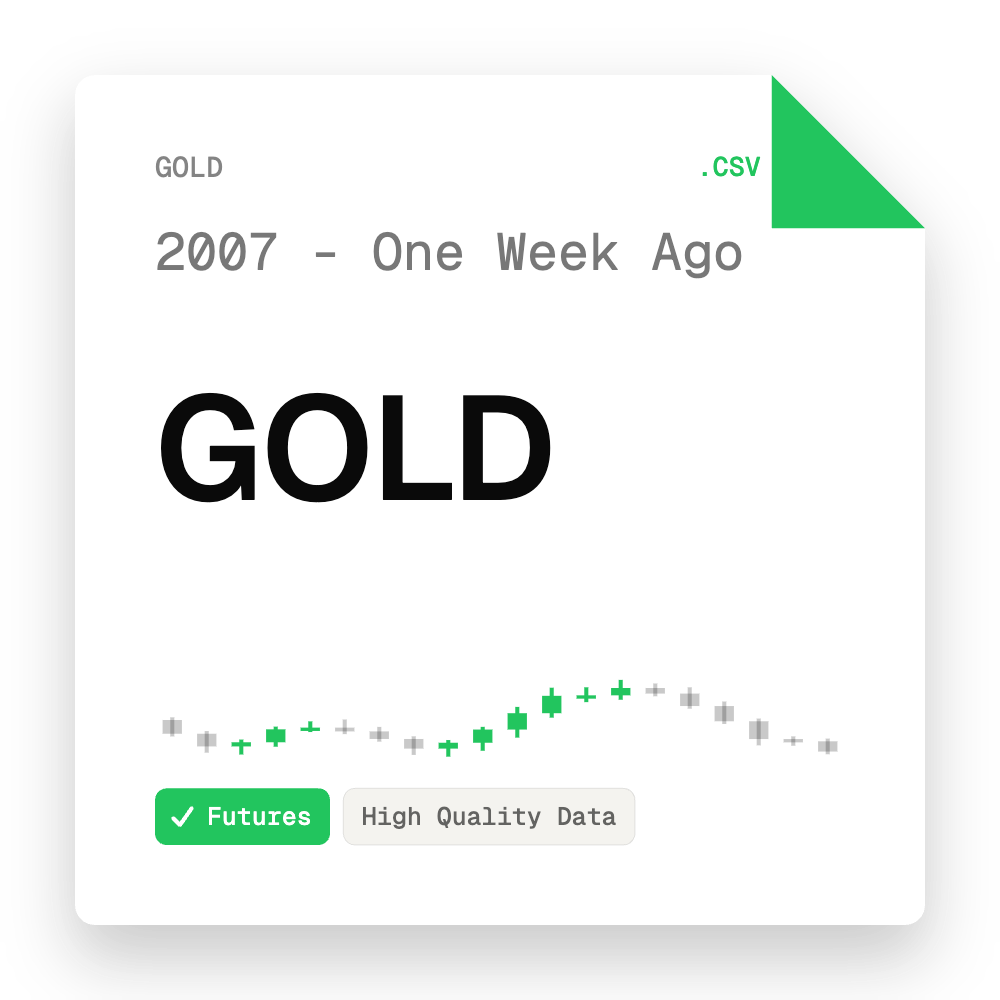
Backtestmarket has built clean minute-bar historical intraday data since 2014, covering gold alongside forex, bonds, and stock indices. That history matters for the completeness check above: a longer, continuously maintained dataset gives you more holiday and rollover periods to stress-test before you rely on it.
Here's how the checklist maps onto what to inspect in a GOLD 1m sample:
- Continuous bars: request a sample spanning at least one holiday period and check for gaps.
- Timestamp hygiene: verify the time zone convention matches your platform before import.
- Missing-record policy: ask engineer support directly how gaps are flagged versus filled.
- Import readiness: the files are built for direct MT4/MT5 import, so test that step with the sample first.
Ask support for a reconciliation reference point when you request your sample. It's the fastest way to confirm the dataset holds up before you commit to it.
Minute Bars or Tick Data: Which One Actually Fits Your Strategy?
Most traders don't need tick data, they need reconciled minute bars. Ticks earn their overhead only when your entire edge depends on latency measured in milliseconds. For everyone else, cleaned 1-minute data cuts reconciliation work dramatically while preserving the signal your strategy actually trades on. Prototype on minute bars first. Measure whether a lower-latency feed genuinely moves your results before you pay for the added complexity.
— Start
Get a Sample of GOLD 1m Before You Build on It
Backtestmarket's GOLD 1m dataset gives you continuous, clean 1-minute bars going back through gold's trading history, packaged as a single download built for direct import into MT4 and MT5. No stitching together CSVs from three vendors, no guessing at timestamp conventions.
Some vendors provide support where you can inquire about how a specific gap was handled or how the reconciliation was structured. The smartest way to start is small: request a sample of GOLD 1m, run it through the checklist above, and see how it holds up against your own reconciliation test before you commit to the full history.
Sources
Not all gold data comes from the same place, and the source matters more than the interface. Authoritative references, like the World Gold Council and the Federal Reserve's FRED database, publish benchmark and historical series you can use as reconciliation targets. Exchange fixes (London gold fixings, futures settlement prices) serve the same purpose for intraday work. Vendor APIs and aggregators sit a layer above these, repackaging exchange or interbank feeds, sometimes with added latency or silent smoothing.
Feed types vary by need:
- IBM Institute for Business Value: CDO study (2025)
- Gartner: Data quality guidance
- Decube: How to ensure data accuracy (2026)
- Ataccama: Data quality assurance guide (2026)
Before you commit to a vendor, ask these questions directly:
A vendor that hesitates on that last question is telling you something.
FAQ
What Is the Most Accurate Gold Price Website?
No single site holds a monopoly on accuracy. The World Gold Council's gold.org and the Federal Reserve's FRED database are the most reliable free reference points for spot and historical gold prices, and either works well as a reconciliation target for a vendor feed.
What Happens If I Invested $1,000 in Gold 10 Years Ago?
The actual return depends on the exact entry and exit dates you use, and gold's price history is publicly available through sources like FRED for anyone who wants to calculate a precise figure. Because gold moves in multi-year cycles, investment returns can vary significantly depending on the chosen time window.
Is 100% Gold Purity Possible?
Not in practical terms. Even 24-karat gold, the purest commercial standard, typically contains trace impurities, and refiners generally cap achievable purity around 99.99% (often labeled "four nines") rather than a true 100%.
Could Gold Hit $10,000 an Ounce?
That kind of long-range price forecast depends on macroeconomic conditions no dataset can predict with confidence, and no authoritative source in this article's research supports a specific target. Treat any single price prediction with skepticism and focus instead on the accuracy of the historical and live data feeding your own models.
How Do I Know If a Gold Data Vendor's Feed Is Reliable?
Request a sample and reconcile it against an authoritative source like an exchange fix or FRED series, checking for gaps, duplicate records, and timestamp consistency. A vendor offering clean minute-bar history, like Backtestmarket's GOLD 1m, should hold up under that test without hesitation from their support team.
Recommended
- 5 Audits Quants Must Run on Outlier Handled M1 Data Before MT4/MT5
- Holiday Gaps in Market Data: A Quant's Handling Guide
- Fixing MT4 Missing Data: A Complete Recovery Guide
Related resources
Explore BacktestMarket's historical data packs to put the ideas in this article into practice.