

A trustworthy hedging backtest needs five things a plain price chart never gives you: synchronized underlying minute bars, full option chains with bid/ask and open interest, implied volatility surfaces, per-contract greeks, and contract identifiers that survive expiration. It also needs four validation steps: point-in-time integrity tests, a realistic fills model tied to open interest, walk-forward out-of-sample testing, and transaction-cost sensitivity checks. Skip any of these and your hedge error numbers are fiction.
TL;DR:
- Reliable hedging backtests require synchronized minute bars, full option chains with bid/ask, implied volatility, greeks, and contract identifiers to avoid hidden errors.
- Validation steps such as point-in-time integrity tests, realistic fills models, and sensitivity checks are essential; skipping them leads to fictionally optimistic results.
- Using datasets that contain expired contracts and full historical coverage prevents survivorship bias and reflects more accurate out-of-sample performance.
- Backtests must incorporate macro event flags and high-volatility period adjustments to avoid overestimating hedge robustness during major market moves.
- Vendors supplying clean, timestamped, and fully synchronized data, combined with rigorous validation, offer significant time savings and more trustworthy results than building in-house pipelines.
Table of Contents
- Hedging Backtesting Data: What Your Dataset Actually Needs
- How Lookahead and Survivorship Bias Sneak Into Hedge Backtests
- Building a Reproducible Pipeline for Point-in-Time Hedging Data
- Validating a Hedging Strategy Without Fooling Yourself
- What to Look for in a Hedging Data Vendor
- Why Macro Events Belong in Your Hedging Backtest
- Build vs. Buy: Deciding Where to Spend Your Engineering Hours
- Get Point-in-Time Hedging Data Without Building It Yourself
- Sources
- FAQ
Hedging Backtesting Data: What Your Dataset Actually Needs
Most traders discover the hard way that a clean price series tells you nothing about how a delta hedge would have actually performed. You need the option chain itself, at the moment your strategy would have traded it, because implied volatility, not spot price movement, drives most of the P&L in a hedged options book.
Here is the field-level list that separates a research-grade dataset from a decorative one:
- Bid/ask and last trade price per contract. Mid-price backtests systematically overstate performance because real fills happen at the bid or ask, not the midpoint.
- Best bid/ask timestamps. Without a timestamp on the quote itself, you cannot know whether the price you are trading against was even live when your signal fired.
- Implied volatility per strike and expiration. IV is the actual tradable variable in most hedging strategies, and it needs to be captured at the same timestamp as the underlying.
- Greeks (delta, gamma, vega) per contract. These drive position sizing and rebalancing triggers; recomputing them from stale IV introduces silent errors.
- Open interest and traded volume. OI tells you whether a contract was liquid enough to fill at your assumed size, which matters enormously for tail-hedge strategies that trade far out-of-the-money.
- Contract identifiers, exchange, and multiplier. Corporate actions and contract adjustments break silently if you match on strike and expiration alone instead of a stable contract ID.
The underlying and the option chain must share synchronized as-of timestamps. A common and costly mistake is pulling end-of-day underlying closes against option quotes captured at a different cutoff time; the resulting mismatch shows up as phantom hedge error that has nothing to do with your strategy. A SPX-based hedging thesis built on OptionMetrics and WRDS data makes this point directly: synchronized underlying prices plus full option-chain data, including strikes, expirations, and greeks, are not optional extras, they are the baseline requirement for any hedging exercise that wants to mean something out of sample.
Retention matters just as much as coverage. Datasets that prune expired contracts after they stop trading quietly introduce survivorship bias into any strategy that rolls positions or evaluates a historical universe. Keep every contract that ever existed in your window, tagged with its expiration and delisting status.

On storage, Parquet with an explicit schema beats raw CSV for anything beyond a quick prototype, since it preserves data types and compresses better across millions of contract-day rows. Whatever format you choose, document the schema: contract ID, exchange, multiplier, strike, expiration, and the as-of timestamp convention. Interest rates and dividend assumptions need the same rigor. Store the actual rate curve and discrete dividend schedule used at pricing time rather than a single flat assumption, since pricing engines that assume constant rates across a multi-year backtest will misprice long-dated hedges in ways that only show up when you compare against realized decay.
How Lookahead and Survivorship Bias Sneak Into Hedge Backtests
Every inflated backtest result traces back to one of a handful of repeatable mistakes. The good news is that each one has a concrete test you can run in an afternoon.
- Derived-statistic leakage. If your strategy uses IV rank or IV percentile as a signal, recompute that statistic using only data available before each decision point, then compare it against whatever the dataset ships with. A mismatch means the vendor calculated the statistic using the full historical window, including future data your strategy could not have seen.
- Restatement and versioning drift. Pull the same fixed date range twice, a week apart, and diff the results row by row. If values change without a documented correction, the dataset is being restated behind the scenes, and any nightly backtest run against it will produce inconsistent results over time.
- Open-interest timing errors. OI is often reported as a next-day figure, not a same-day figure. Confirm whether your feed uses preliminary or finalized OI, and if it uses finalized numbers, treat that as a look-ahead risk for any liquidity filter based on OI.
- Event-week spread blindness. Earnings, FOMC decisions, and CPI releases widen bid-ask spreads well beyond normal trading days. A backtest that fills at a static spread assumption around these events will overstate hedge quality precisely when it matters most.
Point-in-time integrity failures like restatement, derived-statistic leakage, survivorship, and live-versus-historical drift show up repeatedly across vendor datasets, and they share a common trait: each one is detectable with a simple, automatable check rather than a complex statistical test.
Pro Tip: Build the re-pull diff and the derived-statistic recomputation into your continuous integration pipeline, not just your onboarding checklist. Vendors update methodology quietly, and a dataset that passed integrity checks in January can silently drift by June.
Add conservative event-week spread multipliers to your fills model rather than assuming your normal-day spread holds during high-volatility windows. This single adjustment tends to close a meaningful chunk of the gap between backtested and live hedge performance for strategies that trade around scheduled macro events.
Building a Reproducible Pipeline for Point-in-Time Hedging Data
A hedging backtest is only as trustworthy as the pipeline that produced its inputs. Treat data preparation as a five-step process, and version every step so you can reproduce a result months later.
- Extract with frozen snapshots. Pull data as a versioned, immutable extract tied to a specific pull date and time. Never query a live database directly inside your backtest loop, since the underlying data can change between runs.
- Retain and normalize contracts. Keep every contract, including expired ones, and standardize strike and moneyness labels across your entire universe so a 5% out-of-the-money put in 2019 is comparable to one in 2026.
- Align timestamps and interpolate carefully. Build a moneyness-maturity grid and define explicit interpolation rules for missing strikes rather than silently dropping them or forward-filling stale quotes.
- Apply a realistic fills model. Use a conservative alpha parameter between 0.3 and 0.7 to simulate where within the bid-ask spread you would realistically fill, combined with an OI-based liquidity discount that penalizes thin contracts more heavily than liquid ones.
- Package for import and store hashes. Export in an MT4/MT5-ready layout, and store a hash of every extract alongside your backtest results so you can prove exactly which dataset version produced which performance number.
Before packaging, run through this quick verification list:
- Confirm the extract's contract count matches your expected universe size for that date.
- Spot-check five random contract-days against a second independent source.
- Verify the schema documentation matches the actual column layout in the file.
- Confirm expired contracts appear in the historical file, not just active ones.
This sequence sounds procedural, but skipping any step tends to surface later as an unexplainable gap between backtested and live results. Guides on MT5 data import and handling calendar gaps cover the mechanics of timestamp alignment and session boundaries in more depth if your instrument universe spans multiple exchange calendars.
Validating a Hedging Strategy Without Fooling Yourself
Split your data chronologically into three blocks: in-sample for calibration, validation for parameter tuning, and out-of-sample for the number you actually report. Never let information from the out-of-sample block touch model selection, and repeat the split across multiple rolling windows using a walk-forward protocol rather than a single static cut.
A 2026 study on standardized implied-volatility observations evaluated forecasts from 2018 through 2023 and found that normalizing IV by moneyness and maturity meaningfully reduces the false signals that come from a strike composition shifting over time. That normalization step belongs in your pipeline before any validation split, not after.
Regime-aware resampling matters too. A block bootstrap that respects volatility clustering, rather than shuffling individual days independently, gives you a more honest sense of how your hedge would perform across calm markets and stress periods alike.
Report these metrics, not just a single Sharpe ratio:
- Hedge-error distribution, including skew and kurtosis, not just mean and standard deviation.
- Tail losses and CVaR at the 95th and 99th percentiles.
- Turnover, since high rebalancing frequency erodes returns through transaction costs even when raw hedge error looks good.
- P&L attribution split into theta, transaction costs, and directional components from delta, gamma, and vega exposure.
- Drawdown depth and duration alongside risk-adjusted metrics like Calmar ratio.
- A fill-sensitivity table showing how results change as your alpha parameter moves across its plausible range.
Research on richer stochastic volatility models like Heston versus simpler Black-Scholes approaches consistently finds that model sophistication alone does not guarantee better hedge outcomes. Out-of-sample hedge error after calibration to real chains is the only test that matters.
Present uncertainty explicitly. A single point estimate for expected hedge error is nearly meaningless without a confidence interval or a scenario table showing performance under a doubled transaction-cost assumption.
What to Look for in a Hedging Data Vendor
Vendor-supplied datasets can save weeks of engineering time, but only if you know what to check before you trust the numbers. Minute-bar synchronization is the first thing to verify: if the underlying and the option chain are captured on different clocks, every intraday hedge rebalance in your backtest inherits that mismatch. Minute-resolution data with documented coverage gaps and a live-versus-historical parity guarantee is the baseline, not a premium feature.
There are vendors that supply clean minute-bar historical intraday data across forex, metals, stock indices, bonds, and commodities since 2014, packaged as complete downloads ready for direct import into popular trading platforms. That all-in-one format matters more than it sounds. Manual reassembly of separate underlying, chain, and rate files is where most timestamp mismatches originate, and a pre-synchronized bundle removes an entire category of self-inflicted error before you write a line of backtest code.
Whatever vendor you use, run these checks before relying on their extracts for a live decision:
- Request a re-pull diff on a fixed historical window to confirm the data is not being restated.
- Ask how derived statistics like IV rank are constructed, and whether they use only prior-period data.
- Verify parity between the vendor's live feed and its historical archive for a recent overlapping period.
- Confirm how expired contracts are retained and whether the historical universe reflects true point-in-time membership.
Backtestmarket's engineer-level support exists specifically to answer these questions directly rather than routing you through a generic help desk.
Why Macro Events Belong in Your Hedging Backtest
A delta-hedged options book does not fail because of small daily price drift. It fails on the days when a Federal Reserve announcement, a CPI print, or an unscheduled earnings surprise moves implied volatility faster than your rebalancing frequency can track it. Ignoring macroeconomic and event-driven data in a hedging backtest is one of the fastest ways to overstate a strategy's real-world robustness.
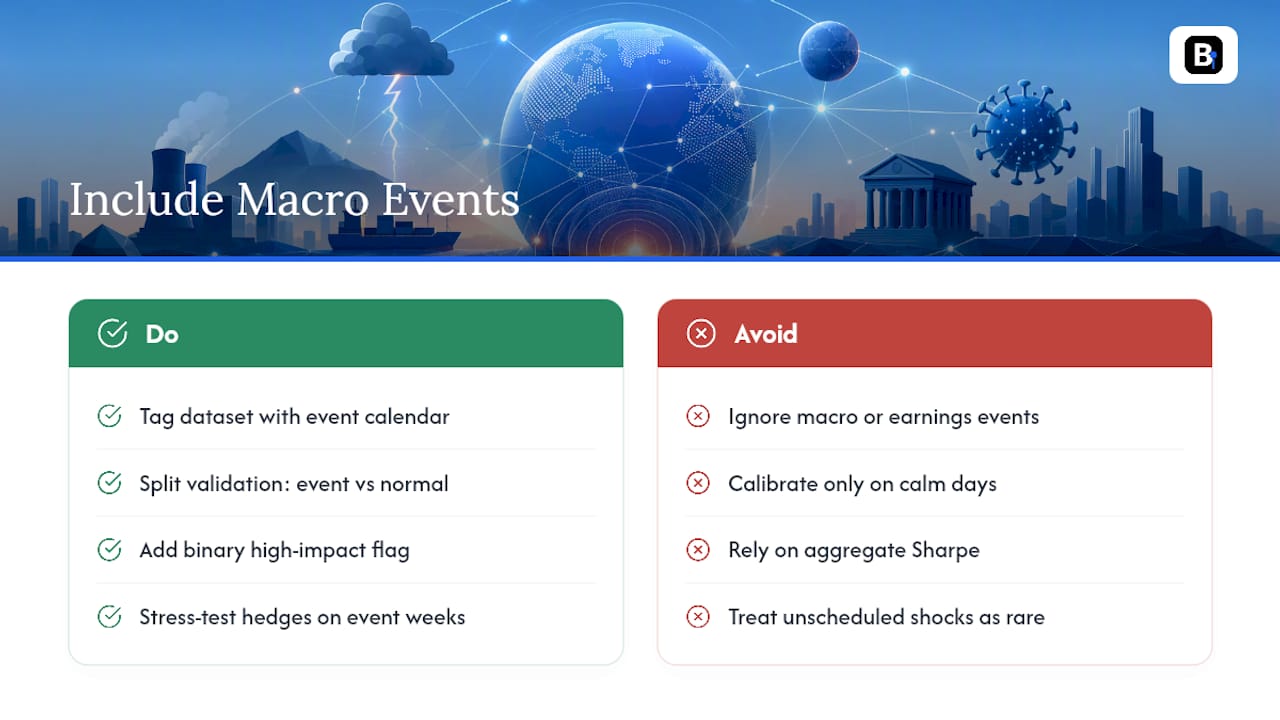
Tag your dataset with a calendar of scheduled macro events, earnings dates, and known volatility catalysts, then run your validation split separately for event weeks versus normal weeks. A strategy that performs well on average but collapses during the four CPI weeks in your sample has a concentration risk that an aggregate Sharpe ratio will hide completely.
Unscheduled events matter just as much as scheduled ones. Flash crashes, sudden rate moves, and geopolitical shocks widen spreads and spike implied volatility in ways your fills model needs to account for, not just your entry logic. If your conservative alpha parameter and OI-based liquidity discount were calibrated only on calm-market days, they will understate transaction costs precisely when a hedge is most likely to be tested. Building a simple event flag into your dataset, even a binary "high-impact week" column, gives you a way to stress-test hedge performance against the periods that actually determine whether a strategy survives contact with real markets.
Build vs. Buy: Deciding Where to Spend Your Engineering Hours
Building an in-house pipeline gives you full control over every normalization rule, but it costs real engineering time: expect weeks, not days, to get point-in-time integrity, retention, and fills modeling right, and every schema change afterward carries reproducibility risk.
Buying a vendor archive shifts that cost into upfront due diligence instead. Run the vendor checklist before you commit: ask about versioning policy, request a parity check between live and historical feeds, confirm instrument coverage matches your universe, and get the vendor to state explicit limitations rather than assuming completeness.
Vendor extracts make the most sense when you need research-grade reproducibility on a compressed deadline, or when your team simply does not have the headcount to maintain a data engineering pipeline alongside strategy development. If you are a solo quant or a small desk, the math usually favors buying: the hours saved on data plumbing translate directly into more hours spent on the strategy logic that actually generates edge. Larger desks with dedicated data engineering resources may still prefer to build, but even then, a vendor archive makes a useful independent benchmark to catch bugs in an internal pipeline.
— Start
Get Point-in-Time Hedging Data Without Building It Yourself
Backtestmarket sells the exact thing this checklist demands: clean, minute-bar historical data delivered as one complete download, verified bar by bar, and ready to drop straight into MT4 or MT5 without a reassembly step.

If your hedging strategy trades futures, the COFFEE Pack Back Adjusted dataset gives you back-adjusted futures history built for exactly the kind of point-in-time backtest this article walks through. Start by pulling a sample extract and running the re-pull diff described earlier in this piece against it. Browse the full Historical Data catalog to check instrument coverage against your universe, or step up to the Annual Plan at €119 per year for ongoing access. If you need a specific symbol or timeframe validated before you commit, some vendors provide engineer-level support to answer detailed questions and assist with parity checks on the exact contracts planned for trading.
Sources
The claims in this article draw on a small set of sources worth reading directly if you want to verify the methodology yourself rather than take a vendor's word for it.
- Standardized implied-volatility observations (2026 Springer article)
- Point-in-Time Options Data: Why Most Options Backtests Are Optimistic | FlashAlpha
FAQ
Can ChatGPT Backtest a Trading Strategy?
ChatGPT can help you write backtesting code or explain a strategy's logic, but it cannot execute a real backtest on live market data or verify point-in-time integrity on its own. You still need an actual dataset with synchronized option chains, greeks, and a fills model, plus a coding environment to run the test, before any output means anything.
What Is the 3-5-7 Rule in Trading?
The 3-5-7 rule is a risk management guideline suggesting no single trade risks more than 3% of capital, total exposure across all open trades stays under 5%, and your largest winning trades should net significantly more than your losing trades combined. It is a position-sizing heuristic, not a backtesting standard, and it does not replace the point-in-time integrity and fills modeling required for hedging strategy analysis.
How Do You Backtest Option Data?
You backtest option data by pairing synchronized underlying price bars with full option-chain history, implied volatility, greeks, open interest, and contract identifiers at matching timestamps, then applying a realistic fills model and running the strategy across chronological in-sample, validation, and out-of-sample splits. Skipping the point-in-time integrity checks covered above is the single most common reason backtested results fail to hold up live.
What Is a Hedging Strategy?
A hedging strategy is a set of trades designed to offset the risk of an existing position, most commonly using options or futures to neutralize exposure to price, volatility, or time decay. In options trading, delta hedging is the most common example, where a trader continuously adjusts an offsetting position to keep directional exposure near zero as the underlying price moves.
What Data Do I Need to Backtest a Delta-Hedging Strategy?
You need synchronized underlying minute bars and full option-chain data, including bid/ask, implied volatility, and greeks, captured at matching timestamps, plus open interest for liquidity filtering and a documented rate and dividend schedule for pricing. Backtestmarket's historical intraday datasets provide the underlying minute-bar side of that requirement across multiple instrument classes.
Recommended
- Audit First MT5 Backtesting Data: Gap, Timestamp, Ready to Import
- 5 Audits Quants Must Run on Outlier Handled M1 Data Before MT4/MT5
- Data Snooping Bias: How Researchers and Quants Catch It
- How to Achieve 99% Modeling Quality in MT4 for Backtests
Related resources
Explore BacktestMarket's historical data packs to put the ideas in this article into practice.