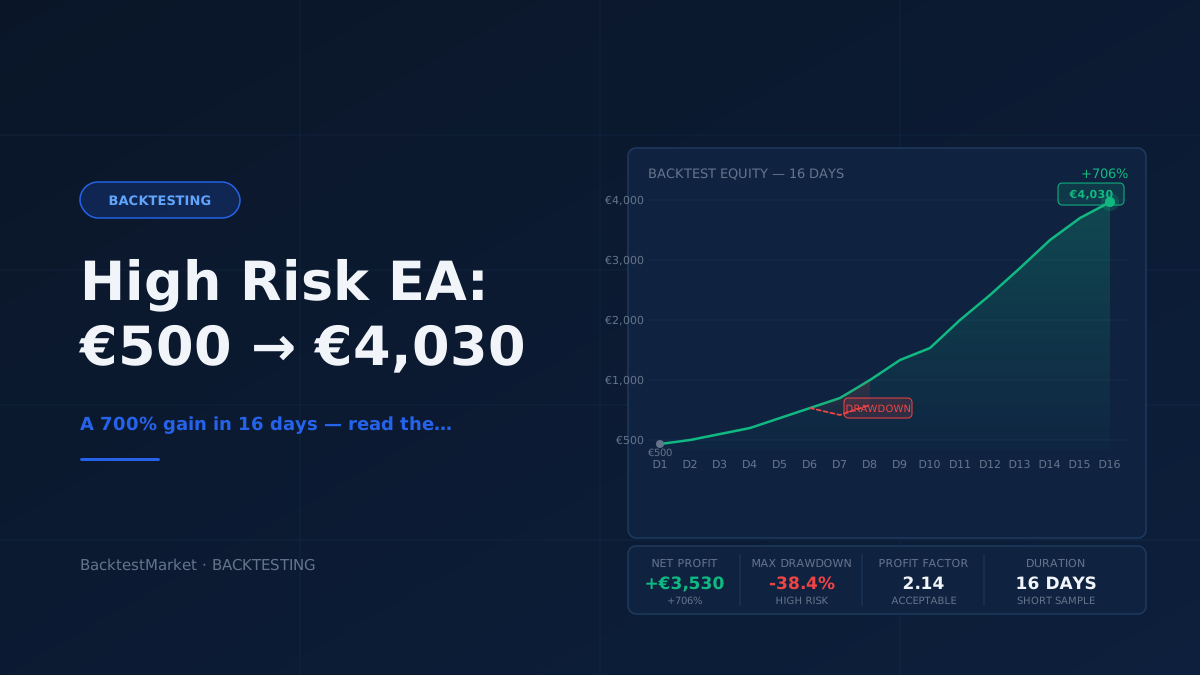
A screenshot circulating on Reddit recently caught a lot of attention: an EA backtest showing a starting balance of €500 growing to €4,030 in just 16 days. The post drew engagement and, predictably, a split reaction — half the comments were excited, the other half deeply sceptical. Both reactions are understandable. What's less common is a measured, technical look at what a result like that actually means.
That's what this article is for.
We're not going to tell you to run out and trade this strategy. What we are going to do is walk through the analytical framework you should apply any time you encounter a high-return backtest, so you can make an informed judgment about whether the underlying logic is worth exploring further.
What a 700%+ Return in 16 Days Implies About Risk
Let's start with the mathematics of the claim. A balance moving from €500 to €4,030 represents a gain of roughly 706% in 16 trading days — approximately three calendar weeks. Even if we accept the backtest at face value, a gain of that magnitude over that timeframe has only one explanation: extremely aggressive position sizing, high leverage, or both.
In MetaTrader 4 and MT5, there are really only a few mechanical levers that can produce returns of this scale in a short window:
Martingale or grid position sizing. These strategies compound lot sizes after losses (Martingale) or open a grid of orders at fixed price intervals (grid). Both can produce spectacular short-term equity curves because they naturally pyramid into positions. The problem is that the risk profile is asymmetric — gains accumulate gradually, but a single adverse move against a large compounded position can wipe the account entirely.
High fixed lot sizes relative to account balance. If an EA is trading 1.0 or 2.0 standard lots on a €500 account, each pip of movement is worth €10–€20. A 50-pip move in your favour on a 2-lot position yields €1,000 — double the account balance. This explains the velocity of the return. It also explains why a 50-pip adverse move would cause a total loss.
Scalping with very tight stop-losses and high win rates. Some EAs run dozens of small trades targeting 3–5 pips with stops of 1–2 pips. A clean trending day can stack up many small wins. But spread costs, slippage, and a single news spike can catastrophically unwind a strategy like this in live conditions.
The point isn't that any of these approaches are inherently illegitimate — it's that the return profile is inseparable from the risk profile. You cannot have one without the other. When you see a 706% return in 16 days, you should immediately be asking: what was the maximum drawdown? What lot sizes were used? What leverage? What would have happened if the backtest window had started one week earlier or later?
The Five Backtest Quality Checks You Should Always Run
Before you get excited about any backtest result — high-return or otherwise — there is a standard checklist that experienced algo traders apply. Here it is, applied to the type of result we're discussing.
1. Modelling quality and tick data
MetaTrader's Strategy Tester shows a modelling quality percentage in the report header. Results generated with "Open prices only" or low-quality tick data are almost meaningless for short-term strategies. An EA that scalps or uses tight stops must be tested on high-quality tick data, ideally 99% modelling quality using real tick data imported from a reliable source. If the backtest was run on default MT4 data with 90% modelling quality, the results are best treated as directional estimates rather than accurate performance figures. You can find properly prepared historical data packs that make this kind of rigorous testing straightforward.
2. Drawdown relative to return
A backtest report should show maximum drawdown as both an absolute figure and a percentage of the account balance. A strategy that produces 700% returns but also has a historical max drawdown of 95% isn't a winning strategy — it's a strategy that happened to not hit its worst-case scenario during the test window. Always contextualise the return against the drawdown, not in isolation.
3. Trade sample size
16 days is a very short window. Depending on how frequently the EA trades, this might represent 10 trades or it might represent 400. A Martingale EA might execute 200 trades over 16 days but only experience one serious recovery sequence. The statistical significance of 16 days of trading is low — this is not a criticism of the backtest, it's just a fact about sample sizes. Robust backtesting typically requires hundreds to thousands of completed trade cycles across multiple market regimes.
4. Spread and commission settings
Check the backtest configuration for spread settings. Many EAs tested on fixed spreads of 1–2 pips will show inflated results compared to live trading, where spreads widen during news events, low liquidity periods, and market opens. For a short-term EA, setting a realistic variable spread — or at minimum a conservative fixed spread — is critical.
5. Forward walk-forward or out-of-sample testing
Any parameter set that has been optimised on historical data will tend to show inflated performance on that same data. The only honest test of an EA is how it performs on data it has never been optimised against. If you see a backtest without any corresponding walk-forward analysis or out-of-sample period, the strategy's real edge is still an open question.
Understanding the Risk Profile Before You Ever Touch a Live Account
Let's assume the backtest passes all five checks above. It's on quality tick data, the drawdown is disclosed, the trade sample is reasonable, the spread is realistic, and there's walk-forward evidence. You're now dealing with a genuinely interesting result rather than a misleading one. What then?
The honest answer is that a strategy with a risk profile sufficient to generate 700% returns in 16 days is likely operating at a risk-of-ruin level that most retail traders should treat with extreme caution. That doesn't make it useless — some traders deliberately run high-risk EAs on small, ring-fenced accounts as a form of speculative allocation they're fully prepared to lose. That's a different decision than treating such a result as a replicable wealth-building tool.
A few practical considerations for anyone wanting to explore EAs in this performance category:
Use a demo account first, then a micro account. Run the EA on a demo account for at least 30–60 days to observe live spread conditions, slippage, and broker execution quality before risking real capital. Then, if you proceed at all, start with the smallest possible live account.
Understand exactly what the EA does. Before running any Expert Advisor, open the backtest report and look at the trade log. Is this a Martingale? A grid? A fixed lot scalper? What is the maximum number of open positions at any one time? What is the theoretical maximum loss if all positions go against you simultaneously? These aren't rhetorical questions — they have specific answers you should be able to find before you ever click "Start".
Set a hard stop-loss on the account level. Most brokers and MT5 account configurations allow you to set account-level stop-out parameters. If you're running a high-risk EA on €500, decide in advance that if the balance hits €250 you turn it off. This is not automated risk management — it's manual discipline, and it matters.
Beware of backtest windows that only cover favourable market conditions. A 16-day backtest might coincidentally cover a strong trending period for the traded instrument. The same EA run across a choppy, mean-reverting two-week window might have produced a completely different result. If you can, extend the backtest to cover at least one full year and ideally multiple years across different volatility regimes.
The Honest Takeaway
A backtest showing €500 growing to €4,030 in 16 days is not a scam by definition, and it's not proof of a working strategy either. It's a data point — a compelling one that deserves rigorous scrutiny rather than either blind acceptance or reflexive dismissal.
The skill that separates profitable algo traders from unprofitable ones over the long run isn't finding the highest-return backtest. It's developing the analytical discipline to correctly interpret what a backtest actually tells you and, equally importantly, what it doesn't.
If you want to test strategies like this yourself, start by making sure your testing environment is sound. Low-quality historical data is one of the most common reasons backtest results fail to translate to live trading. Getting that foundation right before you spend time optimising an EA will save you significant time and capital in the long run.
High-return backtests will always attract attention. The traders who last in this space are the ones who know how to read them.