

A historical data update is any change a provider makes to a dataset after its initial release, whether that means appending new rows or quietly correcting values from years ago. The immediate move is simple: before running any analysis, check the provider's changelog, confirm the dataset version, and snapshot what you're working with. Skip that step and you risk building a backtest on numbers that no longer match the official record.
TL;DR:
- Providers often revise datasets during scheduled annual updates, which can significantly alter previously considered final values, making version control essential.
- Data formats like CSV, Parquet, or API access require different workflows for tracking versions and ensuring data integrity during updates.
- Changelogs must include version numbers, detailed notes, and scope information; lacking these means the update may not be trustworthy for rigorous backtesting.
- To prevent unreproducible results, always archive raw data snapshots, verify checksum and differences, and document dataset versions used in each backtest.
- Regularly monitor official update schedules and automate changelog checks to stay aware of retrospective corrections that could impact strategy performance.
Table of Contents
- Understanding Historical Data Updates: Coverage and Format Basics
- How Often Historical Records Get Revised, and How to Read a Changelog
- Managing Historical Records Without Breaking Your Backtests
- Why Historical Data Gets Corrected, and What to Check Afterward
- Operational Habits That Keep Historical Data Audit-Ready
- Why Transparent Update Logs Matter More Than Most Providers Admit
- Get Update-Ready Historical Data Built for Backtesting
- Where to Track Official Historical Data Changes
- Sources
- FAQ
Understanding Historical Data Updates: Coverage and Format Basics
Before trusting any update, check whether the underlying dataset actually covers what you need. Coverage gaps are the most common reason quant strategies fail in live trading after passing a backtest cleanly.
Time span matters more than most analysts admit. A dataset claiming "15 years of history" for equities might only have clean minute bars for the last five, with the rest reconstructed from daily closes. Instrument coverage matters just as much: forex majors versus exotic pairs, or major indices versus thinly traded futures contracts, often carry very different update reliability.
Granularity determines what kind of update even applies to you. Tick data, one-minute bars, five-minute bars, and end-of-day closes each get revised on different timelines, and OHLCV conventions (open, high, low, close, volume) can shift slightly when a provider re-processes a session.
Format choice shapes your update workflow directly:
- CSV files are portable but require manual version tracking on your end.
- Parquet handles large historical dumps efficiently and preserves schema across updates.
- API access delivers incremental pulls, which suits continuous ingestion better than bulk downloads.
- MT4/MT5-ready bundles save import time but tie you to whatever update cycle the provider follows for that platform.
Minute-bar data in particular needs careful handling around timezone conventions, a detail covered in more depth in this guide to minute bar data for quants running reliable backtests.
How Often Historical Records Get Revised, and How to Read a Changelog
Update cadence isn't uniform, and treating it as if it were is where a lot of pipelines break. Nightly ingestion jobs append the previous session's closing data. Intraday streaming feeds update continuously during market hours. Then there's a third category analysts underestimate: scheduled annual revisions that rewrite figures analysts already treated as final.
The U.S. Bureau of Economic Analysis scheduled its 2026 annual updates to national, industry, and regional economic accounts for September 30, 2026, revising GDP and related statistics all at once. That's a point-in-time addition and a retrospective revision happening on the same calendar date, and it's a useful model for how any serious data provider should structure a major release.

Statistic Callout: In the same release window, FRED added 5,665 new data series from the Annual Integrated Economic Survey in September 2026, mapped to NAICS codes. That's not a correction. It's an entirely new layer of business-level history appearing overnight.
When you read a changelog, look for three things:
- Version numbers, so you can pin your pipeline to a known state
- Release notes describing what changed and why
- Scope fields specifying which series, dates, or instruments were touched
A changelog that lacks any of these three isn't a changelog. It's a marketing page pretending to be one.
Managing Historical Records Without Breaking Your Backtests
Ingesting an update carelessly is how reproducible research turns into unreproducible guesswork. The fix is procedural, not clever.
- Archive raw downloads immutably. Never overwrite a snapshot. Tag each one with a release ID so you can always point to exactly what a given backtest used.
- Choose incremental or bulk replace deliberately. API-based incremental pulls work well for daily appends. Bulk replacement suits major provider releases, like an annual revision cycle, where many historical values shift at once.
- Run a verification sequence before promoting anything to production. Check file checksums, diff the new dataset against the archived version, and run a smoke backtest to confirm the strategy still behaves as expected on the updated series.
Pro Tip: Keep a spreadsheet or lightweight database mapping backtest run IDs to the exact dataset snapshot ID used. When a result looks off six months later, you'll know in thirty seconds whether the data changed under you.
Analysts working with MT5 environments specifically benefit from auditing gaps and timestamps as part of this process, a workflow detailed in this MT5 backtesting data guide.
Why Historical Data Gets Corrected, and What to Check Afterward
Corrections happen for reasons that have nothing to do with sloppy data collection. Methodology changes, re-basing exercises, late-arriving reports, and straightforward error fixes all produce retrospective edits to numbers you already used.
SEER's published change history documents exactly this pattern: retrospective population and variable adjustments that shift counts and rates across past years, sometimes years after the original release. Financial datasets behave the same way. Corporate actions, delisted tickers, and back-adjusted futures contracts all require the provider to touch history, not just add to it.
Statistic Callout: Even niche historical datasets aren't exempt. Retrosheet's 2026 semi-annual release promoted previously deduced data files to full verified event files, purely because new source material surfaced. If a sports statistics archive gets revised on new evidence, financial history should be held to at least that standard.
Run this checklist after every update:
- Compare record counts against the prior snapshot
- Sanity check OHLCV values for outliers or reversed high/low fields
- Diff rolling statistics (mean, volatility) across the overlap period
- Flag anomalies for manual review before trusting the new data in production
Operational Habits That Keep Historical Data Audit-Ready
The gap between a dataset that looks clean and one that survives an audit comes down to habits, not luck. A few practices separate teams that catch problems early from teams that discover them during a client review.
- Automate changelog watching. Don't rely on someone remembering to check a provider's page manually. Poll it, or subscribe to release notifications where available.
- Archive raw minute-bar files alongside ready-to-import bundles. Keep both, tagged with timezone and source metadata, so you can always trace a discrepancy back to its origin.
- Run a standard verification suite after every release. Timestamp alignment checks, corporate-action reconciliation, and hash verification catch most problems before they reach a live strategy.
Pro Tip: If you're recovering from a known gap in your intraday history, patch it before the next update lands on top of it. Layering a fresh release over unresolved gaps compounds the problem instead of fixing it. Analysts dealing with MT4 gaps specifically can work through this missing data recovery guide before their next ingestion cycle.
Public, machine-readable changelogs are worth favoring over vague "data refreshed" notices. Providers that log ingest jobs, statistical computations, and correction dates give you something you can actually automate against, rather than something you have to trust blindly.
Why Transparent Update Logs Matter More Than Most Providers Admit
A dataset without a public changelog asks you to trust it on faith, and faith isn't a research methodology. Versioned releases with dated release notes let another analyst, or an auditor, reconstruct exactly what your backtest saw and when.
That's the standard Backtestmarket holds its own data to: every dataset ships with clean minute bars, clear provenance, and support from engineers who actually built the pipeline, not a support queue reading from a script. When a client asks why a number changed between downloads, someone can answer with specifics instead of a shrug.
*— Start *
Get Update-Ready Historical Data Built for Backtesting
Backtestmarket exists for exactly the problem this article walks through: getting minute-bar historical data you can trust, version after version, without reconstructing your own audit trail from scratch. Datasets cover forex, metals, stock indices, bonds, and commodities, delivered as a single clean download ready to drop straight into MT4 or MT5.
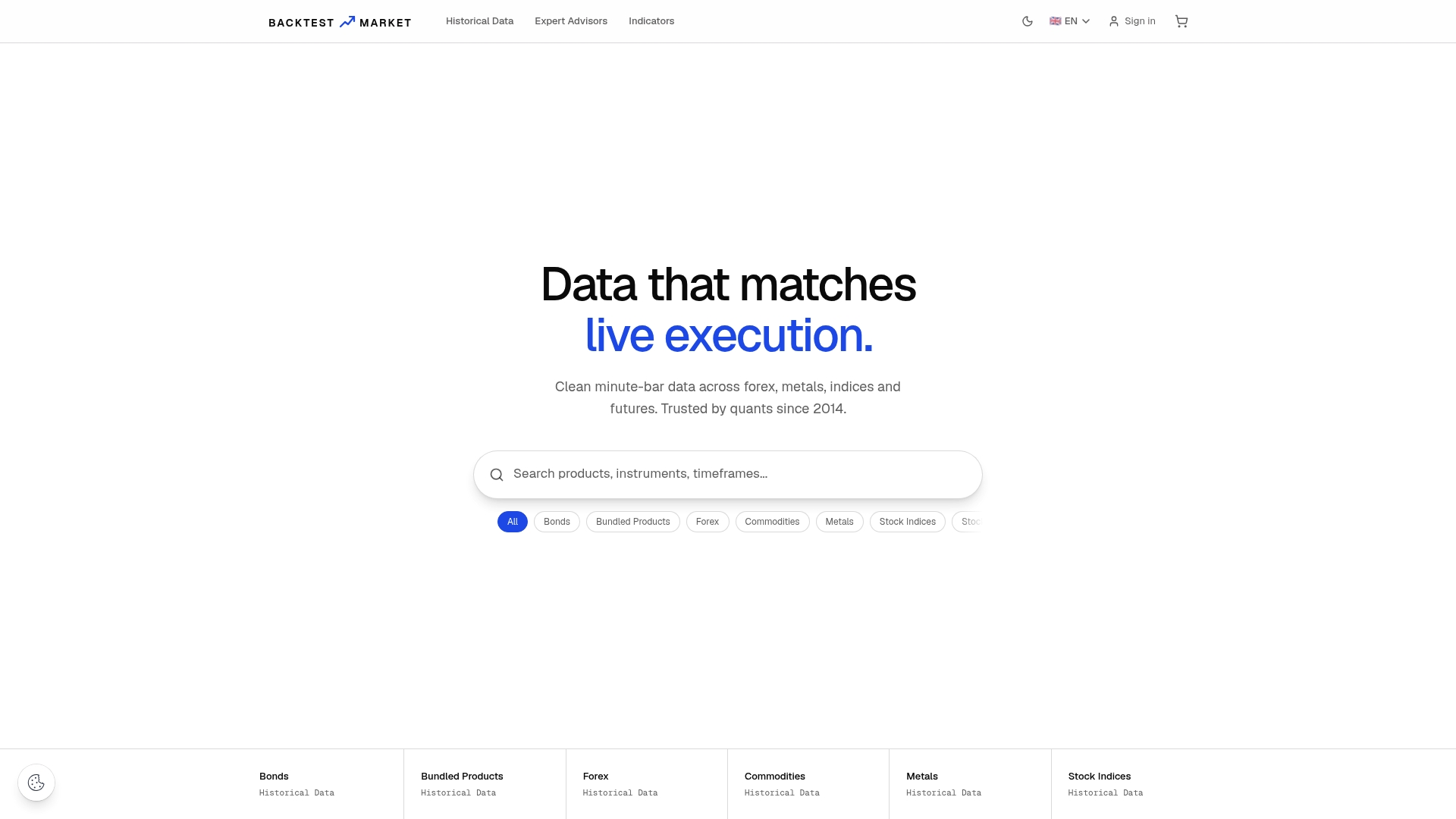
Every release comes with provenance detail this article argues for, including clear versioning and documented scope. If you're working with fixed-income series specifically, the Treasury Bond five-minute dataset is ready to import today, or browse the full historical intraday data catalog to find the instrument and granularity your strategy actually needs.
Where to Track Official Historical Data Changes
- BEA's 2026 annual update schedule covers GDP, industry, and regional accounts.
- FRED's AIES series addition tracks new business-level economic data.
- FiscalData's historic release covers federal fiscal records to 1793.
- SEER's data change log documents retrospective corrections.
Sources
- Information on 2026 Annual Updates to the National, Industry, State, and County Statistics | U.S. Bureau of Economic Analysis (BEA)
- Historic data announcement | FiscalData
- SEER data change history | SEER
FAQ
What Is Considered Historical Data?
Historical data is any recorded observation, price, or statistic tied to a past date rather than the current moment, ranging from daily stock closes to decades-long economic series like the fiscal records FiscalData traces back to 1793.
What Is a Data Update?
A data update is any change to a dataset after its first release, including both new appended records and retrospective corrections to existing values, such as the scheduled annual revisions government agencies run each year.
Where Can I Download Historical VIX Data?
VIX historical data is typically available through exchange data feeds and specialized market data providers offering minute-bar or daily granularity; Backtestmarket's forex and index datasets follow the same clean, versioned delivery model for other instruments.
What Is the Historical Data Used For?
Analysts use historical data to backtest trading strategies, model economic trends, and validate forecasts against real past outcomes, which is why data accuracy and clear versioning matter more than raw volume.
How Often Should I Check for Historical Data Updates?
Check changelogs at least monthly for actively traded instruments, and immediately after any known scheduled revision window, since retrospective corrections can silently change values your strategy already relied on.
Recommended
- Minute Bar Data: What Quants Need for Reliable Backtests
- Fixing MT4 Missing Data: A Complete Recovery Guide
- Audit First MT5 Backtesting Data: Gap, Timestamp, Ready to Import
- Holiday Gaps in Market Data: A Quant's Handling Guide
Related resources
Explore BacktestMarket's historical data packs to put the ideas in this article into practice.