

Expect three common price bands for market data: free to a modest monthly cost for delayed end-of-day data or small-scope APIs, a moderate monthly range for multi-year intraday history from most vendors, and substantially higher charges for exchange-level or full-tick feeds. The exact amount depends on your data granularity needs and whether you choose a subscription or one-time purchase. The number you land on depends almost entirely on two choices: how granular the data needs to be, and whether you want a subscription or a one-time purchase. If you need clean, minute-bar history that imports straight into a trading platform, a one-time dataset like the ones Backtestmarket sells usually beats a subscription on total cost.
TL;DR:
- Vendors price market data based on feed type, granularity, history length, and licensing fees, which can significantly affect total costs.
- Exchange-level data costs are high, often including monthly recurring fees and separate charges for historical data delivery per device, making direct purchase suitable mainly for high-frequency, regulatory needs.
- For backtest and strategy development, one-time flat-file datasets generally cost less over multiple years than monthly subscription plans, especially beyond the first year.
- Estimating your actual needs upfront, such as granularity level and symbol count, can prevent overpaying for unnecessary data or scope creep during project execution.
- Choosing a clean, ready-to-import dataset from a vendor like Backtestmarket can reduce development time and eliminate recurring fees, making it ideal for long-term testing workflows.
Table of Contents
- What Drives Historical Market Data Cost
- Exchange-Level Pricing Examples and What They Actually Mean
- Vendor Pricing Models and Realistic Price Bands
- How to Budget and Choose the Right Data Source
- Where Backtestmarket Fits Into the Cost Picture
- What I've Learned Negotiating Data Contracts
- Get Clean Minute-Bar Data Without the Recurring Bill
- Sources
What Drives Historical Market Data Cost
Vendors and exchanges don't price data as one product. They price it as a stack of components, and each layer adds its own charge. Understanding the stack is the fastest way to stop overpaying for data you don't need.
Feed type is the first fork in the road. A proprietary exchange feed, straight from the source, carries the highest fees because it comes with the exchange's own licensing terms and infrastructure costs baked in. A consolidated feed, blended from multiple venues by a third-party vendor, costs less because the vendor spreads that licensing overhead across thousands of customers instead of billing you directly for exchange access.
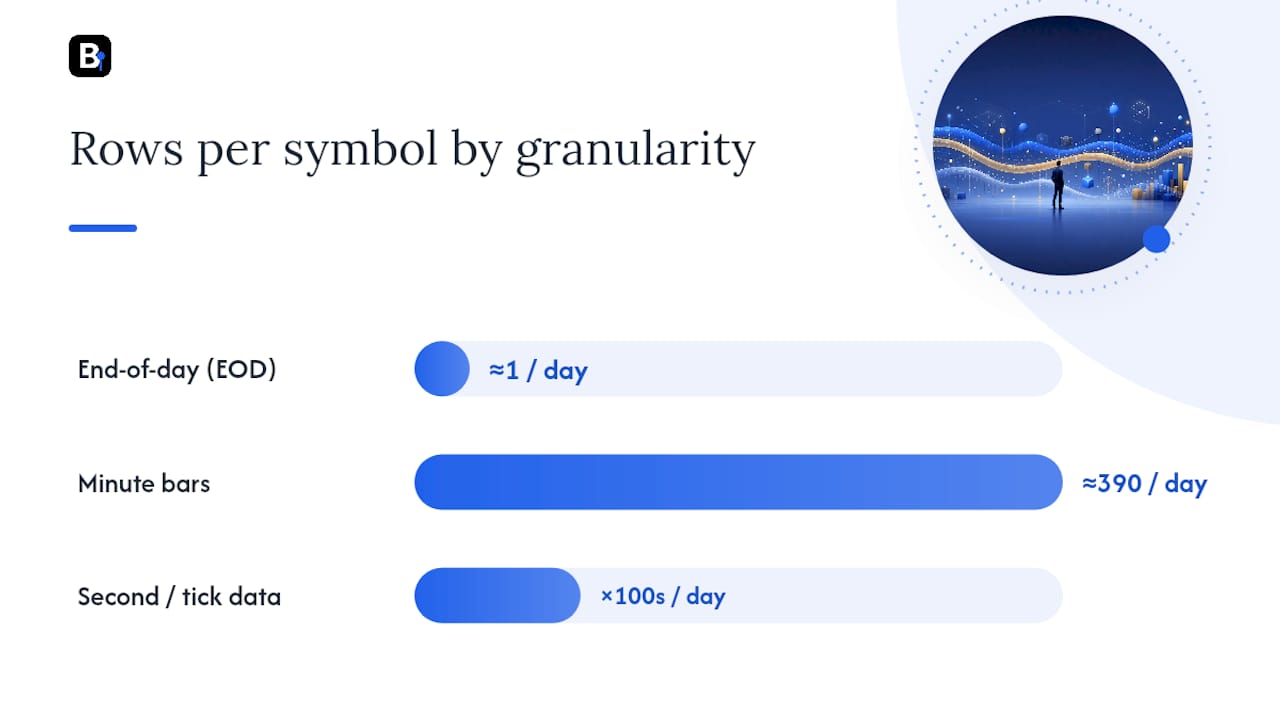
Granularity is the second, and it scales cost almost exponentially. End-of-day (EOD) data is cheap to store and cheap to license because it's a handful of data points per symbol per day. Minute bars multiply that by roughly 390 rows a day for a single US equity session. Second-level and tick data multiply it again, sometimes by a factor of hundreds, because every trade and quote change gets its own record. More rows means more storage, more processing, and, almost always, a steeper license fee.
History length works differently. Some vendors charge a flat rate regardless of how far back you go; others charge per data-month, meaning five years of history literally costs five times what one year costs. Exchange back-history products frequently use this model, and it's worth checking before you assume "historical access" means "unlimited history included."
Then come the licensing slices that catch people off guard:
- Per-user fees that multiply your bill by headcount, even if only one person touches the data
- Professional vs. non-professional classification, where "professional" users (anyone using data for a business purpose, broadly defined) pay multiples of the retail rate
- Redistribution and non-display fees, charged separately if the data feeds a product other people see, not just your own screen
- Delivery and infrastructure costs, including device shipping for exchange-mailed archives, data transfer charges, API throughput tiers, and the labor of cleaning and reformatting raw exchange output into something a backtest engine can actually read
That last item rarely shows up on a price sheet, but it's real. Cleaning and timestamp normalization on raw exchange data can add several developer hours per symbol before the dataset is even usable.
Pro Tip: Before comparing prices across vendors, write down your actual granularity need in one sentence — "5 years of minute bars for 12 forex pairs," for example. Most sticker shock comes from pricing out tick data you never needed in the first place.
Exchange-Level Pricing Examples and What They Actually Mean
Exchange fee schedules are public documents, and reading a few of them tells you more about market-data economics than any vendor's marketing page. They also explain why most individual traders and small teams should never buy directly from an exchange.
NYSE's historical proprietary market data pricing schedule lists recurring access fees ranging from roughly $1,000 to $5,000 a month depending on the product, plus a separate back-history charge often billed per data-content-month, in the neighborhood of $500 per month of historical data requested. That means pulling three years of a NYSE TAQ-style product isn't a flat fee. It's the monthly access charge plus 36 months of back-history billing, and the total climbs fast.
Cboe's LiveVol data exhibits follow a similar structure: ad-hoc historical requests and subscription tiers priced separately, with end-of-day historical tiers running lower than intraday tiers, and academic or trial pricing sometimes available for qualifying users on a Cboe LiveVol fee exhibit. If you've ever wondered why a "sample" from an exchange-adjacent vendor looks so much cheaper than the full product, prorated ad-hoc pricing like this is usually why.
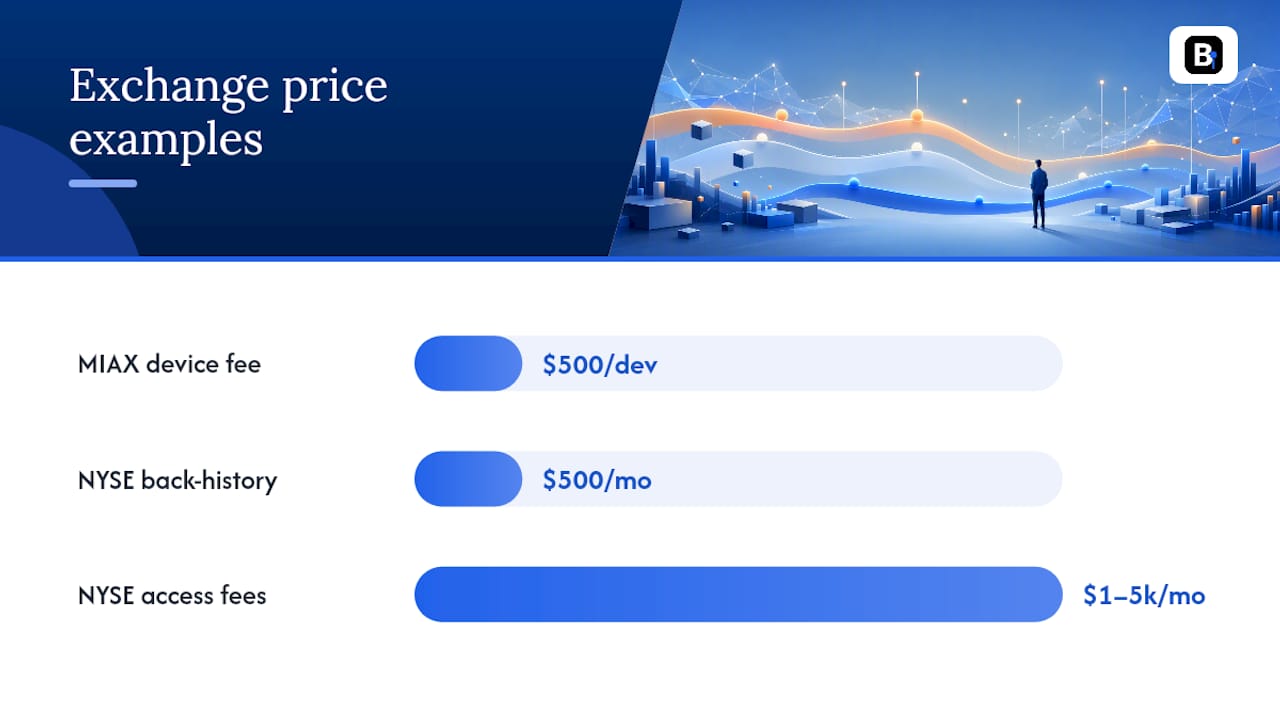
The MIAX Emerald example is the clearest illustration of how exchanges think about historical-data delivery as a physical, device-based service rather than a simple download. A 2020 SEC filing describes a $500 flat fee per device for historical data requests, capped at up to six months of data per device, with delivery on a T+1 basis (the day after the request). That structure exists because someone on the exchange side has to provision a device, load the data, and ship or transfer it. The fee isn't really for the data itself; it's for the labor and hardware behind getting it to you.
A few numbers worth holding onto:
- $500 per device, up to six months of history, T+1 delivery (MIAX Emerald model)
- $500 per data-content-month for NYSE back-history requests, on top of monthly access fees
- $1,000 to $5,000 a month in recurring NYSE access fees, depending on the specific product tier
Here's the practical takeaway: exchange-direct purchasing makes sense almost exclusively for firms that need sub-millisecond accuracy, full order-book depth, or regulatory-grade audit trails. Market data is often the third-largest expense line for financial firms, according to Exegy's analysis of market-data infrastructure costs, and Exegy specifically advises smaller firms to avoid direct exchange feeds unless sub-millisecond trading requires it. For everyone else, that recommendation holds. If you're backtesting a swing strategy on 15 currency pairs, you do not need a NYSE TAQ subscription. You need clean minute bars, and there are far cheaper ways to get them.
Vendor Pricing Models and Realistic Price Bands
Once you step away from exchange-direct pricing, the market opens up into a handful of recognizable billing models. Knowing which one you're looking at helps you predict your real monthly run rate before you commit.
The most common structures are:
- Free or delayed EOD tiers, often with a 15 to 20 minute lag and limited symbol coverage, aimed at casual research rather than production use
- Monthly API subscription tiers, priced by request volume, symbol count, and history depth, typically $30 to $199 plus a month for retail-friendly plans covering multiple years of intraday data
- Pay-per-request or metered API access, where you're billed on usage rather than a flat monthly rate, useful for irregular or bursty workloads
- Flat-file one-time purchases, where you buy a complete historical dataset once and own it outright, no recurring bill
- Enterprise licensing, negotiated case-by-case, usually for firms redistributing data or running high-volume production systems
Marketdata is a good real-world anchor: starter tiers sit near the free end for delayed or limited-history access, while mid tiers offering multiple years of minute-level history land in the $30 to $199-plus range per month. Interactive Brokers takes a different approach entirely, publishing a detailed per-exchange fee matrix where individual feeds can run from a couple of dollars a month up to over a hundred dollars for certain real-time products, with separate rates for professional versus non-professional accounts.
Here's roughly how the bands map to actual use cases, with helpful context for checking live crypto prices:
| Use case | Typical price band | Common model |
|---|---|---|
| Casual research, single market | Free to $30/month | Delayed EOD, limited history |
| Routine backtesting, multiple symbols | $30 to $150/month | API subscription, 2 to 5 years history |
| Professional quant work, cleaned minute bars | $150 to $500/month | Subscription or one-time flat file |
| Tick/TAQ-level, institutional scope | $500 to $5,000+/month | Exchange-direct or enterprise vendor |
The hidden costs live in the multipliers. A plan that looks like $99 a month can become a $400 a month problem once you add 30 more symbols, extend the history window from two years to seven, or blow through the API rate limit during a heavy backtesting run. Storage and compute for tick-level data compounds this further; a single year of tick data for one liquid symbol can run into gigabytes, and cleanup work (bad ticks, gaps, timestamp drift) adds labor cost on top of the vendor invoice.
Before signing anything annual, run a trial month against your actual expected request volume. Vendors size their tiers around average users, and quant backtesting workloads are rarely average. One backtest run across 20 symbols and five years of minute data can burn through a "generous" monthly quota in an afternoon.
How to Budget and Choose the Right Data Source
Treat this as a four-step filter, not a shopping trip:
- Define your granularity and time range first. Decide whether you need EOD, minute bars, or tick data, and how many years back, before you look at a single price page. This one decision eliminates most of the market instantly.
- Estimate your symbol count and request volume. Multiply symbols by years by expected backtest runs to get a realistic sense of what a metered API plan would actually cost you, not what the advertised starting price suggests.
- Choose your delivery format. A one-time flat-file purchase suits a fixed backtest project; an API subscription suits ongoing, evolving research where the data needs to stay current.
- Request a sample file and read the license terms before paying. A reputable vendor will show you real sample data and spell out redistribution limits in plain language, not buried in a PDF exhibit.
Build your budget around these line items, not just the sticker price: one-time back-history fees, monthly access charges, per-user costs if more than one person needs access, API overage charges, storage and compute for larger tick datasets, and the QA time your team will spend cleaning whatever arrives. That last item is easy to forget and often the most expensive one.
Watch for red flags during vendor conversations: no sample file offered, licensing language that avoids stating whether your use case counts as "professional," or no stated policy for correcting bad ticks after delivery. Those gaps tend to surface as surprise fees or bad backtest results later.
Pro Tip: If your project has a fixed scope, run the math on a one-time purchase versus 12 months of subscription fees before deciding. For a five-year, multi-symbol backtest, the one-time dataset almost always wins on total cost, because you're not paying for months you don't need.
Where Backtestmarket Fits Into the Cost Picture
Some vendors sell clean, minute-bar intraday data across forex, metals, stock indices, bonds, and commodities, delivered as one-time downloads ready to import into popular trading platforms. That structure directly targets the two biggest hidden costs covered above: ingest engineering and licensing ambiguity.
Because such data is often available as a one-time purchase rather than a metered subscription, there's no API overage risk and no monthly bill creeping up as your backtest scope grows. Data in a cleaned format can reduce developer hours spent on cleaning raw exchange or vendor flat files. Practical advantages worth weighing:
- No recurring access fee or per-user licensing tier to track
- Ready-to-import format, avoiding some of the timestamp normalization work raw feeds require
- Coverage across multiple asset classes in one purchase, rather than stitching together several vendor accounts
It's worth being direct about fit: this model is built for quant backtesting and strategy development, not for low-latency live trading, where you'd need a real-time feed instead. For that specific job, buying historical intraday data once tends to cost less over a multi-year project than any subscription discussed above.
What I've Learned Negotiating Data Contracts
Vendors expect pushback, and the ones worth working with will give you a short ad-hoc export or sample dataset before you commit to anything larger. Ask for it. If a seller refuses to hand over even a small real sample, that's information in itself.
Write down your intended use before you ever get on a call: research and backtesting, or a production system other people will see. That one sentence protects you from a surprise reclassification into "professional" or "redistribution" pricing months into a contract, which is one of the most common ways a reasonable-looking quote turns into a much larger bill.
Where you have leverage, push for a capped pilot period, thirty or sixty days, priced separately from the full contract. It lets you verify that the data actually imports cleanly and that your cost assumptions about symbol count and request volume hold up against reality, before you're locked into twelve months of a plan sized for someone else's workload.
— Start
Get Clean Minute-Bar Data Without the Recurring Bill
Some providers offer an alternative to exchange subscriptions and metered vendor APIs for anyone building or testing a trading strategy: one payment gets you complete, cleaned minute-bar history instead of a monthly invoice that grows with every symbol you add.
Datasets may cover forex, metals, stock indices, bonds, and commodities, and can be formatted to import into popular trading platforms without the cleanup work raw exchange files usually demand. For strategy developers comparing a $150-a-month API plan against a one-time cost, the math tends to favor the one-time purchase once a project runs past a year or two. If you're weighing vendor tiers against a flat-file option, start by browsing the full product lineup or head straight to the historical data page to see asset coverage and pricing, then check the MetaTrader import guide to see exactly how fast a purchased dataset gets you back to testing.
Sources
- How Market Data Fees Can Inform Your Infrastructure Plans
- HISTORICAL PROPRIETARY MARKET DATA PRICING
- Pricing - Market Data
Recommended
- Minute Bar Data: What Quants Need for Reliable Backtests
- Holiday Gaps in Market Data: A Quant's Handling Guide
- Nasdaq Intraday Data: Access, Specs, and Practical Use
Related resources
Explore BacktestMarket's historical data packs to put the ideas in this article into practice.