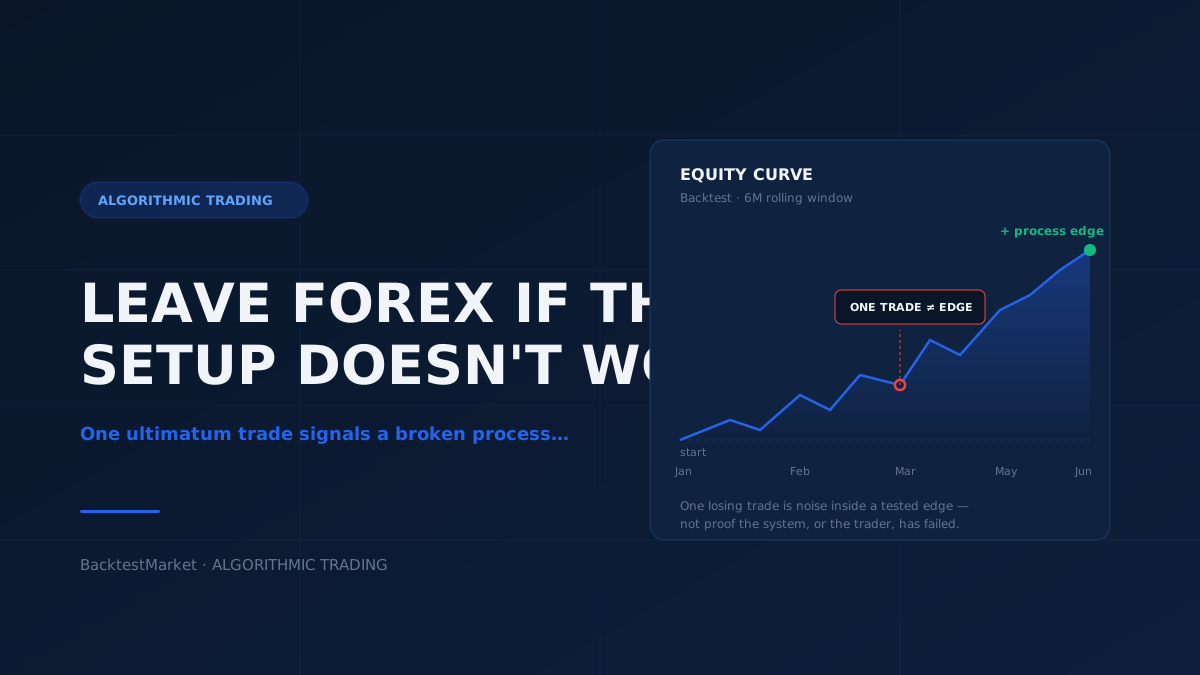
Every trading forum has seen some version of this post: a trader posts a chart, explains a setup they've been watching for weeks, and closes with a line like "if this doesn't work, I'm done with forex." It gets engagement because it's honest — and because a lot of people recognize themselves in it. But if you strip away the emotion, that sentence contains a testable hypothesis buried under a psychological trap. This article is about separating the two.
The Ultimatum Trade Is a Sizing and Process Problem, Not a Strategy Problem
When someone says a single setup will determine whether they stay in the game, they're revealing something about their account, not about the market. No individual trade in a properly sized, statistically validated system should carry that much weight. If one trade can make or break your trading career, one of two things is true:
- Your position sizing is too aggressive relative to your account size and the strategy's historical drawdown profile.
- You don't actually have a strategy with a known edge — you have a hunch, and the "leave forex" framing is your subconscious way of admitting that.
Neither of these is solved by the trade working out. Even if the setup wins, the underlying issue — undersized data, oversized risk, or both — is still there, waiting for the next trade to expose it. This is precisely why backtesting exists as a discipline: it forces you to evaluate a strategy across hundreds or thousands of historical instances instead of betting your conviction on one.
A properly backtested EA doesn't "believe" in a setup emotionally. It executes rules across a dataset, and the resulting equity curve tells you what a large sample of similar setups actually did — including the losers you'd rather not think about right now. If you've never run your current setup through a systematic backtest across multiple years and multiple market regimes, that's the actual gap, not the outcome of this one trade.
What a Real Backtest Would Tell You About "This Setup"
Let's assume the setup in question is a recognizable pattern — a breakout, a moving average cross, a support/resistance bounce, whatever it is. Before treating it as a make-or-break moment, a disciplined approach would ask:
- How many times has this exact setup occurred in the last 3–5 years of data? A handful of anecdotal wins on a live chart is not a sample size. You need dozens, ideally hundreds, of comparable instances across different volatility regimes.
- What was the historical win rate and average risk-to-reward when this setup appeared? Not "it felt like it worked last time" — an actual count of outcomes.
- How did the setup perform during high-impact news windows, low-liquidity sessions, or trending versus ranging conditions? A pattern that works beautifully in a trending market can fail completely in a chop, and vice versa.
- What was the maximum consecutive losing streak historically? If the answer is "five losses in a row happened twice in the last two years," and your current risk sizing can't survive five losses in a row, the setup isn't the problem — your bet sizing is.
This is exactly the kind of question that quality historical data is built to answer. Without a clean, sufficiently long dataset, you're reconstructing history from memory, which is notoriously biased toward the trades you remember — usually the dramatic wins and losses, not the boring, representative middle.
If you're testing on MetaTrader, importing a proper historical dataset rather than relying on your broker's default history (which is often short, gapped, or inconsistent across timeframes) is a foundational step. The guide to importing data in MetaTrader walks through getting clean OHLC data into MT4/MT5 so your backtest results actually reflect market conditions rather than data artifacts.
Why "All or Nothing" Thinking Undermines Statistical Edge
Trading strategies — even genuinely profitable ones — are probabilistic. A system with a real, positive expectancy over a large sample can still lose five, eight, or twelve trades in a row purely due to variance. That's not a flaw in the system; it's how probability distributions behave. The problem is that "all or nothing" thinking treats each trade as a referendum on the entire strategy, when in reality no single trade — or even a short losing streak — tells you much of anything about whether the underlying edge is real.
This is one of the strongest arguments for using systematic, rule-based execution instead of discretionary, emotionally-loaded setups. An Expert Advisor built and backtested on sufficient historical data removes the emotional ultimatum entirely. The EA doesn't "need" this trade to work — it executes the rule set consistently, trade after trade, and your job shifts from hoping to monitoring: watching live performance against backtested expectations, checking for drift, and adjusting position sizing based on realized drawdown versus historical drawdown.
That shift — from "this trade has to work" to "does live performance match the distribution I backtested" — is the single biggest mental and structural upgrade a retail trader can make. It doesn't guarantee profitability (nothing does), but it replaces a fragile emotional dependency on one outcome with an ongoing, falsifiable process you can actually evaluate.
Building a Process That Doesn't Depend on One Trade
If you recognize yourself in the "I'll leave forex if this doesn't work" mindset, here's a more constructive way to spend the next few weeks instead of watching one chart:
Pull multi-year historical data for the pairs you actually trade. Forex price action varies significantly by pair and by era — a EUR/USD dataset from a low-volatility period behaves very differently from one spanning a high-rate environment. Quality forex historical data that covers multiple regimes is the raw material for any test that's going to tell you something useful.
Codify the setup into explicit, mechanical rules. "Price broke resistance and I liked the volume" isn't testable. "Close above the 20-period high with ATR above X and RSI between Y and Z" is. If you can't write the rule down precisely enough for a computer to execute it, you can't backtest it — and if you can't backtest it, you're back to relying on a single trade's outcome as your evidence.
Run the backtest across the full available history, not just the period that matches your current bias. It's tempting to backtest only the last six months because that's when "the setup has been working." A strategy needs to be evaluated across enough time to include losing streaks, low-volatility grinds, and news-driven spikes — otherwise you're just curve-fitting a story to fit your emotional attachment to the trade.
Define your maximum acceptable drawdown before you look at the equity curve. This forces you to size positions based on what your account and psychology can actually survive, rather than backing into a size that "felt right" for this particular trade.
Separate the account you test on from the account you depend on. If your livelihood or trading future genuinely hinges on one setup, that's a sign the position size (or the account size relative to your expenses) needs to change — not a sign that you need this trade to hit.
If you're working across platforms, keep in mind that data and execution assumptions differ between MetaTrader and other platforms like NinjaTrader — spreads, tick data granularity, and session times can all shift your backtest results. The NinjaTrader import guide covers the platform-specific steps if you're testing the same setup across environments to check for consistency.
The Takeaway
The honest version of "I'll leave forex if this setup doesn't work" is usually "I don't have enough evidence that this setup has a real, repeatable edge, and my position size reflects that uncertainty rather than a tested one." That's not a criticism — it's just where most discretionary traders start. The way out isn't a lucky trade; it's converting the setup into explicit rules, testing it against years of real historical data across multiple market conditions, and sizing positions according to what the data — not the hope — actually supports.
Before your next trade becomes an ultimatum, spend an afternoon backtesting the setup properly. If it holds up across a large enough sample, you'll have real evidence to size into it with confidence. If it doesn't, you'll have saved yourself from staking your trading future on a single roll of the dice — and that's a far better outcome either way.