Index trading hours depend on what you trade. A U.S. cash index such as the S&P 500 is calculated only while its stocks trade, from 9:30 a.m. to 4:00 p.m. ET on regular weekdays. Index futures trade almost around the clock, five days a week. Most confusion about index market hours, and most errors in index backtests, come from mixing those two clocks.
This guide gives you the main U.S. session times, shows how they differ from futures sessions, and lists what to verify in your timestamps before you trust a backtest.
TL;DR
- Cash indices update only while their constituent stocks trade. The S&P 500 runs 9:30 a.m. to 4:00 p.m. ET, Monday to Friday.
- Index futures such as E-mini S&P 500 trade nearly 24 hours a day, Sunday evening to Friday afternoon ET, with a short daily break.
- When the cash index is frozen overnight, futures keep repricing. Broker "cash index" quotes outside exchange hours are often derived from futures.
- Holidays, early closes and daylight-saving changes shift session boundaries. Your data's timestamps need to reflect them.
- Before backtesting, confirm the time zone, the session you are testing and the holiday calendar of every instrument.
Table of Contents
- Cash index hours vs. index futures hours
- U.S. stock index session times at a glance
- How the cash open and close link to futures
- Weekends, holidays and early closes
- Time zones and daylight saving
- What to verify before you backtest an index strategy
- Our perspective
- Get index data with the hours already sorted
- FAQ
- Sources
Cash index hours vs. index futures hours
An index is a calculation. A cash index is computed from the prices of its member shares, so it can only move while those shares trade. Cash indices are calculated only while their constituents are trading, whereas index futures trade close to 24 hours across the week and react to overnight news while the cash index stays frozen.
That has three practical consequences:
- The cash index has a gap every night. The last print at 4:00 p.m. ET and the first print the next morning can differ a lot, because news arrives in between.
- Futures lead the open. Futures carry the overnight move, so they show where the cash market is likely to start.
- Liquidity changes with the clock. Index-futures liquidity drops outside stock-exchange hours because index arbitrageurs can no longer trade the underlying stocks. Spreads and slippage are usually worse overnight than during the cash session.
Brokers add a further layer. Cash index instruments offered by brokers are often CFDs that track the cash index during exchange hours and are derived from futures during off-hours, often with daily financing and dividend adjustments built in. So a "US500" chart that moves at 3 a.m. ET is not the S&P 500 cash index. It is a broker's synthetic price. Check your broker's contract specification for the exact hours.
U.S. stock index session times at a glance
U.S. equity indices follow the stock exchanges. Their futures follow the exchange that lists them, which for the major equity index futures is CME Globex.
| Instrument type | Regular session (ET) | Notes |
|---|---|---|
| S&P 500 cash index | 9:30 a.m. to 4:00 p.m., Mon to Fri | Value updates only while constituent stocks trade |
| Dow Jones and Nasdaq cash indices | Follow NYSE and Nasdaq hours | U.S. indexes show a current value only during NYSE trading hours |
| E-mini S&P 500 futures | Sunday to Friday, 6:00 p.m. to 5:00 p.m. ET | Daily trading halt from 4:15 p.m. to 4:30 p.m. ET |
| Stocks, extended hours | As early as 4:00 a.m. to 8:00 p.m. ET | Varies by platform, see below |
The S&P 500 officially opens at 9:30 a.m. ET and closes at 4:00 p.m. ET, while S&P 500 futures trade nearly 24 hours a day, five days a week on CME Globex. That answers one of the most common questions readers ask: the index "opens" at 9:30, but you can trade its futures for roughly 15.5 hours before that.
The 15-minute overlap after the close
The cash index stops at 4:00 p.m. ET, but equity index futures keep trading until 4:15 p.m. ET before the halt. In that window the futures price moves with no cash index to compare against. If your strategy uses both a cash series and a futures series, those 15 minutes are a known source of misalignment.
Extended-hours stock trading
Extended hours affect the shares inside an index, not the index value itself. The NYSE keeps a core session of 9:30 a.m. to 4:00 p.m. ET, with extended sessions starting as early as 4:00 a.m. ET on some platforms and running up to 8:00 p.m. ET. Trades there do not feed the official cash index calculation, so the index does not move on them.
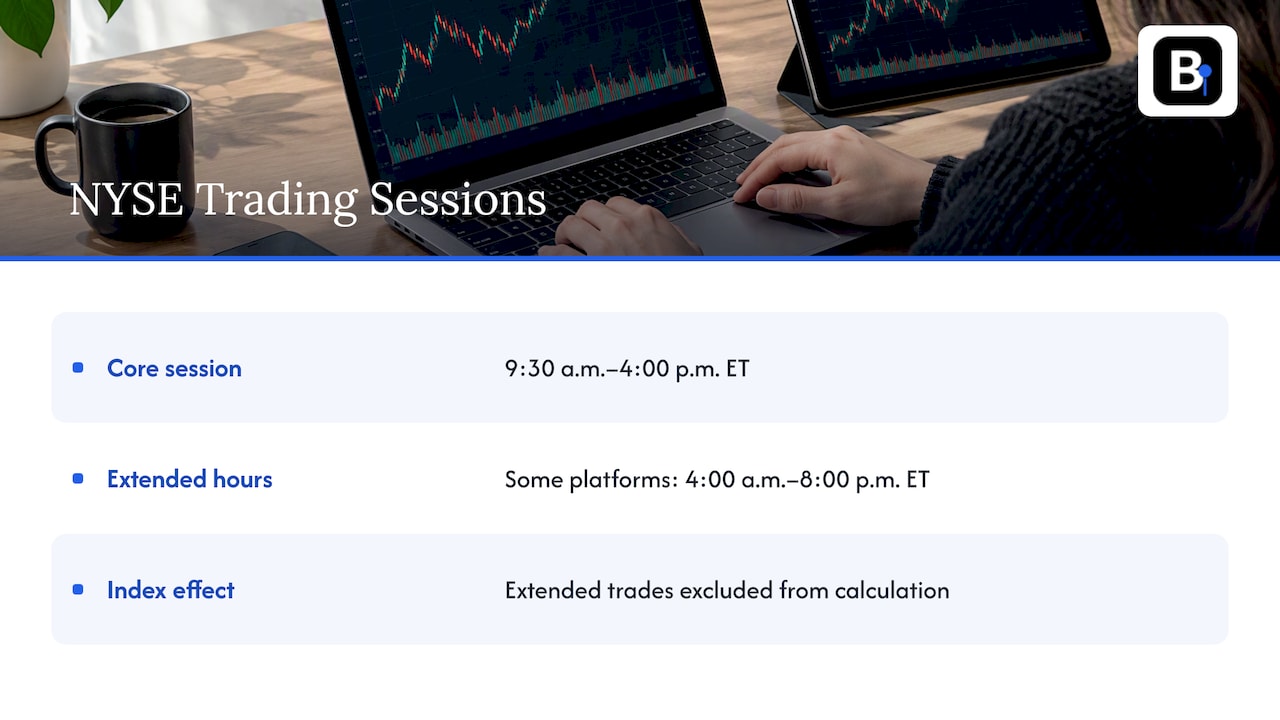
For a detailed rundown of NYSE core and extended sessions, holiday closures and early-close days, see this overview of U.S. stock market hours and holidays.
How the cash open and close link to futures
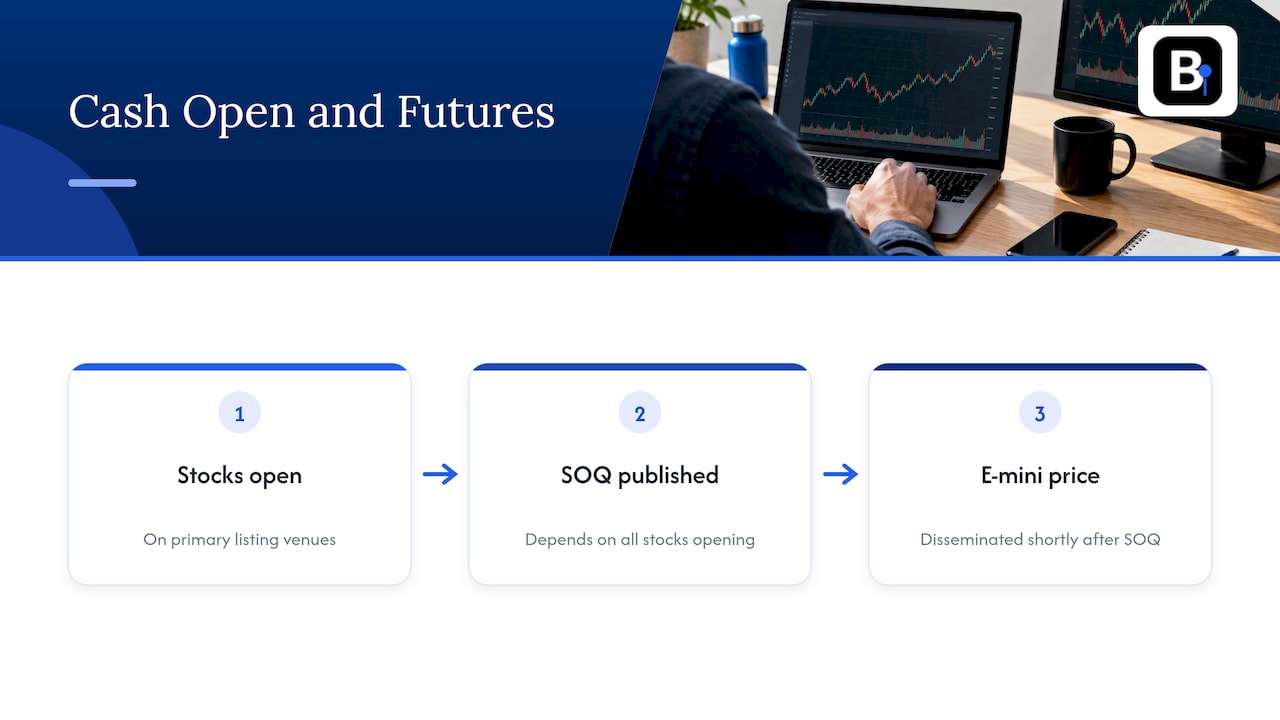
The cash open is not just a clock time. It is a calculation that needs every constituent stock to have opened. CME explains that the final price of E-mini S&P 500 futures is disseminated shortly after the special opening quotation (SOQ) is published, and the SOQ depends on all constituent stocks opening on their primary listing venues. On a day when a few large stocks open late, the official open prints late too.
Two CME mechanisms exist for trading against these official levels. Basis Trade at Index Close (BTIC) and Trade at Cash Open (TACO) let participants trade futures relative to the official closing or opening cash index level, and their sessions can start on the prior business day. You will meet them mostly when reading exchange specifications, but they explain why some futures sessions look longer than the regular Globex window.
Weekends, holidays and early closes
Cash indices stop for weekends and exchange holidays. Futures stop for the weekend too, but their holiday schedules often differ from the stock market's: some futures sessions run with shortened hours on days when stocks are closed, and some do not.
For stocks, the NYSE publishes the official list. NYSE markets observe the listed U.S. holidays and close early at 1:00 p.m. ET on the day after Thanksgiving and on Christmas Eve in 2026. The same page covers later years, so check it each year rather than relying on a remembered list.
For futures, use the exchange's own holiday schedule for each product. Never assume that "stocks closed" means "futures closed". Commercial calendar services also track market holidays, partial sessions and unplanned closures, and thousands of markets in over 100 countries with historic and projected hours and auction times. They are handy if you work across many exchanges.
Time zones and daylight saving
Session times are quoted in local exchange time, usually ET for U.S. stocks and ET or Central Time for CME products. Two things then go wrong.
- Daylight saving changes the offset to UTC. The NYSE cash open is 9:30 a.m. local all year, but in UTC it moves by an hour when the U.S. clocks change. Europe and the U.S. change on different dates, so for a few weeks each year the gap between London and New York sessions is one hour different from normal.
- Data vendors stamp bars in different time zones. Some use UTC, some use exchange time, some use a server time offset such as the one MT4 and MT5 brokers set. Mixing them shifts every bar.
Trading-hours data providers handle this by including time-zone conversions and daylight-saving changes in their schedules. For the same issue on the currency side, see our guide to forex session times, overlaps and DST shifts.
What to verify before you backtest an index strategy
A backtest is only as honest as its clock. Run this checklist before you trust any result.
- Which instrument did you actually test? A cash index, a futures contract, a continuous back-adjusted futures series and a broker CFD all have different hours and different gaps.
- What time zone are the timestamps in? Confirm it, and confirm how it behaves across the two daylight-saving changes per year.
- Which session are you trading? Decide whether your rules apply to the regular session only or to the full 23-hour futures day. Filter bars explicitly instead of assuming.
- How are the overnight gap and the daily break handled? Your stops, indicators and "previous close" logic should know whether the previous close is 4:00 p.m. cash or 5:00 p.m. futures.
- Are holidays and early closes in the data? Half days at 1:00 p.m. ET produce short, thin sessions. A strategy that expects a full day of bars can misbehave on them.
- Do extended-hours prints belong in your data? NYSE distinguishes prior-day, pre-SIP, pre-core, core and post-close trading, which have different SIP reporting practices, and extended-hours trades are flagged by message types in data feeds. If you build bars from tick data, decide deliberately which of those to include.
- Is the data clean? A single bad tick at the open can trigger a fake signal. Our write-up on a three-condition spike test for intraday data shows one way to catch them.
A worked example
Suppose your rule is "buy if the first five-minute bar after the open closes above the prior day's close." On cash index data, the first bar starts at 9:30 a.m. ET and the prior close is the 4:00 p.m. value. On futures data in UTC, the 9:30 a.m. ET bar sits at 14:30 UTC in winter and 13:30 UTC in summer. If you hard-code 14:30 UTC, your test is wrong for roughly eight months of each year. And if the "prior close" is the 5:00 p.m. futures settlement window instead, the gap logic changes completely. Same words, three different strategies.
Our perspective
Most index backtests we see fail on the calendar, not on the strategy. The signal logic is fine. The bars are stamped in a time zone nobody wrote down, the holiday half days are missing, or a bad tick sits at the open.
That is why we focus on clean minute-bar data, built bar by bar with the adjustments documented. When the person who collects the data also answers your questions, a question like "which session does this series cover?" gets a precise answer.
Our data sets are designed to import straight into MT4 and MT5, so you spend your time testing ideas, not repairing timestamps. The standard we hold ourselves to applies to human-built and AI-driven backtests alike: if the clock is wrong, every result downstream is wrong too.
Start
Get index data with the hours already sorted
If you would rather test than clean, our INDICES SuperPack bundles minute-bar index data sets in one download, ready to import into MT4 and MT5. You can also browse every historical data set or look at the Annual Plan, listed at €119 per year.
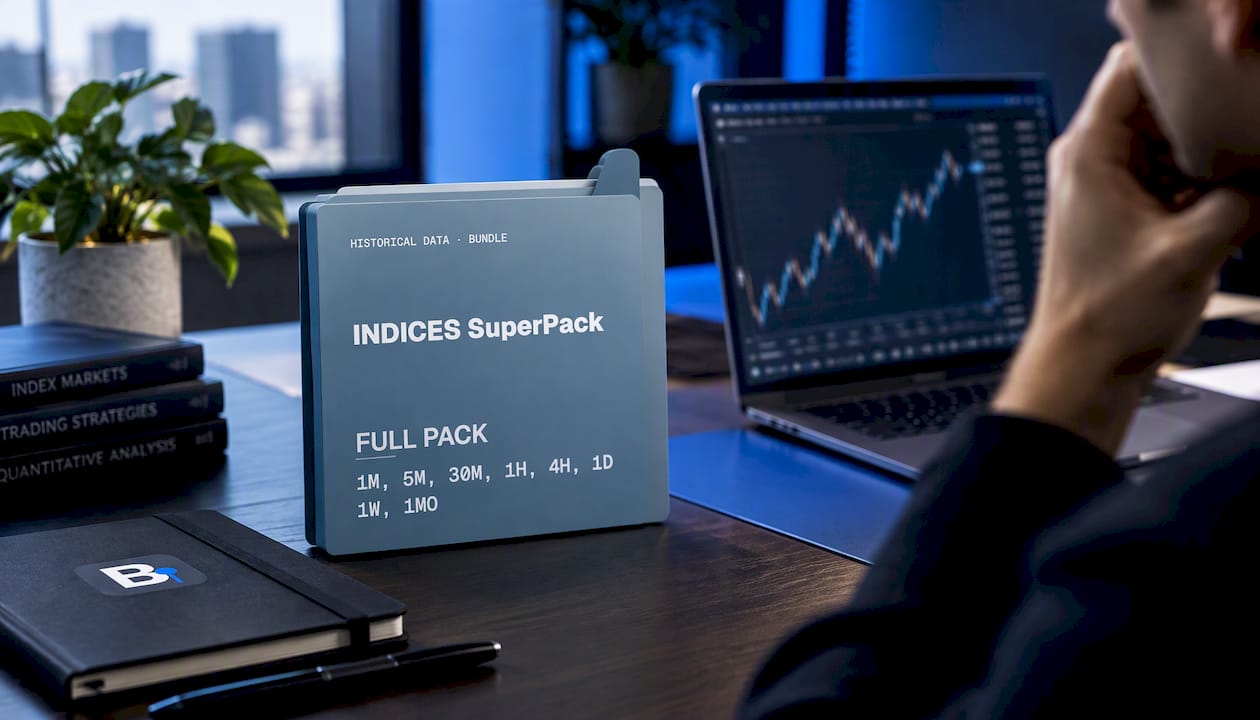
Each data set is maintained for direct compatibility with MT4 and MT5, and our engineers answer support questions directly.
FAQ
What time does the S&P 500 index open?
The S&P 500 cash index opens at 9:30 a.m. ET and closes at 4:00 p.m. ET, Monday to Friday. Its futures trade almost around the clock on CME Globex, so you can trade S&P exposure well before the index officially opens.
Why does my broker's index chart move when the stock market is closed?
Because it is usually not the cash index. Brokers often offer CFDs that track the cash index during exchange hours and are derived from futures outside them. Check the contract specification for the exact hours and any financing or dividend adjustments.
Are index futures hours the same as stock market hours?
No. Equity index futures on CME Globex run from Sunday 6:00 p.m. ET to Friday 5:00 p.m. ET, with a daily halt from 4:15 p.m. to 4:30 p.m. ET. Stocks have a 9:30 a.m. to 4:00 p.m. ET core session, plus extended hours that vary by platform.
Do early closes affect index data?
Yes. NYSE closes at 1:00 p.m. ET on the day after Thanksgiving and on Christmas Eve in 2026, so those days have shorter sessions with fewer bars. Make sure your backtest calendar includes them, and check the NYSE page each year for the current list.
Sources
- Index trading hours, Alpari Academy
- How to Use Index Futures, Investopedia
- Using futures as an indicator, Fidelity
- CME Group E-mini S&P 500, MarketsWiki
- Understanding the SPX Cash Index and S&P Futures, e-futures
- Holidays & Trading Hours, NYSE
- Trade at Cash Open (TACO) FAQ, CME Group
- Night Moves: What Trades and When in the Overnight Market, NYSE Data Insights
- Market Calendar API, TradingHours
- Trading Hours, Swaps Monitor
Recommended
- Forex Session Times: Hours, Overlaps and DST Shifts
- Nasdaq Intraday Data: Access, Specs, and Practical Use
- Forex World main Sessions Indicator
Related resources
Explore BacktestMarket's historical data packs to put the ideas in this article into practice.