

For live execution, use licensed exchange feeds from CME, LME, or ICE, or a vendor that redistributes them with proper timestamps. For backtesting, use cleaned, back-adjusted minute-bar historical datasets, since raw exchange dumps rarely arrive analysis-ready. Most traders should start there: real-time feeds for orders, audited historical bars (Various vendors publish these) for research.
TL;DR:
- Real-time exchange data for live trading requires licensed feeds with low latency and proper timestamps, while backtest data should be cleaned, back-adjusted minute bars for accuracy.
- Public LME pages are delayed by 15 minutes and are unsuitable for execution, whereas LMElive or licensed vendors provide true real-time prices at a higher cost.
- Vendor APIs vary widely in data delivery, with tick streams suitable for live monitoring and aggregated bars better for backtesting, while synthetic prices do not reflect actual market depth.
- For backtesting, minute bars are generally sufficient, but it is crucial to verify timestamp accuracy, contract roll handling, and data gaps through sample downloads before use.
- Exchange licensing restricts redistribution, so traders should review licensing terms carefully and avoid relying on vendor data for publicly shared signals without proper agreements.
Table of Contents
- What Do CME, LME, And ICE Actually Publish?
- How Do Vendor APIs And Aggregators Compare?
- Tick Data Or Minute Bars: Which Fidelity Do You Need?
- Choosing A Source: Execution Versus Backtesting Checklist
- Why Backtestmarket's Minute-Bar Data Solves Backtest Integrity Problems
- What Alternative Data Should Metals Traders Watch?
- How Do You Clean And Normalize Metals Intraday Data?
- Are There Legal Limits On Using Or Sharing Metals Data?
- What Working With Metals Data Actually Looks Like Day To Day
- Get Clean Metals History Without the Vendor Runaround
- Where To Verify These Sources Directly
- Sources
- FAQ
What Do CME, LME, And ICE Actually Publish?
CME Group runs COMEX, home to gold and silver futures, and distributes data through its Market Data Platform (MDP) with multiple latency and depth tiers depending on subscription level. Historical tick and bar data is available directly from CME or through licensed redistributors like Databento, which sources futures data straight from CME and ICE and packages it for programmatic use.
The London Metal Exchange handles most of the world's industrial metals trading and has its own quirk worth knowing before you build anything around it.
Data point: LME's public price and trade pages are commonly 15 minutes delayed, with true real-time access available through LMElive or licensed vendor networks.
That delay catches new traders off guard constantly. Someone builds a dashboard off the free LME.com pages, assumes it's live, and wonders why their fills don't match what they saw on screen.
- LME's contract structure uses prompt dates rather than standard monthly expiries, which changes how you build continuous series.
- ICE and other regional venues (Shanghai Futures Exchange, Multi Commodity Exchange in India) each define contracts differently, so symbol mapping matters more than most vendor documentation admits.
- Redistribution licenses are often the expensive part, not the data itself, and exchange licensing terms frequently cost more than the vendor subscription wrapped around them.
If you need genuinely live LME prices for execution, budget for LMElive or a vendor pass-through. If you just need daily settlement context, the delayed public pages are free and fine.
How Do Vendor APIs And Aggregators Compare?
Commercial APIs vary enormously in what they actually deliver, and the marketing copy rarely tells you which category you're getting. Metals-API is a good example of the mid-tier vendor model: it documents intraday endpoints, bid and ask data, historical LME and LBMA series, and rate limits tied to subscription tier, which gives you a concrete sense of what to expect before you sign anything.
- WebSocket tick streams push every trade or quote change as it happens, ideal for live monitoring or algo triggers.
- REST historical bars return aggregated OHLC data on request, better suited to backtesting pipelines than live decisioning.
- Top-of-book (L1) feeds show the best bid and ask only, not full market depth.
- Symbol catalogs vary wildly between vendors, so gold might be
XAUUSD,GC, orGOLDdepending on the provider.
Here's the distinction that trips up more quants than anything else: a synthetic reference price, blended from several venues to produce a smooth composite, is genuinely useful for dashboards and alerting but is not equivalent to executable market depth. If your strategy needs to know exactly what was available to trade at a given microsecond, a synthetic feed will lie to you convincingly.
Pro Tip: Before committing to any vendor, pull a sample API key and download one trading day in both raw tick and aggregated bar form. Check the timestamp field format, confirm whether it reflects exchange time or ingest time, and count the bars against expected session length. A missing hour of data during a session you assumed was continuous is the kind of thing that only shows up when you actually look.
Enterprise players like Bloomberg and S&P Global sit at the top of this spectrum, bundling terminal access, analytics, and compliance-grade data delivery, usually at a price point built for institutional desks rather than independent quants.
Tick Data Or Minute Bars: Which Fidelity Do You Need?
The format you choose has downstream consequences for storage, backtest speed, and how faithfully your simulation reflects real trading conditions.
- Tick data captures every trade and quote update, giving maximum fidelity but generating enormous file sizes. A year of tick data for one gold contract can run into tens of gigabytes.
- Minute bars compress that into open, high, low, close, and volume per minute, dramatically cutting storage while preserving enough granularity for most swing and intraday strategies.
- Timestamp hygiene matters more than people expect: check whether timestamps are in epoch milliseconds or seconds, whether they reflect the source exchange or the vendor's ingest time, and whether daylight saving transitions are normalized consistently across your dataset.
- Contract rolls need documented logic. Undocumented or opaque back-adjustment methods introduce bias into continuous futures series that can quietly wreck a backtest's win rate without ever throwing an error.
- Latency differs by delivery method: WebSocket ticks typically arrive in milliseconds, REST polling introduces request overhead, and vendor SLAs should specify both average and worst-case delivery times.
For most backtesting work, clean minute bars strike the right balance. Reserve tick-level analysis for microstructure research or execution-cost modeling, where the extra detail actually earns its storage cost.
Choosing A Source: Execution Versus Backtesting Checklist
The mistake that costs traders the most money isn't picking a bad vendor. It's picking the right vendor for the wrong job.
- Confirm freshness and latency match your use case: live orders need milliseconds, research needs completeness.
- Check continuity: request a full month, not a sample day, and scan for silent gaps around holidays or contract rolls.
- Demand documented roll and back-adjustment methods in writing, not a vague "we handle it."
- Ask for sample data before purchase. Any vendor unwilling to provide a test file is telling you something.
- Review licensing terms for redistribution rights if you plan to share signals or run a fund.
Pro Tip: Pair a low-latency execution feed with a separately sourced, reconciled historical dataset rather than assuming your broker's historical export is backtest-grade. Broker terminals are built for trading, not data integrity audits, and their historical downloads often silently drop bars during thin liquidity windows.
Red flags worth walking away from: no sample data offered, ambiguous timezone handling, and adjustment methodology described only in marketing language rather than technical documentation. If a provider can't tell you exactly how they handle a futures roll, assume they don't handle it well.
Why Backtestmarket's Minute-Bar Data Solves Backtest Integrity Problems
Some vendors publish comprehensive clean minute-bar historical intraday data across forex, metals, bonds, and stock indices since 2014; it is built specifically for the kind of reconciliation checks described above.
- Datasets arrive in a format that supports import into MT4 and MT5, cutting out the formatting work that eats hours before a single backtest even runs.
- Adjustments and timestamp handling are described as documented and consistent across the full dataset rather than patched together from mismatched vendor exports.
- Support is provided by knowledgeable staff familiar with the data, not a generic help desk reading from a script.
Traders evaluating a new minute bar data source generally run the same checks recommended above: sample days, timestamp fields, and gap counts. A vendor's positioning often rests on passing that exact audit, since the value of a backtest depends entirely on whether the input data reflects what actually happened in the market.
What Alternative Data Should Metals Traders Watch?
Price data tells you what happened. Macro and sentiment sources help explain why, and metals markets react harder to macro headlines than most asset classes.
Gold and silver move on real yield expectations, dollar strength, and central bank buying, so tracking the CFTC Commitments of Traders report gives you positioning context that pure price data never will. It shows how commercial hedgers and speculators are leaning in aggregated futures positions, published weekly and widely used as a contrarian indicator when speculative positioning gets stretched.
Industrial metals like copper and aluminum respond more to manufacturing data, China trade figures, and inventory reports from LME-registered warehouses. A sudden drawdown in warehouse stocks often moves copper before any price feed catches up.
News and analyst commentary matter too, but treat them as context rather than a trading signal. A Fastmarkets price assessment, for instance, follows IOSCO-compliant methodology specifically designed to reduce the kind of noise that ad hoc news coverage introduces. That distinction between an assessed, methodology-backed price and a headline-driven estimate is worth understanding before you build any signal around either one.
Layer these sources rather than picking one: positioning data for medium-term bias, macro releases for event risk, and warehouse or inventory reports for industrial metals specifically.
How Do You Clean And Normalize Metals Intraday Data?
Raw metals data arrives messier than most traders expect, and normalization is where a surprising number of backtests quietly go wrong.
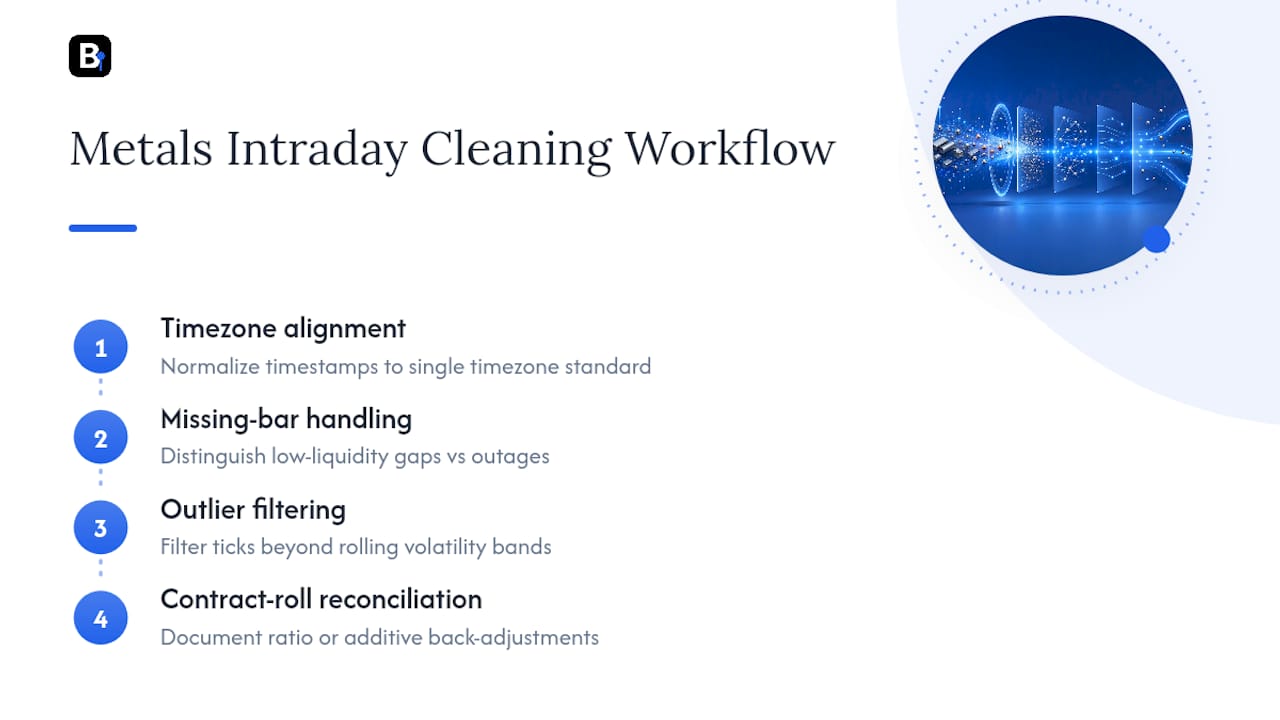
Start with timezone alignment. Metals trade nearly around the clock across Asian, European, and American sessions, and a dataset that mixes UTC timestamps with exchange-local ones will misalign your session boundaries without any obvious error message. Normalize everything to a single timezone standard before you touch the strategy code.
Next, handle missing bars deliberately rather than letting your backtest engine silently forward-fill or skip them. A gap during a legitimate low-liquidity window (Asian lunch hour on COMEX gold, for example) is different from a gap caused by a data outage, and treating them the same way corrupts volatility calculations.
Outlier detection matters more for metals than equities because thin overnight liquidity can produce a single erroneous tick that spikes far outside the real range. A basic filter comparing each bar against a rolling volatility band catches most of these before they contaminate a backtest.
Finally, reconcile contract rolls explicitly. If you're building a continuous gold futures series, decide on and document your back-adjustment method (ratio or additive) rather than accepting whatever a vendor applies by default, since undocumented roll logic is one of the most common sources of invisible backtest bias.
Are There Legal Limits On Using Or Sharing Metals Data?
Exchange data licensing governs far more than most independent traders realize, and the restrictions typically apply to redistribution, not personal use.
If you're pulling data for your own strategy research, most licenses covering vendor subscriptions permit that outright. The restrictions tighten sharply once you redistribute: publishing a live price feed on a website, sharing raw tick data with clients, or running a signal service off licensed exchange data usually requires a separate redistribution agreement with the exchange, and exchange licensing terms are often the more expensive line item compared to the vendor's own subscription fee.
Vendors typically bundle exchange licensing into their pricing, which is part of why prices vary so much between providers offering what looks like the same data. Always read the redistribution clause in a vendor's terms of service before you build a product around their feed, not after.
Regulatory bodies also matter for compliance context beyond licensing. The CFTC's Commitments of Traders program is a public, freely usable regulatory dataset, which is a useful contrast: not every data source carries the same commercial restrictions, and knowing which category a given source falls into avoids an expensive mistake down the line.
What Working With Metals Data Actually Looks Like Day To Day
Most functioning setups stack three layers: an exchange or vendor feed for execution, a broader aggregator for monitoring across instruments, and a separately sourced, cleaned minute-bar history for backtesting. Treating those as interchangeable is where strategies quietly break. Before scaling anything, reconcile a handful of sample days against a second source and only then trust the pipeline. Synthetic reference prices are fine for a dashboard alert. They are not what you want sitting underneath a live execution decision.
— Start
Get Clean Metals History Without the Vendor Runaround
Some vendors offer a clean, ready-to-import minute-bar dataset as an alternative to stitching together mismatched exchange exports and undocumented vendor adjustments: one dataset instead of weeks spent reconciling timestamps yourself.

If gold is your focus, the BND XAUUSD - Gold Cash dataset gives you a ready-to-import cash series built for exactly the reconciliation checks covered above. Browse the full range of metals, forex, and index datasets on the historical data page, or pair a one-time dataset purchase with the Annual Plan offering ongoing access and support. Every file imports directly into MT4 and MT5, and requesting a sample before you buy is the same first step recommended throughout this guide: pull a day of data, check the timestamps, and confirm continuity before committing to the full history.
Where To Verify These Sources Directly
For primary documentation, start with LME's reports and data page for intraday licensing and LMElive access, Metals-API's documentation for sample endpoints and rate limits, and the CFTC Commitments of Traders portal for positioning data. MetalCharts also maintains a running list of exchange and vendor references worth bookmarking.
Sources
Every metals data source falls into one of four buckets, and picking the wrong one for the job is the single most common mistake traders make when they start building or testing a strategy.
- Reports and data | London Metal Exchange
- Metals-API
- Commodity futures data and APIs - Databento
- CFTC Commitments of Traders
Live trading demands low latency and executable depth. Backtesting demands continuity, documented adjustments, and no silent gaps. Conflating the two is how strategies that look great in simulation fall apart in production.
FAQ
How Do I Get CME Data For Free?
CME's public delayed quotes and end-of-day summaries are available at no cost through its market data pages, but true real-time and historical tick data require a subscription or a licensed vendor pass-through. Free access almost always means delayed data, not live execution-grade feeds.
Is There A Free API For Futures Data?
Some vendors offer limited free tiers with restricted rate limits or delayed data, and Metals-API is one example that documents its free-tier limits alongside paid plans. Fully free, unrestricted real-time futures APIs are rare because exchanges charge licensing fees that vendors have to recover somewhere.
Is There A Free API For Historical Stock Data?
Several vendors provide limited free access to historical bars, though depth, history length, and rate limits are usually capped compared to paid tiers. For backtesting work that requires validated continuity and documented adjustments, a purpose-built historical dataset tends to save more time than assembling free API calls yourself.
What Does BacktestMarket's Historical Data Cost?
Backtestmarket sells one-time historical datasets, including metals bundles, with pricing available directly on the historical data page. An Annual Plan is also available for €119 per year for readers who want ongoing access alongside their dataset purchase.
Recommended
- Minute Bar Data: What Quants Need for Reliable Backtests
- Nasdaq Intraday Data: Access, Specs, and Practical Use
- Holiday Gaps in Market Data: A Quant's Handling Guide
- 5 Audits Quants Must Run on Outlier Handled M1 Data Before MT4/MT5
Related resources
Explore BacktestMarket's historical data packs to put the ideas in this article into practice.