

Minute bar data (also called M1 data) is OHLCV price information sampled once every 60 seconds: a timestamp in UTC, plus open, high, low, close, and volume for that window. It's the standard resolution for intraday strategy development because it's granular enough to model entries and exits realistically, without the storage and noise problems that raw tick data brings.
For reproducible backtests, skip patchwork sources. Use an exchange-sourced or professionally cleaned full historical pack, such as Backtestmarket's HISTORICAL DATA COMPLETE PACK, where the schema, adjustments, and timezone handling are already documented.
Before committing to a purchase:
- Pull a sample file and check the column headers match your ingestion script
- Confirm the timestamp column is UTC, not a broker's local server time
- Verify the file imports cleanly into MT4/MT5 or your Python pipeline without reformatting
Key Takeaways
Reproducible backtests depend on minute bar data with a documented UTC timestamp, verified adjustments, and a schema you've tested against a sample before buying.
| Point | Details |
|---|---|
| Confirm the schema | Check timestamp (UTC), OHLCV columns, and optional fields like bid/ask before ingestion. |
| Match depth to hypothesis | Use a dataset whose historical range actually covers the market regimes your strategy needs to survive. |
| Run validation checks first | Test for gaps, duplicate timestamps, zero-volume bars, and adjustment accuracy before trusting any results. |
| Prefer columnar formats at scale | Parquet cuts I/O overhead significantly versus CSV for multi-year minute-bar backtests. |
| Choose a supported, import-ready pack | Backtestmarket's HISTORICAL DATA COMPLETE PACK offers MT4/MT5-ready minute bars with back-adjusted futures and engineer support. |
Table of Contents
- What Standard Fields and Resolutions Look Like in Minute Bar Data
- Where Minute Bar Data Actually Comes From
- How Minute Bar Datasets Get Delivered to You
- The Data Quality Checks Every Quant Should Run First
- How to Choose the Right Minute Bar Dataset for Your Backtest
- What Backtestmarket Brings to Minute Bar Data Analysis
- Why Data Cleanliness Changes What a Backtest Actually Tells You
- Get the Complete Historical Minute Bar Data Pack
- Frequently Asked Questions
- Sources
What Standard Fields and Resolutions Look Like in Minute Bar Data
A clean M1 record has six required columns: timestamp, open, high, low, close, and volume. Some vendors add optional fields like bid/ask (useful for spread-sensitive forex strategies) or tick_count (a rough proxy for liquidity within that minute). The timestamp should always be UTC. Mixing local exchange time with UTC across instruments is one of the most common causes of silent lookahead bias in backtests.
Resolution matters as much as the fields themselves. Most datasets are offered at:
- 1 minute (M1): the base resolution most quant workflows resample from
- 5 minute and 15 minute: aggregated bars for lower-frequency signals
- Tick data: the rawest form, used to build custom bar types (volume bars, dollar bars)
Watch how a provider handles session boundaries. Some bin data into regular trading hours only; others deliver full 24-hour bars for forex and futures. A typical CSV or Parquet row looks like 2026-01-15 09:31:00,1.0842,1.0845,1.0839,1.0841,312, and confirming that structure against a sample before buying saves hours of ingestion debugging later.
Where Minute Bar Data Actually Comes From
Provenance determines whether your backtest results will hold up outside the sample period. Exchange-provided feeds, like consolidated TAQ for US equities, are the gold standard for completeness and timestamp accuracy, but they're expensive and require licensing to redistribute. Aggregated sources fill the gap. Dukascopy tick data, for example, is widely repackaged into 1-minute OHLCV for forex research and is a common backbone for EURUSD M1 data and other major pairs.
Historical depth varies sharply by instrument class:
- Equities: minute data is often available back 10 to 20 years, but requires split and dividend adjustment to be usable
- Futures: back-adjusted continuous contracts are standard practice, since raw front-month data creates artificial price gaps at rollover
- Forex: tick aggregates (like XAUUSD minute data or EURUSD minute data) commonly extend a decade or more, since there are no corporate actions to adjust for
A publicly distributed Forex 1-Minute OHLCV dataset covering 2018 through 2026 cites Dukascopy as its tick source and follows the same minute-candle schema most commercial vendors use. That consistency is worth checking for: if a paid dataset's schema doesn't match the conventions you'd find in a public reference set, ask the vendor why before you buy.
Pro Tip: Ask any vendor exactly how they handle back-adjustment for futures and whether split/dividend adjustments are baked into the historical prices or applied separately. If they can't answer specifically, treat that as a red flag.
How Minute Bar Datasets Get Delivered to You
Delivery method affects how fast you can start testing. Bulk downloads (a zipped folder of CSVs) are the simplest and most common option for one-time purchases. Cloud buckets like S3 suit teams pulling large datasets programmatically. APIs work best for ongoing, incremental updates rather than deep historical backfills. Most reputable vendors, including public repositories like HistData-style archives, also offer sample downloads so you can test ingestion before paying for anything.
File format is where a lot of quants leave performance on the table:
- CSV: universally readable, but slow to parse at scale and bulky in storage
- Parquet: columnar, compressed, and dramatically faster for multi-year backtests run in pandas or Polars
- MT4/MT5 formats: pre-packaged .hst or .csv files built for direct import into MetaTrader, skipping manual reformatting entirely
If your backtest environment is MetaTrader, look for a provider offering MT4/MT5-ready packages rather than raw CSVs you'd otherwise convert by hand. Backtestmarket's step-by-step import guide walks through exactly that process.
The Data Quality Checks Every Quant Should Run First
A dataset can look complete and still quietly corrupt your results. Run these checks before trusting any minute bar file:
- Continuity check. Scan for missing minutes and duplicate timestamps. A dataset with unexplained gaps during active trading hours will distort any strategy relying on continuous price action.
- Value sanity check. Flag price spikes that exceed a reasonable multiple of the surrounding bars, and flag zero-volume bars, which often signal a feed outage rather than real market inactivity.
- Adjustment verification. For equities, confirm split and dividend adjustments were applied by spot-checking a known historical split date. For futures, verify the back-adjustment methodology doesn't introduce negative prices in older contracts, a common bug in poorly built continuous series.
- Row-count audit. Compare row counts per trading day against the expected count (390 one-minute bars for a standard US equity session, for instance) to catch partial-day gaps.
- Visual spot-check. Plot a few random weeks as a minute bar chart. Patterns that look mechanically repetitive or oddly smoothed usually indicate synthetic or improperly resampled data.
Authoritative sources like FRED's published time series are a useful reference point for how documented, stable timestamp conventions should look. Minute bar data deserves the same rigor, just at much higher frequency.
How to Choose the Right Minute Bar Dataset for Your Backtest
Match historical depth to your hypothesis, not the other way around. If your strategy needs to be tested across multiple market regimes, a dataset that only goes back three years won't tell you anything about how it behaves in a different rate environment or volatility cycle. Never retrofit a short history to a long-horizon question.
A few decision rules that hold up across asset classes:
- Favor full-day, exchange-sourced or professionally cleaned packs over patchwork free data when reproducibility matters
- Check file format and import tooling against your actual stack before buying, not after
- Read the licensing terms if you plan to redistribute results or share data with a team
- Confirm what support looks like if you hit a data issue mid-project. An engineer who can answer a specific schema question beats a support ticket queue
Public repositories and community datasets, including the HistData-style archives referenced earlier, are genuinely useful for testing your ingestion pipeline for free. They tend to fall short on enterprise-grade cleaning and corporate-action handling, which is where a paid, professionally maintained pack earns its cost for anything you intend to trade real capital against.
What Backtestmarket Brings to Minute Bar Data Analysis
Backtestmarket has built minute-bar historical datasets since 2014, covering forex, metals, stock indices, bonds, and commodities. The offering is built around a few specific commitments:
- Clean, continuous minute-bar coverage with documented gap handling
- MT4/MT5-ready downloads that import without reformatting
- Back-adjusted futures data, so continuous contracts don't carry rollover artifacts
- Direct support from engineers, not a generic ticket system
A dataset that imports cleanly on the first try and holds up under a row-count audit is the difference between a backtest you can trust and one you have to re-run three times before you believe the numbers.
New customers can preview format samples before buying, and the company's main product catalog outlines exactly which instrument bundles are available.
Why Data Cleanliness Changes What a Backtest Actually Tells You
A strategy that looked profitable on noisy, gap-filled minute data collapsed the moment I reran it on a cleaned pack. Same logic, same period. Reproducibility isn't a nice extra. It's the whole point of testing in the first place.
Get the Complete Historical Minute Bar Data Pack
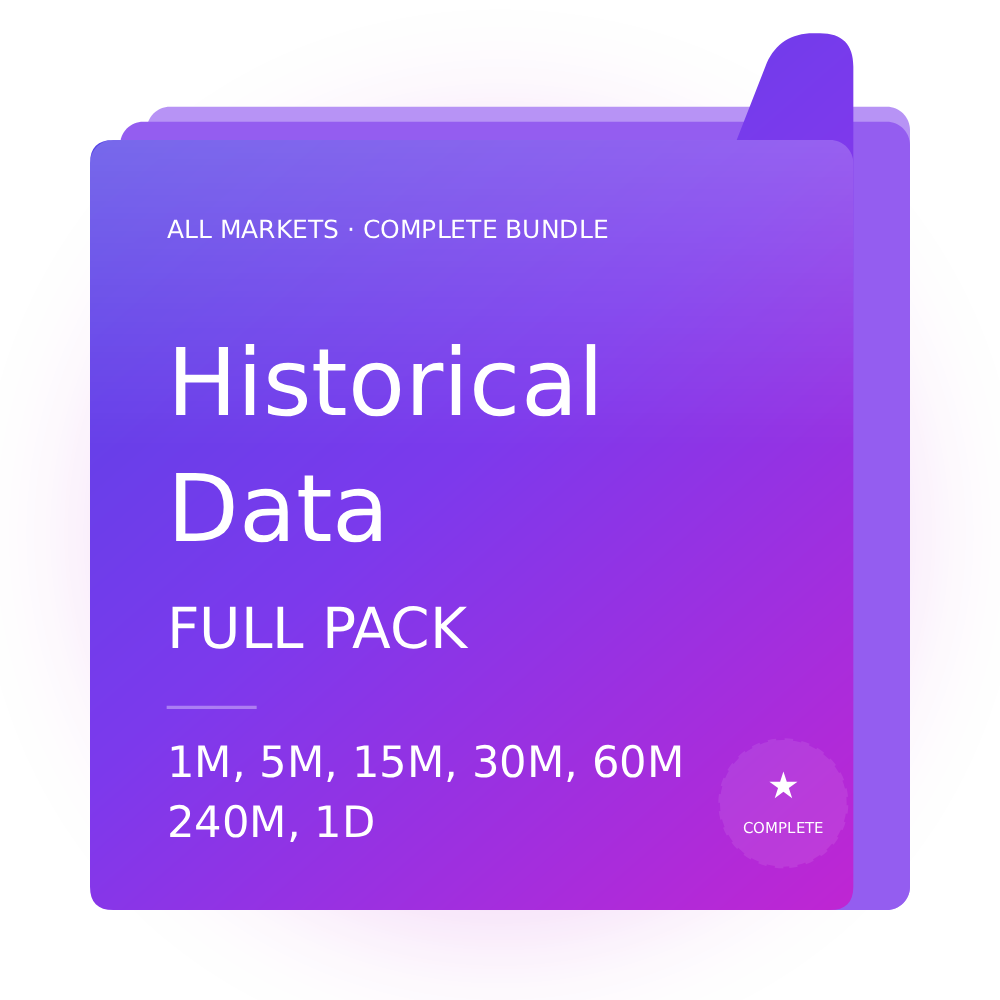
The HISTORICAL DATA COMPLETE PACK bundles minute-resolution OHLCV data across forex, metals, stock indices, bonds, and commodities into a single one-time download, ready for MT4/MT5 without manual reformatting.
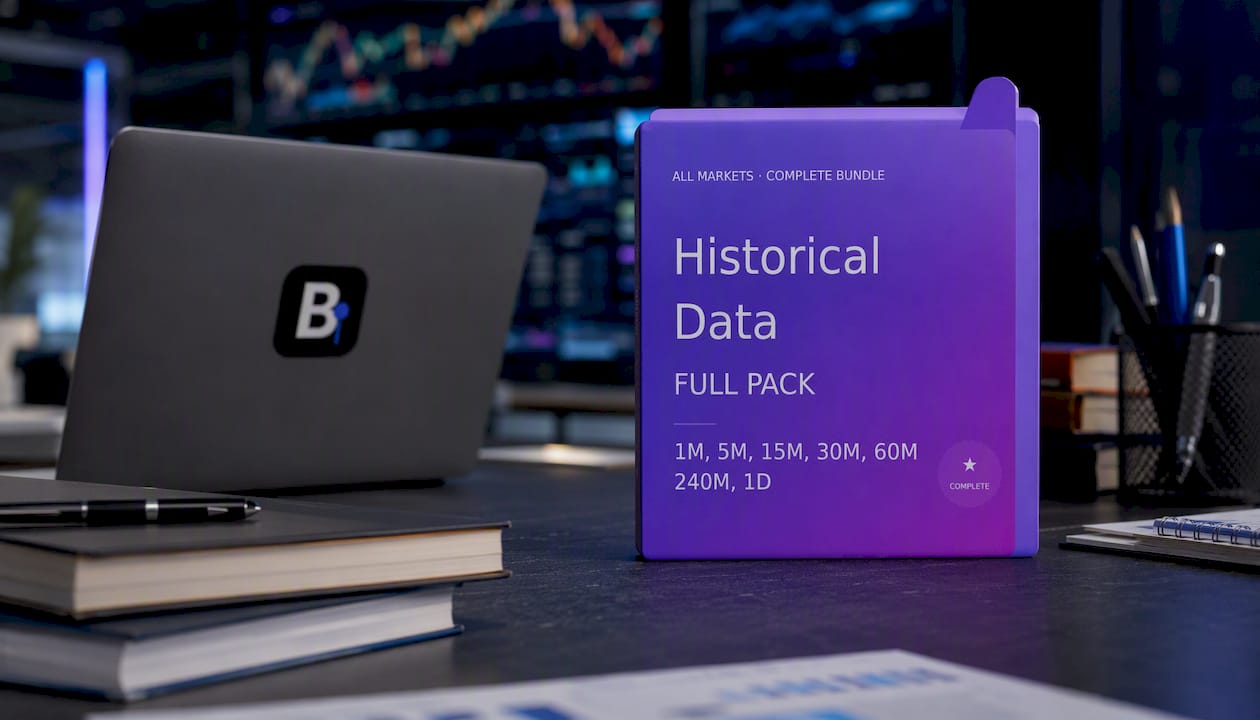
Here's the practical difference versus stitching together free repositories yourself: instead of merging separate downloads, checking three different schemas, and hand-fixing timezone mismatches, you get one file set that's already back-adjusted for futures and cleaned for gaps. For teams evaluating trading software options, that import-readiness matters as much as the price paid for the data itself.
Licensing covers standard backtesting and strategy development use, and support comes directly from the engineers who built the pack, not a general help desk. Download a sample file first to confirm the schema fits your pipeline, then head to the product page to get the full historical range for your instruments.
Frequently Asked Questions
What is minute bar data used for?
Minute bar data powers intraday backtesting, feature engineering for machine learning models, and signal research where daily bars are too coarse to capture entry and exit timing.
What's the difference between M1 data and tick data?
M1 data aggregates all trades within a 60-second window into a single OHLCV record. Tick data records every individual trade or quote change, which means far more storage and noise, but more flexibility for building custom bar types.
How far back does forex minute data typically go?
Tick-aggregated forex minute data, including EURUSD M1 data and XAUUSD minute data, commonly extends a decade or more since there are no corporate actions to adjust for, unlike equities.
Do I need to adjust minute bar data for splits and dividends?
Yes, for equities. Unadjusted historical prices around a split date will show an artificial price jump that can trigger false signals in any strategy relying on continuous price series.
What file format works best for large minute bar backtests?
Parquet generally outperforms CSV for multi-year datasets because its columnar structure reduces read time significantly, which matters when you're iterating on a backtest dozens of times.
Can I test a dataset before buying it?
Most reputable vendors offer sample downloads specifically so you can validate schema and formatting against your own ingestion pipeline before committing to a full purchase.
Sources
- algogenetic/dukascopy-1 · GitHub
Recommended
- Blog | BacktestMarket | BacktestMarket
- BacktestMarket — Professional Trading Data & Expert Advisors | BacktestMarket
- BacktestMarket — Professional Trading Data & Expert Advisors | BacktestMarket
- How to Import Data in NinjaTrader | BacktestMarket | BacktestMarket
Related resources
Explore BacktestMarket's how to import data into MetaTrader to put the ideas in this article into practice.