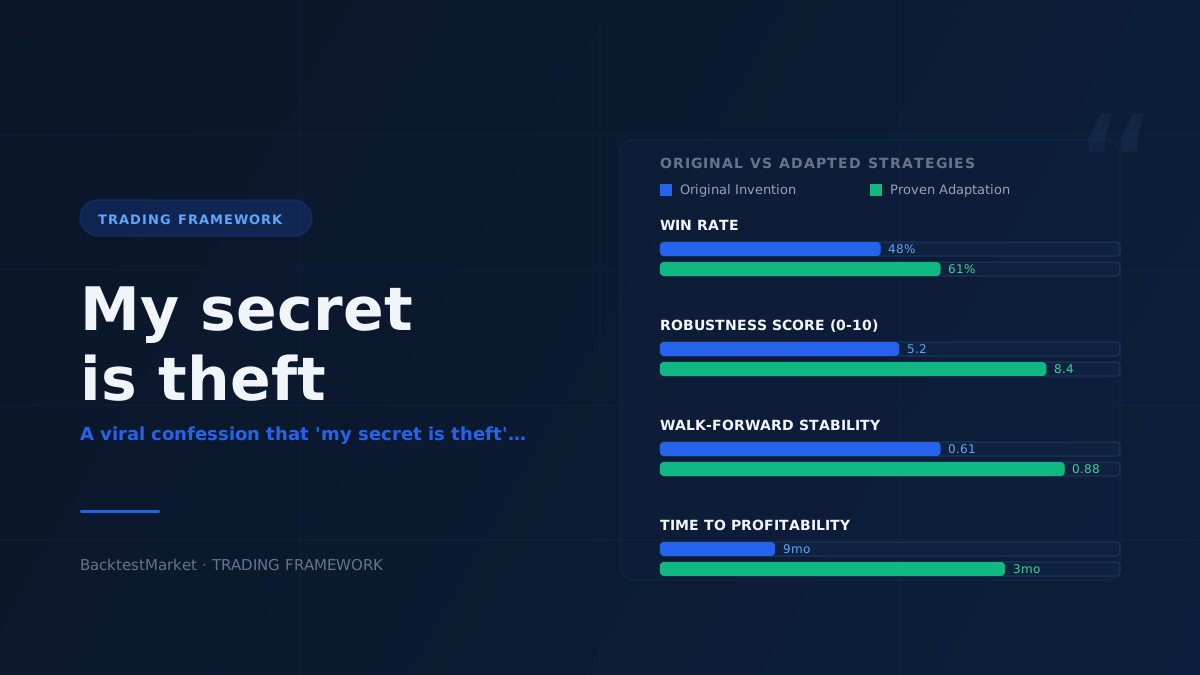
A short, almost throwaway line circulated widely this week in trading forums: "my secret is theft." It wasn't attached to a leaked hedge fund memo or a court filing. It was a trader admitting, half-jokingly, that the edge behind their results wasn't a flash of genius — it was borrowed. Reworked. Recombined. Stolen, in the loosest possible sense of the word.
It struck a nerve because it contradicts the mythology that surrounds algorithmic trading. The industry sells the idea that somewhere out there is a secret formula — a proprietary indicator, a hidden pattern, an exclusive dataset — that separates the professionals from everyone else. The reality, documented repeatedly in academic finance literature and in the public track records of systematic funds, is far less romantic. Most durable trading logic is built on ideas that have existed for decades, recombined and re-tested against new market regimes.
This article isn't an endorsement of intellectual property theft, code piracy, or copying someone's proprietary Expert Advisor line by line. It's an argument for something more useful: treating "theft" as a disciplined process of studying, reverse-engineering, and rigorously backtesting publicly known strategy logic — rather than chasing the fantasy of inventing something from nothing.
The Myth of the Original Strategy
Ask most retail algorithmic traders where their strategy came from, and the honest answer is rarely "I invented it in a vacuum." It's usually some version of: I read about a moving average crossover, modified the filter, added a volatility condition, and tested it on five years of data.
That's not a confession of weakness. It's how quantitative strategy development has always worked. Breakout systems, mean-reversion models, trend-following filters, and volatility-based position sizing have been written about in public literature since the 1970s and 1980s. The famous Turtle Trading rules, Donchian channel breakouts, and basic RSI divergence setups are not secrets — they're public domain concepts that have been tested, broken, rebuilt, and tested again by thousands of practitioners.
What separates a profitable systematic trader from an unprofitable one is rarely the novelty of the core idea. It's:
- The rigor of the backtest methodology applied to that idea
- How the idea is adapted to a specific instrument, timeframe, and volatility regime
- How honestly the strategy's weaknesses and drawdown periods are evaluated before risking capital
- How the position sizing and risk controls are layered on top
In other words, the "secret" isn't the raw strategy logic. It's the quality of the testing process wrapped around it. A well-known breakout concept, properly backtested across multiple market cycles with realistic spread and slippage assumptions, will usually outperform a genuinely novel idea that was only curve-fit to six months of recent price action.
Reverse-Engineering Is a Legitimate Research Method
There's a meaningful difference between copying someone's compiled EA file and reverse-engineering the logic behind a published strategy concept. The former is a legal and ethical problem. The latter is simply how research works in every technical field, including trading.
When traders talk about "stealing" a strategy, what they usually mean in practice is:
- Observing a published rule set — a classic indicator combination, a session-based breakout rule, a volatility filter described in a book, forum post, or strategy write-up.
- Rebuilding it independently in MQL4, MQL5, or a strategy testing platform, rather than copying proprietary code.
- Testing it against historical data across different symbols, timeframes, and years to see whether the original claims hold up outside the conditions it was first described under.
- Modifying the parameters and filters until the logic fits the trader's own risk tolerance, account size, and instrument selection.
This is closer to how a structural engineer studies an existing bridge design before adapting it for different terrain than it is to theft in any legal sense. The raw concept of a trend filter or a breakout entry isn't owned by anyone — the specific implementation, code, and branding of a commercial product is. Confusing the two is where many retail traders get into both legal and analytical trouble.
For traders building or refining systems this way, access to clean, long-horizon historical data matters more than access to someone else's "secret" rule set. A strategy concept that looks brilliant on three months of recent data can fall apart completely when tested against a decade that includes a low-volatility grind, a high-volatility shock, and a prolonged trend — which is exactly why reverse-engineering only works when it's paired with honest, multi-regime backtesting.
Why "Stolen" Ideas Still Require Original Work
The uncomfortable part of the "my secret is theft" confession is what it leaves out: taking a known idea and making it survive contact with real markets is itself hard, original work. Borrowing the core concept is the easy 10%. The remaining 90% is:
Parameter sensitivity testing. A moving average crossover with a 10/20 period setting behaves completely differently from one with 20/50. Public strategy descriptions rarely specify the exact combination that will hold up on a given instrument, so this has to be tested methodically rather than copied blindly.
Spread, commission, and slippage modeling. A strategy concept described in a book written for institutional or low-cost environments may not survive the transaction costs of a retail MT4/MT5 account on a particular broker. This is one of the most common reasons a "stolen" strategy underperforms expectations — the borrowed logic was never adapted to real execution conditions.
Out-of-sample validation. Reworking a known idea and testing it only on the same data used to design it is a textbook overfitting mistake. Serious adaptation of borrowed logic requires splitting data into in-sample and out-of-sample periods, or ideally testing across entirely different years and instruments than the ones used during development.
Walk-forward and regime testing. Markets shift between trending and ranging conditions, high and low volatility, and different correlation structures. A strategy "stolen" from a trending-market context and applied unmodified to a ranging instrument is likely to fail — not because the original idea was wrong, but because the adaptation step was skipped.
None of this is secret. It's documented, standard backtesting practice. But it's also the part that most traders skip when they borrow an idea, which is why so many "stolen" strategies underperform their source material. The theft isn't the problem — the shortcut around validation is.
Building a Process Instead of Hunting for Secrets
If there's a practical lesson in the "my secret is theft" sentiment, it's this: stop looking for a hidden strategy no one else has found, and start building a repeatable process for testing and adapting strategies that are already publicly known.
A reasonable process looks like this:
- Identify a well-documented strategy concept (trend-following, mean-reversion, breakout, session-based, correlation-based) relevant to the instruments you trade.
- Rebuild the logic independently rather than relying on a black-box commercial file you can't inspect.
- Source multi-year Forex historical data or data for the relevant asset class to test across different volatility regimes, not just recent price action.
- Apply conservative assumptions for spread, commission, and slippage that match your actual broker conditions.
- Run out-of-sample and walk-forward tests before considering any live or demo deployment.
- Document every assumption, so future you can tell the difference between a robust adaptation and a curve-fit accident.
For traders who prefer to start from a working framework rather than building from scratch, reviewing existing Expert Advisor robots with transparent logic and published backtest methodology can serve the same purpose as reverse-engineering a public strategy — provided the testing assumptions behind them are scrutinized rather than taken on faith. The goal either way is the same: understand exactly why a system behaves the way it does across different market conditions, rather than trusting a label or a headline return figure.
The Takeaway
"My secret is theft" is a catchy line, but the honest version of it is less dramatic: most durable trading systems are built on well-known ideas, adapted carefully and tested rigorously, rather than invented from nothing. There is no shame in that — it's how almost every field of applied engineering works, trading included.
The actionable distinction worth keeping in mind is this: borrowing a strategy concept is normal and legitimate; skipping the validation work that makes it survive real market conditions is where most traders actually lose money. Before adapting any idea — borrowed, published, or purchased — pull sufficient historical data, test it across multiple regimes, and document your assumptions honestly. If you're setting up that workflow in MetaTrader for the first time, our guide to importing historical data in MetaTrader is a practical starting point for building a testing environment you can trust before you trust the strategy running inside it.