

Nasdaq intraday data is trade and quote level market information, last sale prices, volume, and bid/ask quotes, delivered either as raw ticks or aggregated into bars at 1 minute, 5 minute, 15 minute, and hourly intervals. Professional feeds stream this data trade by trade in real time, while public displays and most vendor downloads work in fixed time buckets.
The fastest path depends on what you're building. For real-time trade flow feeding a live strategy, Nasdaq Data Link's streaming API is the direct route. For historical bars to backtest against, REST endpoints or a vendor's pre-built dataset save weeks of pipeline work. For a quick visual read on where a stock stands right now, Nasdaq's own public market activity pages update minute by minute at no cost.
- Real-time trading and execution research: streaming APIs or consolidated feeds like CQT
- Historical backtesting: REST bar endpoints or clean vendor minute-bar files
- Quick price checks or charting: Nasdaq's free delayed public pages
Key Takeaways
Reliable Nasdaq intraday analysis depends on matching feed granularity to your use case and rigorously normalizing timestamps and corporate actions before trusting any backtest result.
| Point | Details |
|---|---|
| Match granularity to purpose | Use tick data for execution research, 1 to 5 minute bars for short-horizon strategies, and hourly bars for swing-style systems. |
| Choose the right access route | Public pages suit quick checks; REST fits historical bars; streaming fits real-time order-flow work. |
| Normalize before you trust it | Convert timestamps to one timezone and document your corporate-action adjustment method. |
| Reconcile against a consolidated feed | Cross-check volume and price against CQT to catch missing venues or unpropagated corrections. |
| Buy clean data for backtesting | Backtestmarket's NASDAQ Pack and Nasdaq Pack Back Adjusted deliver ready-to-import, pre-adjusted minute-bar files without API onboarding. |
Table of Contents
- Nasdaq Intraday Data Types, Intervals, and Coverage
- How to Get Nasdaq Real-Time Quotes and Historical Bars
- Nasdaq Trading Indicators: Fields and Message Types to Know
- Best Practices for Working With Intraday Stock Data
- Where BacktestMarket Fits for Traders Needing Nasdaq Data
- Pricing Structure and Cost Overview for Nasdaq Intraday Feeds
- Data Quality Issues and Corrections in Intraday Feeds
- Regulatory Considerations for Using Nasdaq Market Data
- Practical Use Cases for Nasdaq Intraday Data
- What Actually Matters When You Pick an Intraday Feed
- Get Clean Nasdaq Intraday Data Ready for Backtesting
- Sources
Nasdaq Intraday Data Types, Intervals, and Coverage
Not every intraday dataset serves the same purpose, and picking the wrong granularity wastes both storage and analysis time.
- Tick or trade-level data captures every executed trade with its own timestamp, price, and size. High-frequency strategies and market microstructure research need this resolution; almost nothing else does.
- 1-minute and 5-minute bars suit short-horizon intraday strategies, scalping models, and volatility studies where you need granularity but not every individual print.
- 15-minute and hourly bars work well for swing-style intraday systems and for overlaying intraday structure onto daily charts without drowning in noise.
Bars are constructed from open, high, low, close, and total volume within the interval, which differs fundamentally from a snapshot (a single point-in-time quote) or a last-sale record (the most recent trade price alone). Nasdaq's own charting pages confirm this bar structure across its standard intraday timeframes.
History depth varies by source. Consolidated feeds like CQT and Nasdaq's direct exchange feeds often carry deep historical archives for institutional clients, while public displays and many vendor packages cap history at a shorter rolling window unless you buy an extended archive.
How to Get Nasdaq Real-Time Quotes and Historical Bars
Three access routes cover almost every use case, and each trades off latency, cost, and engineering effort differently.
- Public Nasdaq Market Activity pages show minute-delayed charts and last-sale prices. Fine for a quick gut check on price action, useless for anything requiring a documented, auditable dataset.
- Nasdaq Data Link REST endpoints cover Last Sale, Bars, and Snapshot products for historical queries and bulk bar retrieval, real time or delayed depending on the product tier.
- Streaming APIs and consolidated feeds such as CQT and Nasdaq TotalView deliver low-latency, event-driven data suited to institutional order-flow analysis, requiring stateful consumer logic and reconnect handling rather than a simple request-response call.
Onboarding for the paid tiers isn't self-serve. Nasdaq requires contacting Sales directly for trial access and credential issuance, client ID, client secret, and offset parameters for authenticated calls. Worth noting: Nasdaq Data Link has flagged some documentation endpoints for retirement in favor of its newer Data Access Tools, so confirm current endpoint status before building a production pipeline around any single URL.
Pro Tip: Before committing engineering time to a streaming integration, prototype against the REST historical endpoint first. If your strategy only needs end-of-bar data rather than tick-by-tick execution signals, you'll save weeks of reconnect-logic development.
Nasdaq Trading Indicators: Fields and Message Types to Know
Every intraday dataset worth using documents its fields precisely, and the differences between feeds show up exactly there.
Core fields you should expect in any serious dataset:
- Last sale/price and trade size (volume)
- Bid/ask quotes with corresponding bid/ask size
- Bar OHLC (open, high, low, close) for aggregated intervals
- Trade condition codes flagging odd lots, late reports, or corrected prints
Beyond price fields, feeds carry system and stream events that mark the trading day's structure: SOD (start of day), MKO (market open), MKC (market close), and EOD (end of day), along with LULD (limit up/limit down) timestamps that flag when a security hits its regulatory price band. The CQT technical specification documents these message types in detail, since consolidated feeds must standardize them across every reporting exchange.
That consolidation matters more than most traders assume. A single-exchange feed only sees trades executed on that exchange. CQT rolls in activity from Nasdaq, NYSE, and other market centers, plus OTC and non-listed venues where applicable, into one unified tape. If your strategy relies on total market volume rather than one venue's slice of it, a single-exchange feed will consistently understate the real number.
Best Practices for Working With Intraday Stock Data
Clean-looking data can still wreck a backtest if you skip the setup work. A few habits separate reliable analysis from a strategy that looks great on paper and fails live.
- Normalize every timestamp to a single timezone, ideally UTC, before merging sources. Institutional feeds often carry nanosecond-resolution timestamps relative to midnight UTC, and mapping those correctly to U.S. Eastern trading sessions is where most homemade pipelines break.
- Apply corporate-action adjustments for splits and dividends, and back-adjust futures contracts where relevant. Document which method you used, ratio adjustment or cumulative factor, because two datasets adjusted differently will disagree on returns even when the raw prices match.
- Run health checks before trusting a dataset: scan for missing intervals, duplicated ticks, and volume spikes that look anomalous against neighboring bars. Cross-reference against a consolidated feed when something looks off.
Pro Tip: Keep a written log of every adjustment method applied to a dataset. Six months from now, when a backtest result looks different than you remember, that log is the difference between a five-minute fix and a lost afternoon.
Run this checklist before any dataset goes into production: timezone confirmed, adjustments documented, gaps checked, volume outliers reviewed.
Where BacktestMarket Fits for Traders Needing Nasdaq Data
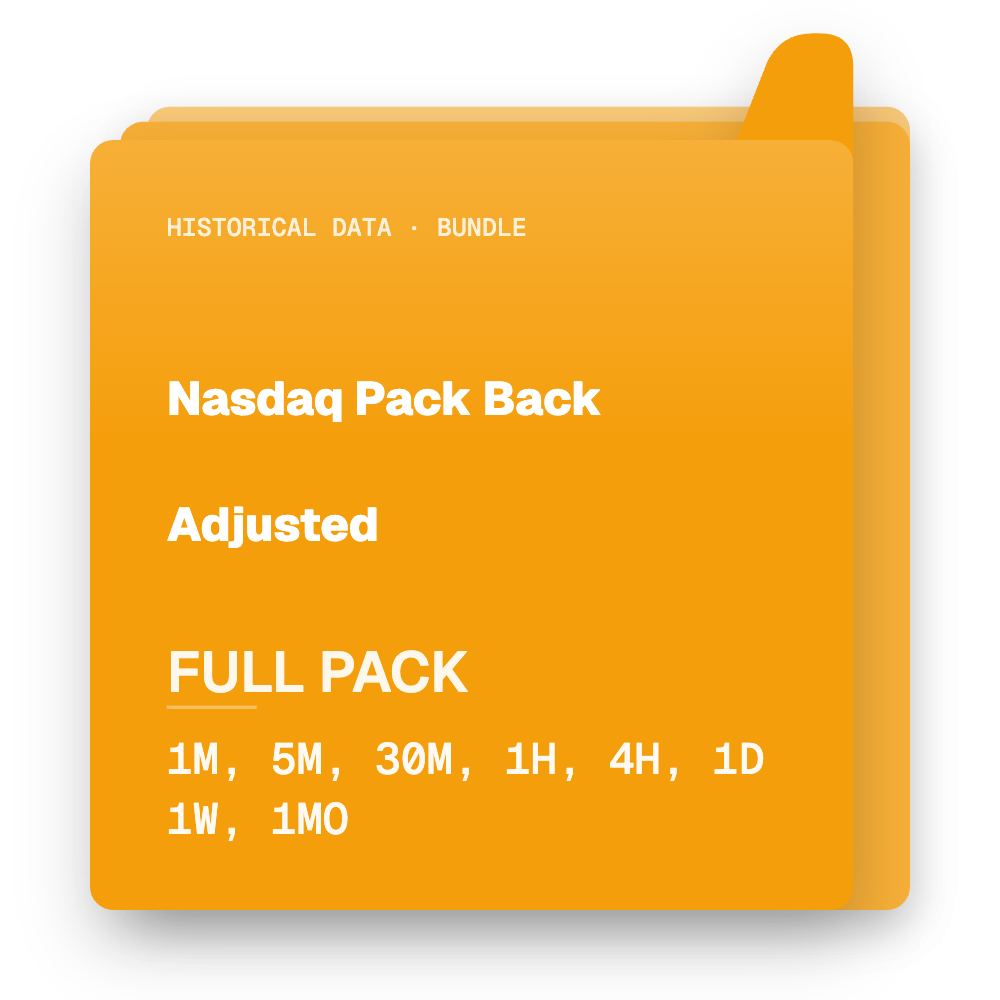
Building a clean intraday pipeline from raw feeds takes real engineering time, which is exactly the gap Backtestmarket set out to close. Since 2014, the platform has sold clean, minute-bar historical intraday data across forex, metals, stock indices, bonds, and commodities, all delivered as one complete download rather than a piecemeal API integration.
For Nasdaq specifically, two products cover the practical range traders ask for:
- NASDAQ Pack: raw historical intraday data across multiple timeframes, formatted for immediate import into MT4 and MT5.
- Nasdaq Pack Back Adjusted: the same coverage with splits and dividend effects already normalized, useful when you need return calculations that won't be distorted by unadjusted corporate actions.
Clean data isn't a nice-to-have for backtesting. It's the difference between a strategy result you can trust and one you have to re-verify from scratch.
Every purchase comes with direct access to engineer support rather than a generic ticketing queue, plus import guides for platforms like NinjaTrader for traders working outside MetaTrader. If you already know you need a specific bar interval, the 1-minute, 5-minute, or 15-minute Nasdaq datasets are sold individually as well.
Pricing Structure and Cost Overview for Nasdaq Intraday Feeds
Cost structures across Nasdaq intraday feeds fall into three rough tiers, and understanding which tier you actually need prevents both overpaying and under-provisioning.
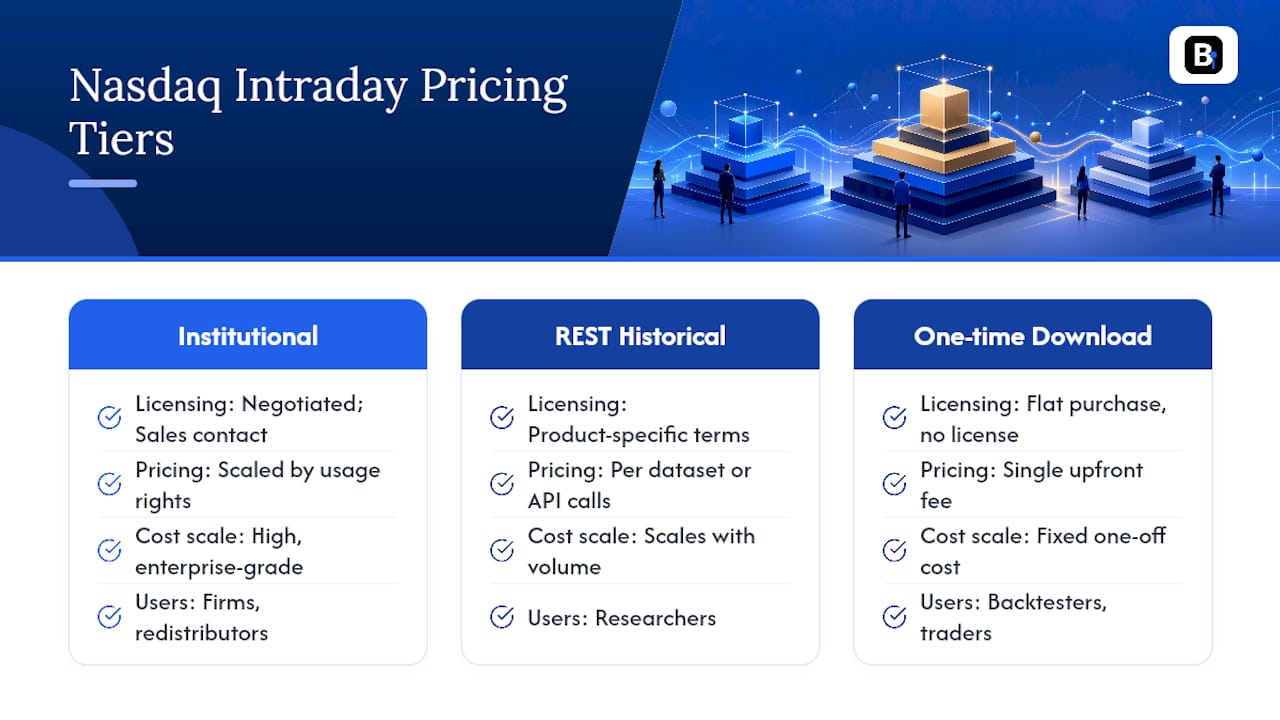
At the top, institutional-grade streaming access through Nasdaq Data Link or direct exchange feeds like CQT and TotalView typically involves negotiated licensing, since Nasdaq requires contacting Sales for trial access and credential issuance rather than posting a fixed rate card. Pricing here scales with usage rights: internal research use, redistribution, and display to end clients all carry different licensing terms, which is part of why Nasdaq handles onboarding case by case rather than through self-serve checkout.
In the middle sit REST-based historical products, priced per dataset or by API call volume depending on the specific product (Last Sale, Bars, Snapshot). These fit researchers who need defined historical windows rather than continuous live streams, and costs scale with how much history and how many symbols you pull.
At the accessible end, vendor-cleaned datasets sold as one-time downloads, Backtestmarket's Nasdaq packs among them, charge a flat price for a complete historical file rather than a recurring subscription or metered API bill. For a trader or researcher who needs a defined historical archive to backtest against rather than an ongoing live feed, that one-time-purchase model avoids the licensing complexity and recurring cost of the institutional tiers entirely. The right choice comes down to one question: do you need the data flowing continuously, or do you need a trustworthy archive to test against? Those are different budgets and different products.
Data Quality Issues and Corrections in Intraday Feeds
Every intraday feed, no matter how reputable the source, contains errors. The question isn't whether they exist. It's whether your process catches them before they corrupt a backtest or a live decision.
The most common issue is late or corrected trade reports. Exchanges sometimes revise a trade print after the fact, flagging it with a condition code rather than silently deleting it, which means two pulls of the "same" historical window can legitimately differ if one was taken before a correction posted. Odd-lot trades and non-regular trading hours prints also carry specific condition flags that some naive parsers ignore, inflating apparent volume or creating false price spikes at the open or close.
Gaps are the second recurring problem. A missing bar in a minute-series dataset can result from a genuine trading halt, a feed outage on the vendor's side, or a parsing error that silently dropped a record. Treating all three the same way, usually by interpolating a value, will bake a fabricated data point into your historical series.
Cross-referencing against a consolidated feed like CQT is the most reliable check available, since consolidated volume and price should reconcile closely with any single clean vendor file for the same window. When they don't, the discrepancy usually points to either a missing venue in your feed or a genuine correction that hasn't propagated through both sources yet. Building that reconciliation step into your ingestion pipeline, rather than trusting a single source blindly, is the single habit that separates production-grade data handling from a hobbyist backtest.
Regulatory Considerations for Using Nasdaq Market Data
Using Nasdaq intraday data comes with licensing obligations that catch a lot of independent traders and small research shops off guard, especially once a dataset moves beyond personal, internal use.
Market data from Nasdaq and other exchanges is licensed, not simply public information free for any redistribution. Real-time and delayed data products carry different usage tiers depending on whether you're consuming the data for your own analysis, displaying it to end users on a platform, or redistributing it to third parties. That distinction is why Nasdaq Data Link's onboarding process runs through direct sales contact rather than an anonymous signup form. The license terms attached to your account depend on your actual use case, and getting that classification wrong can create contractual exposure down the line.
For most independent traders and researchers running backtests for personal or internal firm use, a vendor-cleaned historical dataset purchased outright, rather than a live redistribution license, is the simpler and more appropriate path. It sidesteps the ongoing compliance overhead of a market data redistribution agreement entirely. If your use case ever expands to displaying live quotes to external clients or building a product that redistributes Nasdaq data to others, that's the point to have a direct conversation with Nasdaq's licensing team rather than assuming your existing access covers it. Compliance requirements scale with distribution reach, not with how technically sophisticated your pipeline is.
Practical Use Cases for Nasdaq Intraday Data
The same dataset serves very different purposes depending on who's pulling it, and matching the use case to the right granularity avoids both wasted spend and analytical blind spots.
Algorithmic trading and execution research rely on the highest resolution available, often tick-level or 1-minute bars, because entry and exit timing at that scale directly affects realized slippage and fill quality. Intraday swing strategies built around 15-minute or hourly bars need enough granularity to catch intraday structure without the noise of every individual trade. Market microstructure research studying spread behavior, order flow imbalance, or price impact around news events depends on trade and quote level data with accurate LULD and condition-code flags intact.
On the analytical side, volatility and liquidity studies use aggregated bar volume across a trading day to characterize a stock's typical intraday pattern, useful for position sizing and execution scheduling. Backtesting intraday strategies against historical Nasdaq stock market intraday trends is probably the single most common use case among independent quant traders, and it's exactly where a clean, pre-adjusted dataset like a back-adjusted Nasdaq pack saves the most time versus wrangling raw consolidated ticks. Academic and institutional research into Nasdaq price movement patterns, meanwhile, often blends daily overlays with intraday bars to study how information gets incorporated into price throughout the trading session.
What Actually Matters When You Pick an Intraday Feed
Most guidance on Nasdaq intraday data focuses on where to find it, streaming versus REST, public versus paid, and skips the part that actually determines whether your analysis holds up: what happens to the data after you've received it.
The conventional advice treats data acquisition as the hard part and cleaning as an afterthought. In practice, the reverse is true for most independent traders. Nasdaq's documentation is genuinely thorough on message types, LULD timestamps, and consolidated feed structure. What it can't do is tell you whether your specific pipeline handled a corrected trade report correctly, or whether your backtest silently interpolated over a real trading halt.
If you're choosing between building a raw ingestion pipeline from a consolidated feed and buying a vendor-cleaned historical dataset, the honest answer for most backtesting use cases is that engineering time is better spent on the strategy logic than on re-solving corporate-action adjustment and timestamp normalization from scratch. Prioritize documentation of your adjustment method over chasing the lowest-latency feed you can find. Most intraday strategies fail on flawed assumptions, not on a few milliseconds of feed lag.
— Start
Get Clean Nasdaq Intraday Data Ready for Backtesting
Backtestmarket is the practical alternative to building a Nasdaq data pipeline from scratch: one download, already cleaned, already formatted for MT4 and MT5, with no API credentials to negotiate and no reconnect logic to write.
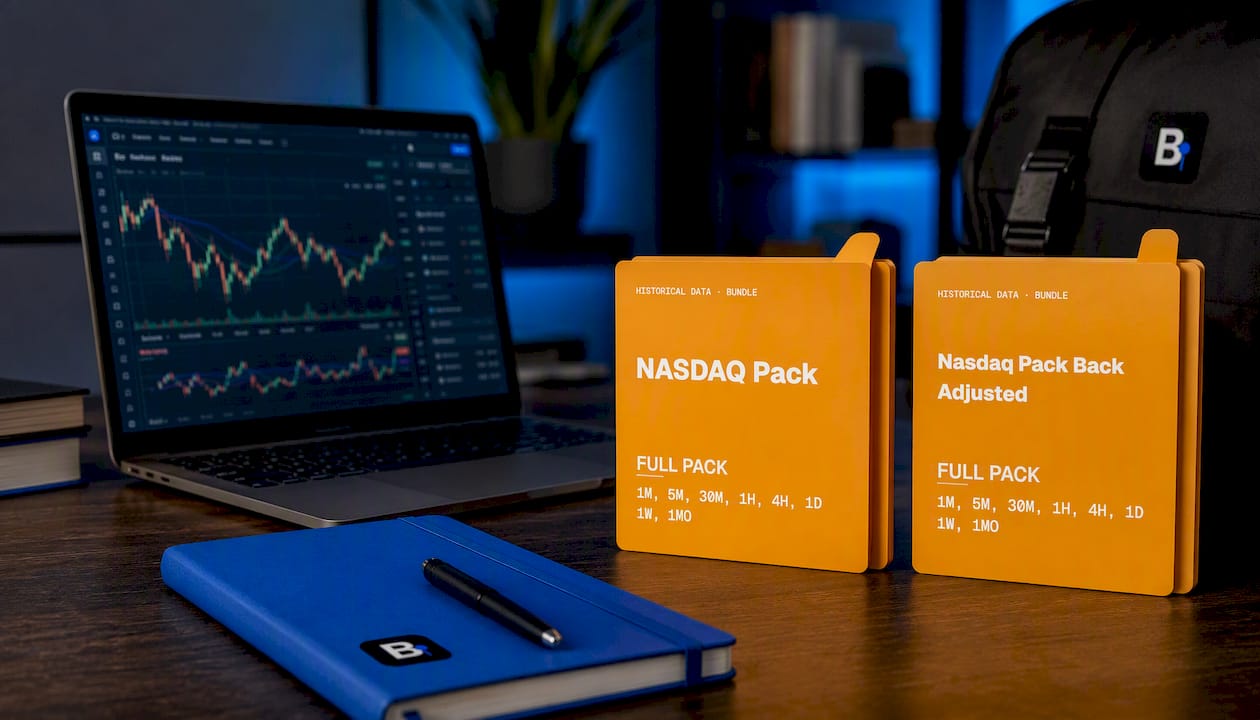
If you've read this far, you already know the real cost of intraday data isn't the feed itself, it's the engineering hours spent normalizing timestamps, applying corporate-action adjustments, and reconciling gaps before you can trust a single backtest result. Backtestmarket's NASDAQ Pack and Nasdaq Pack Back Adjusted skip that step entirely, delivered as complete historical files with adjustments already documented, ready to import the same day you buy them. Support comes directly from the engineers who build the datasets, not a support queue. If your next move is a Nasdaq backtest rather than another week of pipeline work, check the current dataset options and get the file that matches your timeframe.
Sources
- Market Activity | Nasdaq
- API for real-time or delayed data | Nasdaq Data Link docs
- Streaming API | Nasdaq Data Link docs
Recommended
- Nasdaq 500 4 hours historical data
- Nasdaq 1 day historical data
- Nasdaq 15 minutes historical data
- Nasdaq 1 hour historical data
Related resources
Explore BacktestMarket's historical data packs to put the ideas in this article into practice.