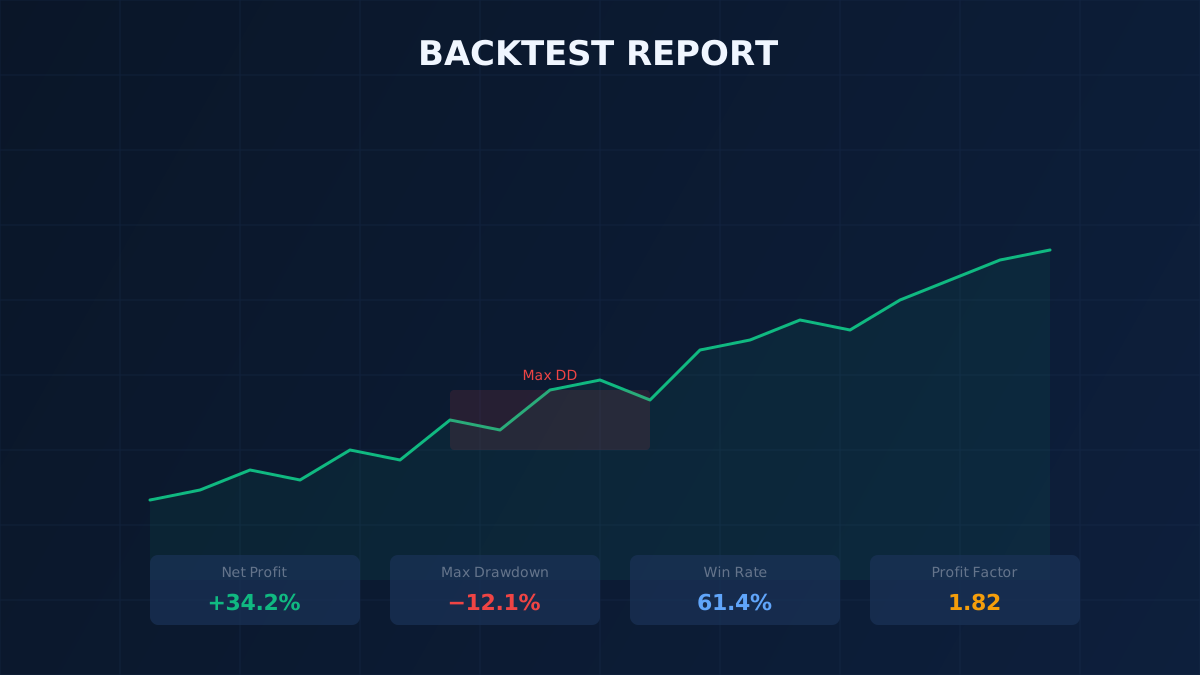
Testing a trading system or Expert Advisor (EA) could be time consuming, but thanks to the Strategy Tester tool on MetaTrader, you can test a trading system using historical price data from several years ago without having to test it in real time. It is called "backtesting", which can make testing a trading system much faster.
It is recommended to perform a backtest before a forward test for time efficiency reasons. Of course, you will need forward testing in a real time market afterward, but a backtest will provide preliminary information about the trading system you are about to use or test. However, in order to get a good quality of backtest result, you have to use adequate historical price data.
After testing a trading strategy using the backtest method, you will have to analyze the result so that you will know whether the trading system or the EA is as good as your expectation. There are many parameters you should look at and you need to understand what those numbers are telling you.
You don't have to understand every number from the report. All you need to look at is just some key parameters that can be used to evaluate whether a strategy is a winning or losing one.
Here are some key parameters and what they tell you about the trading system.
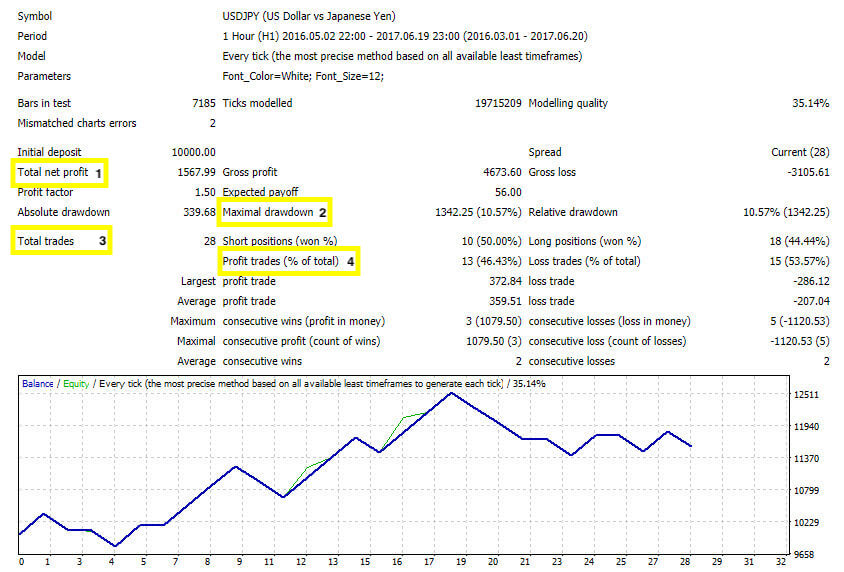
1 — Total Net Profit
This is the financial result of all trades that is generated by your trading system if you had used them in the past. A winning strategy should provide profits instead of losses. This parameter shows you what could happen if you use this strategy properly. Remember, this is not a guarantee that the system will work exactly like this in the future, but at least it can show you how much you possibly will get using this system.
2 — Maximal Drawdown
Maximal drawdown is the largest loss from the local maximum in the deposit currency and in per cents of the deposit. You don't want this number to be too big. However, it would depend on how much money you have in your trading account and how big your risk tolerance is. For example, if you have $10,000 in your trading account and your risk tolerance is just 20% of your money, then your trading system's maximal drawdown should not be more than $2,000. To make it simple, the lower the number is, the better.
3 — Total Trades
This is the total amount of trade positions. You can analyze whether your trading system is aggressive or moderate by comparing this number to the timeframe for the investing horizon. For example, if total trades are 200 in three months, it means the trading system makes 3 trades daily on average (assuming 1 month has 20 business days). It means this strategy is not too aggressive and probably suitable for an intraday trading strategy. If the number is smaller, then it probably would be suitable for mid-term trading.
4 — Profit Trades
This parameter tells you the amount of profitable trade positions and their part in the total trades, in per cents. Simply put, this parameter tells the trading system's win ratio. The bigger, the better.
As mentioned above, you should perform a forward test afterward. A forward test is a test in a real time market. It is necessary in order to validate all of the evidence you've gathered from the backtest. Forward testing is also important to get legitimate proof that you have avoided overfitting during the backtest process.
In this article we decided to show some of the simplest parameters for a backtest, in order to give some inputs on how to start reading a backtest report. It is important to understand all the parameters shown in a backtest report, in order to be able to correctly evaluate the backtest and the potential performances of your Trading System.