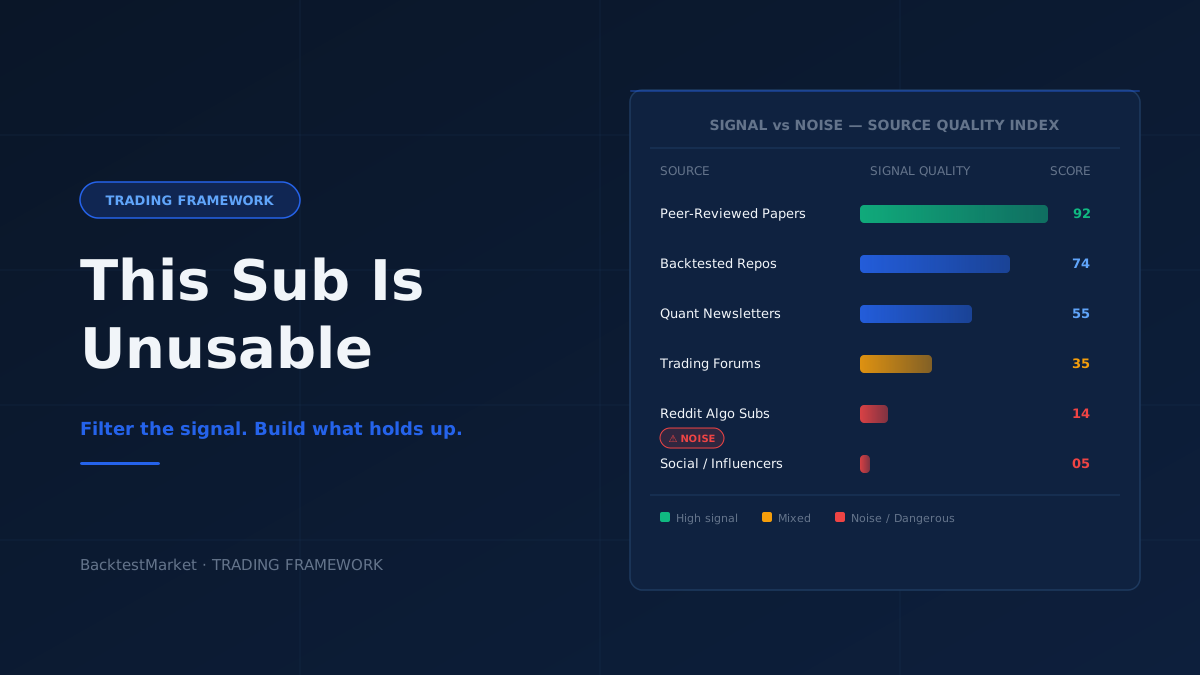
If you've spent any time in Reddit's algorithmic trading communities lately, you've probably seen some version of the same post: "This sub is unusable." It appears with almost clockwork regularity, usually after a wave of low-effort content, contradictory advice, and arguments that generate heat but very little light. The frustration is understandable. What's more concerning is what happens when traders — especially newer ones building their first systematic approach — actually try to use those communities as a foundation for their methodology.
This article isn't a Reddit takedown piece. It's a practical examination of why crowdsourced, engagement-optimized platforms are structurally misaligned with the requirements of good algorithmic trading practice, and what a more reliable framework actually looks like.
Why Engagement Metrics and Edge Don't Mix
Reddit, like every social platform, is optimized for engagement. Posts that generate comments, upvotes, and emotional reactions surface to the top. Posts that are methodologically careful, nuanced, and appropriately hedged tend to get buried because they're less exciting to react to.
This creates a structural problem for traders seeking genuine insight. The content that gets amplified is often:
- Curve-fitted equity curves posted without walk-forward results, out-of-sample data, or any disclosure of optimization parameters
- Strategy claims without context — no mention of the instruments tested, the timeframe, the spread assumptions, or the commission model used
- Anecdotal live trading results presented as evidence of a strategy's robustness, when a few months of live trading proves almost nothing about long-term expectancy
- Cargo-cult indicators — someone posts a screenshot of a profitable period using a well-known indicator, and suddenly the comments are full of people asking for the settings
None of this is malicious. Most people posting this content genuinely believe what they're sharing. But belief and robust evidence are different things, and on an engagement-driven platform, they're treated as interchangeable.
The deeper issue is that good backtesting is inherently anti-viral. A properly conducted backtest takes weeks to build, involves careful data sourcing, multiple robustness checks, and ends with conclusions that are usually provisional rather than definitive. That doesn't make for a compelling post. A screenshot of a 300% return equity curve with no methodology disclosure does.
What a Reliable Trading Framework Actually Requires
Let's be specific about what separates a functional systematic trading framework from the kind of content that tends to go viral on trading forums.
1. Reproducible, High-Quality Data
Every backtesting result is only as good as the data underneath it. This seems obvious, but it's routinely ignored in public forum discussions. Common data problems that invalidate backtests include:
- Gaps and missing bars in historical price feeds, particularly for less liquid instruments
- Incorrect tick data that doesn't account for the actual spread environment at the time
- Survivorship bias in instrument selection — testing a strategy only on assets that are still trading today
- Timezone inconsistencies that affect session-based strategies
When someone posts a backtest result on Reddit, you almost never see the data source disclosed. And when you ask, you'll often find it was built on a broker's default MT4 data feed — typically low-quality, incomplete, and not suitable for serious strategy validation.
Using properly sourced historical data packs is a foundational requirement, not an optional extra. The difference between a result built on clean, complete tick data and one built on a broker's default 1-minute feed can be the difference between a strategy that works and one that looked like it worked.
2. Meaningful Out-of-Sample Testing
In-sample optimization is where most retail backtests end. A parameter set is found that performed well over the historical period, and that's treated as validation. It isn't.
A strategy that has only been tested in-sample has been fitted to noise as much as to signal. The only way to get meaningful evidence about whether a strategy captures a genuine market inefficiency is to test it on data it has never seen. That means:
- Splitting your historical dataset into development and validation periods before you begin optimization
- Conducting walk-forward analysis rather than static backtesting
- Testing across multiple instruments and market regimes, not just the one that produced the best results
This is a considerable amount of work. It's also the minimum required to say with any confidence that a backtest result means something. Forum posts almost never include this kind of methodology disclosure, because it would make the post significantly less impressive.
3. Realistic Execution Assumptions
MetaTrader backtesting environments allow you to configure spread, slippage, and commission. Many retail traders leave these at defaults or set them optimistically. In live trading, the execution environment is rarely as clean as a backtest assumes.
For strategies that trade frequently — scalping approaches, high-frequency mean reversion, anything operating at the 1-minute level — execution assumptions can completely overwhelm apparent edge. A strategy that shows solid results at 0.5 pip spread and zero slippage may be deeply unprofitable at the spreads and slippage actually encountered during news events, Asian session illiquidity, or rollover periods.
When evaluating any backtest — whether your own or one shared publicly — always ask: what spread was used, how was slippage modeled, and what was the commission assumption? If those questions can't be answered, the result is not interpretable.
The Forum Trap: Outsourcing Your Framework to Consensus
Perhaps the most harmful pattern that emerges from trading communities is what might be called consensus drift — the gradual outsourcing of your trading framework to whatever the current forum consensus happens to be.
This manifests in specific ways:
-
Indicator chasing: A thread gains traction about a particular indicator or combination. Hundreds of people start testing it, posting results, iterating on settings. The indicator itself may have no genuine predictive value; what's being shared is largely noise with occasional lucky runs.
-
Strategy hopping: A new system gets posted, generates excitement, and dozens of traders abandon their current approach to try it. When it doesn't immediately produce results, the cycle repeats with the next viral strategy.
-
False validation: When many people in a community hold the same belief about a strategy, it creates the impression of evidence. It isn't. Independent replication of a properly described methodology is evidence. A thousand people agreeing that RSI divergence works is not.
Building a personal trading framework requires the opposite disposition: skepticism toward consensus, rigorous personal testing, and a willingness to sit with inconclusive results rather than force a conclusion.
What to Actually Do Instead
The antidote to forum noise isn't isolation — it's structured, evidence-based practice. Here's a more functional approach:
Start with your data environment. Before building anything, ensure you're working with complete, accurate historical data appropriate to your instruments and timeframes. Understand its limitations.
Define your hypothesis before you test. What market inefficiency are you attempting to exploit? Why should it exist? What conditions would cause it to disappear? Answering these questions before you open the strategy tester prevents you from reverse-engineering an explanation for whatever the optimization produced.
Document everything. Every parameter change, every data adjustment, every version of your strategy should be logged with the rationale. This makes it possible to distinguish genuine improvements from accidental overfitting.
Use Expert Advisors for consistency. Manual backtesting introduces discretionary interpretation at every bar. Systematic testing requires a systematic tool. Well-constructed Expert Advisor robots allow you to test a strategy consistently across large data sets without the ambiguity of manual review.
Treat forums as a library, not an oracle. Communities can be useful for discovering new concepts, finding technical solutions, and understanding how others have approached specific problems. They are not useful for validating strategies or making trading decisions. Use them accordingly.
Apply basic statistical skepticism. A strategy that looks good on a six-month backtest has very limited statistical significance. Most retail backtesting periods are too short to distinguish skill from luck. The longer your out-of-sample test period and the more varied the market conditions it covers, the more meaningful the result.
Practical Takeaway
The recurring "this sub is unusable" complaint is ultimately a symptom of a platform architecture that rewards emotional resonance over methodological rigor. That's not going to change.
What can change is how you use these platforms and what you treat as evidence. If you're building or refining a systematic trading approach, the work happens in your backtesting environment, not in a comments section. It requires clean data, honest out-of-sample testing, realistic execution assumptions, and the discipline to reach inconclusive results without forcing a false positive.
Start by auditing your current data environment. If you're relying on default broker feeds for serious strategy development, that's the first problem to solve. From there, build your methodology from the ground up — documented, reproducible, and independent of whatever happens to be trending this week.
The noise isn't going away. Your ability to ignore it is the actual edge.