A decade ago, the most coveted career on Wall Street was that of a trader — reading the tape, building client relationships, making calls based on experience and intuition. Today, the most coveted hire is an algorithmic engineer. The transformation is structural, and it is accelerating.
The Quant Revolution Is Not New — But It Has Reached Critical Mass
The roots of quantitative trading go back to at least 1974, when mathematician Ed Thorp published early algorithmic concepts. By the late 1980s, Chicago options desks were running secretive information systems to gain execution advantages. Scott Patterson documented the methodology's ascendancy in his 2010 bestseller.
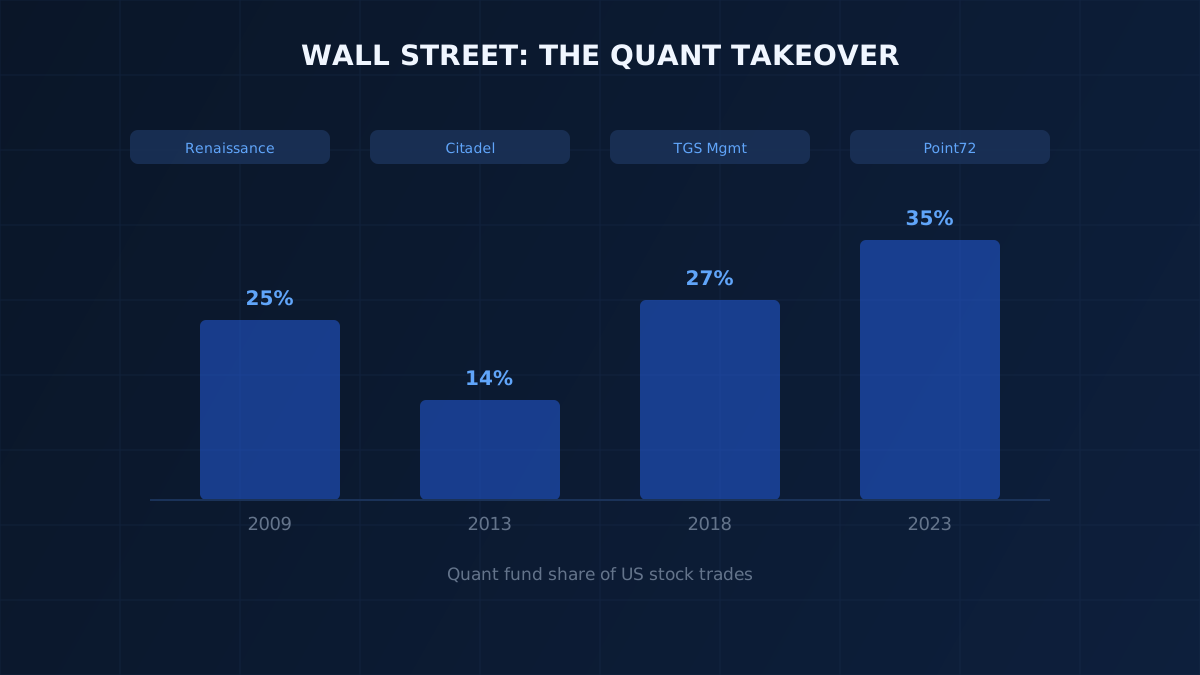
What has changed is scale. Quant funds now execute 27% of all US stock trades, up from 14% in 2013. They hold over $932 billion in assets — more than 30% of total hedge fund capital.
Performance Speaks
The data is clear: algorithmic systems have outperformed traditional human-run funds consistently.
- 5-year average annual returns: 5.1% for quant funds vs. 4.3% for conventional hedge funds
- Q1 of the most recently tracked year: 3.0% quant vs. 2.5% sector average
These margins may look modest, but compounded over years they produce dramatically different outcomes for investors. The structural advantages that drive them — speed, discipline, the absence of emotional decision-making, and the ability to process vast data simultaneously — do not diminish with time.
The Talent War
Firms like Renaissance Technologies, Citadel, and TGS Management compete aggressively to hire algorithmic engineers. The talent pool they draw from is not finance graduates — it is physicists, mathematicians, and computer scientists.
Some notable examples of institutional adaptation:
- Gam acquired British quant firm Cantab Capital Partners for $217 million to access sophisticated mathematical trading strategies
- Guggenheim Partners built a $1 million supercomputer cluster at Lawrence Berkeley National Laboratory for computational trading research
- Steven Cohen's Point72 converted half its managers toward "man-machine collaboration," pairing traditional analysts with data scientists
- Paul Tudor Jones, legendary for predicting the 1987 crash, recruited Italian theoretical physics Ph.D. Dario Villani to build algorithmic systems after his fund underperformed during 2014–2015
Even traditional fundamental analysts are adapting. Point72 invested tens of millions analysing alternative data — credit card transactions, pedestrian foot traffic, satellite imagery — to gain informational edges.
What Quant Trading Actually Is
It is worth distinguishing quantitative trading from high-frequency trading (HFT). The latter targets millisecond-duration positions, exploiting micro-structural inefficiencies in order flow. HFT faces declining returns as competition has intensified and regulators have scrutinised the practice.
Quantitative trading, by contrast, operates across multiple timeframes — from minutes to months. It applies statistical models to identify recurring patterns in price, volume, and other data, executing when those patterns meet predefined criteria. The models are continuously updated as new data arrives.
The Risks of Widespread Adoption
Concentration creates fragility. The 2007 "quant meltdown" demonstrated this clearly: multiple funds running similar models were forced to liquidate simultaneously when one large fund began deleveraging. The correlated selling amplified losses across the sector in ways that no single model had anticipated.
William Byers, author of The Blind Spot, cautioned that mathematical models can create false confidence in prediction reliability. When models agree on a trade and that trade is held by a significant fraction of market participants, the unwinding can be violent.
This does not mean quantitative approaches are flawed — it means that model diversity and proper risk management are as important as the models themselves.
Implications for Retail Algorithmic Traders
The institutional dominance of quantitative methods is actually good news for systematic retail traders, for one reason: it confirms the validity of the approach. If systematic, data-driven methods didn't work, institutions wouldn't be investing billions of dollars in them.
The lesson is not that retail traders need supercomputers or physics Ph.Ds. The lesson is that the structural advantages of algorithmic trading — consistency, backtestable edges, absence of emotional override — are accessible at any scale, including individual retail accounts trading with Expert Advisors on MetaTrader.
The difference is not in the approach. It is in the quality of the data, the rigour of the testing, and the discipline of execution.