"The act of buying and selling a financial instrument within the same day, or even multiple times over the course of a day, taking advantage of small price moves" (definition from Investopedia).
Two primary categories exist: pure day trading (closing positions daily in cash) and swing trading (holding positions overnight or several days). Most strategies blend these approaches depending on the instrument.
Strategies rely on charts, technical indicators, price patterns, volumes, and price movements. Common indicators include resistance/support levels, MACD, moving averages, volatility, Bollinger Bands, RSI, and candlestick patterns.
1. Breakout Strategies
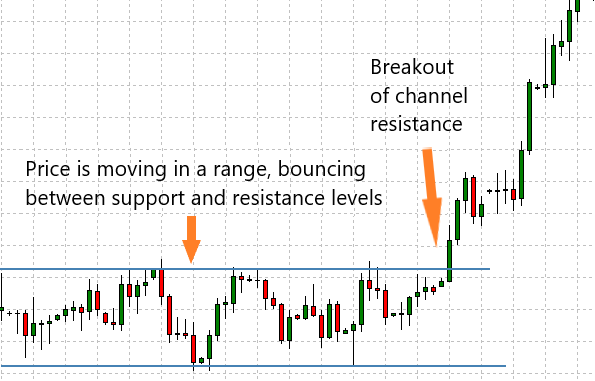
Traders enter when price clears important chart levels (support, resistance, psychological prices). Broken support levels signal downward movement; broken resistance levels indicate upward movement. Increased volume validates sustainability; low volume suggests potential false breakouts.
2. Scalping
Scalpers aim to capture very small price moves — often just 2–5 pips — repeated dozens or hundreds of times throughout the day.
Logic: Small edges compounded over many trades can produce significant daily returns, even if each individual trade is tiny.
Characteristics:
- Very short holding times (seconds to a few minutes)
- Requires extremely tight spreads — scalping is only viable with ECN/STP brokers
- Demands fast execution and a broker that does not requote frequently
- High transaction costs from the sheer number of trades
Scalping is psychologically demanding and not suited to all traders. It also requires deep liquidity, which is why it is most common in EUR/USD, GBP/USD, and other major pairs.
3. Momentum Trading
Momentum strategies enter trades in the direction of a strong, news-driven or technically confirmed move when price is moving rapidly with elevated volume.
Logic: Large institutional orders create directional momentum that tends to persist for minutes to hours before exhaustion.
Triggers:
- Economic data releases (NFP, CPI, rate decisions)
- Earnings surprises (for equities)
- Technical breakout of a key level on high volume
Risk: Momentum can reverse sharply. The entry window is brief — entering too late means buying into an exhausted move rather than a fresh one.
4. Trend Trading (Intraday)
Following market direction (uptrend: higher highs and higher lows; downtrend: lower highs and lower lows). Uses ADX, moving averages, price action, trendlines, and channels.
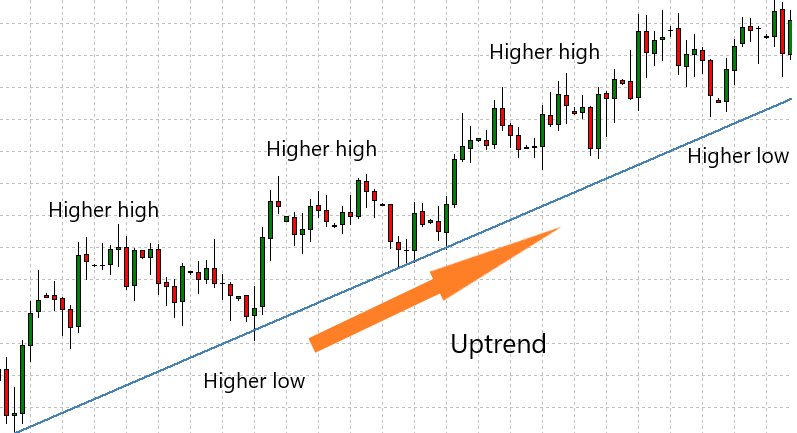
Intraday trend traders identify the dominant directional bias for the day and look for low-risk entries in the direction of that trend.
Indicators used:
- Moving averages (20 EMA, 50 EMA) — price above = uptrend bias
- ADX — measures trend strength; values above 25 suggest a tradeable trend
- Higher highs and higher lows (uptrend) or lower highs and lower lows (downtrend)
Entry: Pullbacks to support in an uptrend, or rallies to resistance in a downtrend
Logic: Trading with the trend reduces the probability of being on the wrong side of a sustained move
The challenge is identifying whether the day's price action is truly trending or simply choppy. ADX below 20 usually signals range conditions where trend-following strategies underperform.
5. Mean Reversion
Mean reversion strategies take positions against an overextended move, expecting price to snap back toward its average.
Logic: Markets oscillate. When price deviates significantly from its mean — measured by Bollinger Bands, RSI, or statistical z-scores — there is a probabilistic edge in fading the extreme.
Entry signals:
- RSI above 70 (overbought) → look for short
- RSI below 30 (oversold) → look for long
- Price touches upper/lower Bollinger Band with a reversal candle
Risk: Mean reversion fails catastrophically in trending markets. A currency that is trending hard will keep pushing through overbought/oversold readings. Always combine with trend filters to avoid fading a genuine breakout.
Choosing the Right Strategy
No strategy works in all market conditions. The best day traders typically:
- Specialise in 1–2 strategies rather than switching between all five
- Define their market conditions filter — know when your strategy has an edge and when to stay flat
- Back-test rigorously before trading live
- Maintain a trading journal to identify what works for them personally
Entry and exit timing are everything in day trading. A sound strategy executed with poor timing produces poor results. This is why backtesting with high-quality data — particularly tick or M1 data — is essential for understanding exactly where your edge exists.