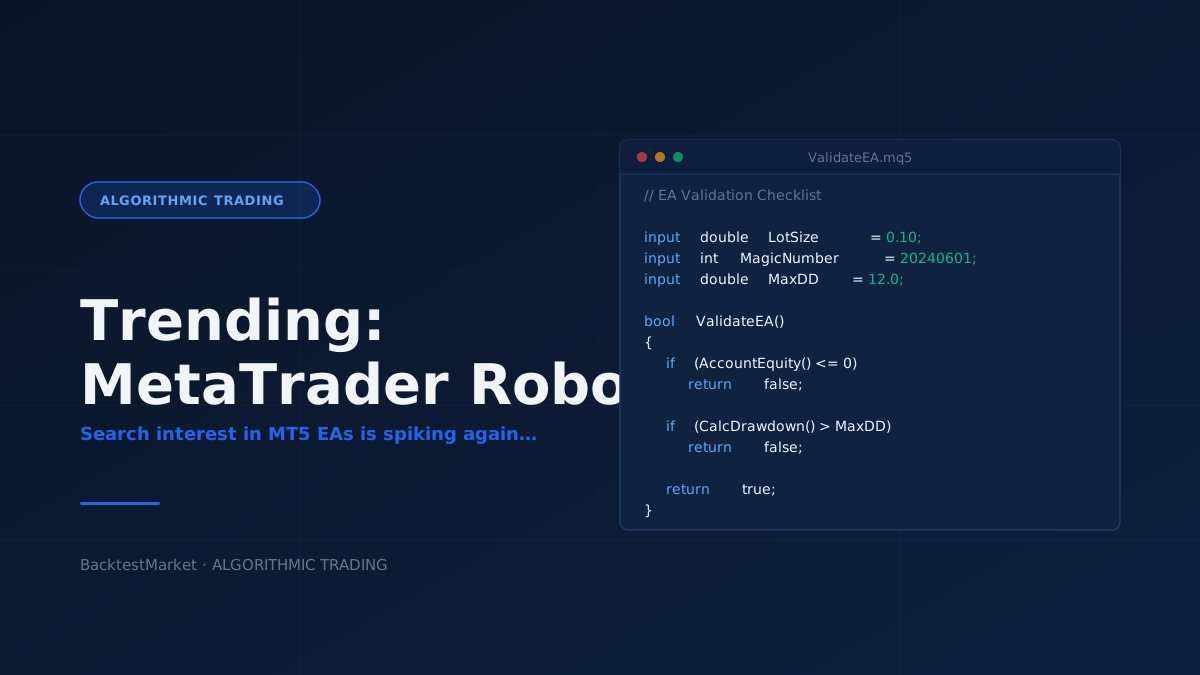
Search interest in "metatrader robot" and "MT5 EA" has picked up again this month, running alongside renewed curiosity about EURUSD-specific strategies. This kind of clustering — a platform term, a specific EA format, and a major pair — usually signals that retail traders are re-entering the automation conversation after a quiet stretch, often triggered by a volatile news cycle or a wave of social media posts showing equity curves without context.
That's worth pausing on, because "metatrader robot" is a search term, not a strategy category. An Expert Advisor can be a mean-reversion scalper on M1, a swing-trading trend follower on H4, a grid martingale system, or a news-event filter. The label tells you almost nothing about whether it fits your account, your risk tolerance, or the market regime you're trading in. This article isn't about which robot to buy — it's about the due diligence framework that separates a defensible automated system from a curve-fitted one, so that whatever you evaluate next (built yourself or downloaded) gets a fair, skeptical test.
What "MetaTrader Robot" Actually Means Today
MetaTrader 4 and MetaTrader 5 remain the dominant retail platforms for algorithmic execution because they standardize three things: a scripting language (MQL4/MQL5), a strategy tester with historical simulation, and a broad broker network offering API-level automation without custom infrastructure. When people search "metatrader robot," they're typically looking for one of three things:
- A pre-built EA they can attach to a chart and run with minimal configuration.
- A backtest or historical dataset to validate a strategy idea before committing capital.
- A framework or template to build their own logic using existing indicators and order-management code.
Each of these has very different risk profiles. A pre-built EA is a black box unless the vendor discloses logic and provides raw backtest reports you can independently verify. A backtest dataset shifts the responsibility to you — you design the rules, but you need clean, tick-accurate historical data to avoid drawing false conclusions. A framework sits in between: you inherit someone else's execution plumbing but retain control of the actual trading logic.
None of these paths is inherently better. What matters is whether the testing process behind the robot — whoever built it — followed principles that hold up under scrutiny.
The Backtesting Checklist Most MT5 EA Reviews Skip
Before trusting any equity curve, whether it comes from a marketplace listing, a forum post, or your own strategy tester, run it through the following checks. These are standard quantitative practices, not proprietary tricks, and they apply whether you're evaluating a downloaded EA or building one from scratch.
Data quality and modeling mode. MT4's strategy tester historically relied on "every tick" simulation built from lower-resolution data unless real tick history was supplied, which can misprice slippage and spread on fast-moving pairs. MT5 improved this with more granular tick modeling, but the result is still only as good as the underlying data feed. If a robot's backtest doesn't specify the data source, timeframe granularity, and modeling quality, treat the results as illustrative at best. Sourcing verified forex historical data separately and re-running the test yourself is a reasonable way to sanity-check a vendor's claims.
Spread and commission assumptions. A strategy that looks profitable on a fixed 0.5-pip spread can behave very differently under the variable spreads and occasional widening that real brokers apply around news releases or low-liquidity sessions. Ask whether the backtest used realistic, broker-representative spread and commission settings, and whether those settings were held constant across the entire test period or adjusted to flatter a particular stretch.
Sample size and market regime coverage. A backtest spanning six months of a strong trending market tells you very little about how a trend-following EA behaves in a ranging or high-volatility regime. Look for testing periods that include at least one clear trend phase, one range-bound phase, and one high-volatility event (a rate decision, a liquidity shock, a major geopolitical print). If the EA's track record doesn't span multiple regimes, its edge — if any — is unproven outside the conditions it was built on.
Parameter sensitivity. This is the most commonly skipped step. Take any published EA's input parameters and shift each one by 10–20% in either direction. If performance collapses or flips to negative with small parameter changes, the original result likely reflects overfitting to historical noise rather than a durable market inefficiency. A robust strategy tends to show a "plateau" of reasonable performance across a range of nearby parameter values, not a single sharp peak.
Walk-forward or out-of-sample validation. Any backtest optimized entirely in-sample and reported without an out-of-sample or walk-forward segment should be treated with heavy skepticism. Splitting data into an optimization window and a genuinely untouched validation window is the minimum bar for taking a result seriously.
EURUSD-Specific Considerations for Automated Systems
Given that EURUSD strategy searches are trending alongside MetaTrader robot queries, it's worth addressing why pair selection changes the due diligence process. EURUSD is the most liquid FX pair, which means tighter spreads and generally lower slippage — a favorable environment for automation. But that liquidity also means the pair is heavily arbitraged and closely watched, so simple technical patterns (moving average crossovers, basic RSI thresholds) tend to get arbitraged away faster than on thinner pairs, and edges that do exist are often narrow and sensitive to execution costs.
Practical considerations specific to EURUSD-focused EAs:
- Session overlap sensitivity. Volatility and spread behavior differ sharply between the London/New York overlap and the Asian session. An EA tuned entirely on overlap-hour data may behave erratically if left running through the Asian session without session filters.
- Correlation with DXY and rate differentials. EURUSD is heavily influenced by relative central bank policy between the ECB and the Federal Reserve. A backtest that doesn't span multiple rate cycles (hiking, holding, cutting) may not capture how the strategy behaves when the macro backdrop shifts.
- News-event behavior. Non-farm payrolls, ECB rate decisions, and CPI releases can produce spread spikes and slippage that a standard backtest — especially one without tick-level data — will systematically underestimate. Some EA vendors build in a news filter that pauses trading around high-impact releases; if a robot lacks one, ask how it historically behaved during those windows specifically, not just in aggregate.
None of this means EURUSD is a poor choice for automation — its liquidity is exactly why it remains the most commonly backtested pair. It means the validation bar needs to account for the pair's specific liquidity and macro-sensitivity characteristics rather than relying on a generic all-pairs backtest summary.
Setting Up a Fair Test Environment
If you're planning to evaluate a robot yourself rather than trust a vendor's report, the setup matters as much as the strategy logic.
Start with clean, complete historical data rather than whatever your broker's default history provides, which is often truncated or inconsistent across timeframes. Importing a dedicated historical data pack and following a proper import process for MetaTrader ensures your strategy tester is working from the same tick-level foundation the strategy was theoretically designed for, rather than gaps that silently skew results. If you're comparing behavior across platforms — say, validating an idea in NinjaTrader before porting logic to MQL — the same discipline applies; see the NinjaTrader import guide for the equivalent workflow.
Once your data is in place, test on a demo account for a meaningful stretch before considering live execution, and treat the strategy tester's report line-by-line: drawdown duration (not just magnitude), the ratio of winning to losing trade sizes, and the consistency of monthly returns matter more than a single headline profit figure. A strategy with modest but consistent performance across varied conditions is generally more informative than one with a spectacular but narrow historical run.
Takeaway
The current spike in "metatrader robot" and "MT5 EA" searches reflects renewed interest in automation, not a signal that any particular robot is newly effective. Before attaching an EA to a live or even demo account, verify the data quality behind its backtest, check parameter sensitivity, confirm out-of-sample validation exists, and — if the strategy targets EURUSD specifically — account for session and macro-cycle coverage. If you're building or testing your own logic, browsing available Expert Advisor robots alongside independent historical data packs gives you the raw materials to run this due diligence yourself rather than relying on a vendor's summary statistics alone. Automation can remove emotional decision-making from execution, but it can't substitute for a rigorous, skeptical evaluation of the logic doing the deciding.