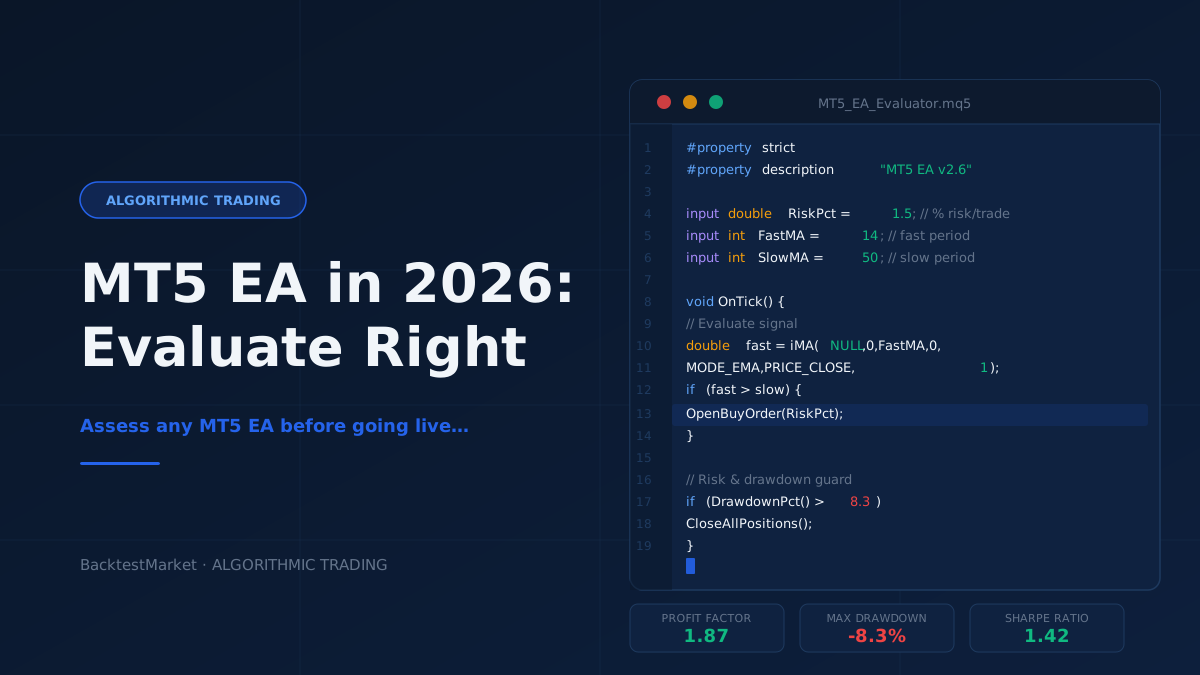
Search interest in "MT5 EA" has spiked again this week, and anyone who has watched the algorithmic trading space for more than a cycle or two knows this pattern well. Retail interest in Expert Advisors tends to surge in waves — often tied to volatility in major pairs, a new MetaTrader build, or simply more traders discovering that MetaTrader 5's native strategy tester has become a genuinely capable research environment. Whatever the trigger this time, the renewed attention is a good excuse to step back and ask a more useful question than "which EA should I run?" — namely, how do you actually evaluate an MT5 Expert Advisor before you trust it with live capital?
This article isn't a ranking of "best EAs." It's a framework for thinking about what makes an Expert Advisor worth your attention, and what red flags should make you close the tab.
Why MT5 EAs Are Trending Right Now
A few structural factors tend to drive spikes in EA search volume, and it's worth naming them so you can separate signal from noise:
- Platform maturity. MT5's strategy tester now supports multi-currency backtesting, more granular tick data modeling, and native Python integration for some brokers. Traders who previously stuck with MT4 for its simplicity are migrating, and that migration itself generates search volume around "MT5 EA" as people look for compatible tools.
- Volatility clusters. Periods of elevated volatility in FX majors, gold, or indices tend to renew interest in automation, because manual discretionary trading becomes harder to execute consistently when price action gets choppy. Automated systems, in theory, remove some of the emotional decision-making — though they introduce their own risks (more on that below).
- Broader retail algo adoption. More brokers now offer VPS hosting, one-click EA deployment, and built-in marketplaces, lowering the technical barrier to running an EA. Lower barriers mean more search traffic from traders exploring the category for the first time.
None of this tells you whether any specific EA is sound. It just explains why the term is trending — and it's a reminder that trend data reflects interest, not quality or edge.
What Separates a Credible EA from a Marketing Gimmick
If you're evaluating an Expert Advisor — whether you built it yourself, downloaded a free version from a forum, or are considering a paid one — there are a handful of non-negotiable checks that separate a credible system from a story dressed up as a strategy.
1. The backtest period and data quality
An EA backtested over six months of 2024 data tells you very little about how it behaves across different regimes. Look for testing across multiple market conditions: trending years, range-bound years, and at least one period of elevated volatility (a rate-decision cycle, a geopolitical shock, a liquidity crunch). If the vendor or developer can't tell you what data range was used, or the data source quality, treat the results with skepticism. Tick-level data versus lower-resolution "every tick based on real ticks" modeling produces materially different fill assumptions, and this matters enormously for scalping or high-frequency logic. If you're sourcing your own historical data for independent verification, a forex historical data pack with documented tick quality is a reasonable starting point rather than relying on whatever the platform happens to ship with.
2. Spread, slippage, and commission modeling
This is where a huge share of "great backtest, terrible live results" stories originate. A backtest run with fixed 0-pip spread on a broker that actually charges variable spreads of 1.5–3 pips during news events will produce an inflated equity curve. Ask (or check) whether the EA's reported results account for:
- Realistic variable spread, not a flat average
- Commission per lot, if the account type charges one
- Slippage on market orders, especially around high-impact news releases
- Swap/rollover costs if the strategy holds positions overnight
3. Sample size and statistical robustness
A strategy that produces 40 trades over three years is not statistically meaningful, no matter how clean the equity curve looks. As a rough heuristic, look for enough trades to apply basic statistical reasoning — the exact threshold depends on the strategy type, but single-digit or low double-digit trade counts should raise your skepticism, not your confidence. Related to this: check whether performance is concentrated in a handful of outlier trades. If removing the best 3–5 trades turns a profitable system into a flat or losing one, the strategy's apparent edge may be closer to noise than to a repeatable statistical advantage.
4. Out-of-sample and walk-forward testing
Any EA can be curve-fit to a historical period given enough parameter tweaking. The real test is whether the strategy holds up on data it was never optimized against. Walk-forward analysis — optimizing on one window, then testing forward on an unseen window, repeated across the dataset — is one of the more honest ways to check whether a strategy's logic generalizes or whether it was simply reverse-engineered to fit the past.
Practical Steps for Testing an MT5 EA Yourself
If you're going to actually run an Expert Advisor rather than just read about one, there's a reasonably disciplined process worth following before it ever touches a live or even demo account with real signal exposure:
Step 1 — Verify the data source. MT5's built-in historical data from your broker may have gaps, especially on less liquid pairs or during low-volume sessions. If you're serious about validating a strategy, consider supplementing with a dedicated historical data pack that documents its source and tick quality, so you're not backtesting against incomplete price history without realizing it. The platform's own data import guide walks through the mechanics of getting clean data loaded correctly, which matters more than most traders assume — a broken import can silently distort an entire backtest.
Step 2 — Run the strategy tester across multiple symbols and timeframes it wasn't designed for. If an EA built for EUR/USD H1 falls apart entirely on GBP/USD H1 with the same core logic, that's useful information about how specific — and potentially overfit — the parameter set is to one instrument.
Step 3 — Stress-test the assumptions. Widen the spread assumption, add slippage, and reduce the sample to see how sensitive the results are. A robust strategy degrades gracefully under harsher assumptions; a fragile one collapses entirely.
Step 4 — Forward test on a demo account before committing capital. This step is unglamorous and it's the one most new EA users skip, but it's the only way to see how a strategy performs under real-time execution conditions, including the lag between signal generation and order fills — something historical backtests can only approximate, not reproduce exactly.
Step 5 — Define a stop condition before you start. Decide in advance what drawdown, consecutive loss count, or time period would cause you to disable the EA and reassess. Having this threshold set before emotional capital is on the line is far more reliable than trying to decide it in the moment.
Reading Trend Data Without Over-Reacting to It
It's worth emphasizing: the fact that "MT5 EA" is trending in search data this week says nothing about whether automated trading is more or less viable right now than it was last month. Search trends reflect attention, driven by news cycles, platform updates, broker marketing, or simple curiosity. They are not a market signal, and they shouldn't be treated as one.
What a spike in interest can do is prompt a useful reset. If you already run an EA, this is a reasonable moment to re-run its backtest with updated data, confirm the spread/commission assumptions still match your current broker's conditions, and check whether its live performance has tracked its backtested expectations or diverged meaningfully. Divergence between live and backtested results is common and not automatically disqualifying — but it's a signal that assumptions need revisiting, not that the strategy is broken.
If you're new to the category and exploring it for the first time, resist the pull toward whatever looks most impressive in a marketing screenshot. An equity curve with no documented methodology is marketing, not evidence.
Takeaway
Trending search interest in MT5 Expert Advisors is a reminder to revisit fundamentals, not a reason to rush into deploying new automation. Before running any EA — your own or one sourced elsewhere — confirm the data quality behind its backtest, check realistic cost assumptions, look for out-of-sample validation, and forward test on demo before committing capital. If you want to build or verify your own testing environment with properly documented historical data, browse the Expert Advisor and historical data catalogs on BacktestMarket, and treat every backtest — yours or someone else's — as a hypothesis to be stress-tested, not a result to be trusted on first read.