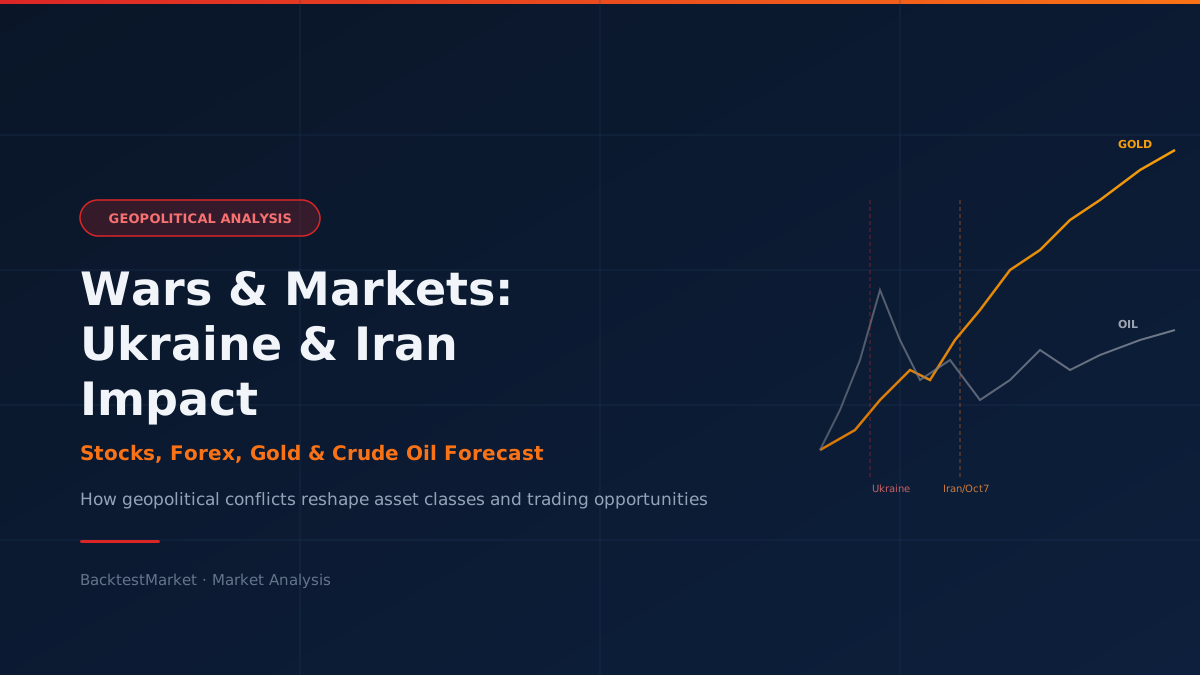
Two Wars, One Structural Shift
Since February 24, 2022, when Russia launched its full-scale invasion of Ukraine, financial markets have been navigating a level of geopolitical risk not seen since the Cold War. Then, in October 2023, the Hamas attack on Israel and the subsequent escalation involving Iran — including direct Iranian missile strikes on Israeli territory in April and October 2024 — added a second, simultaneous front of instability to an already fragile global system.
This is not a temporary shock. These two conflicts have fundamentally repriced several major asset classes, and the structural changes they introduced will persist regardless of how the wars themselves resolve.
The question for traders is not whether to react — it is how to position intelligently in an environment where geopolitical risk is now a permanent component of every price.
What the Ukraine War Actually Did to Markets
The First Wave (2022): Inflation + Rate Shock
The initial impact of the Ukraine war was not primarily a military risk premium — it was an energy and commodity supply shock that amplified the inflation problem the Fed and ECB were already failing to manage.
Russia supplies roughly 10% of the world's oil and about 40% of Europe's natural gas (before the war). When sanctions hit and pipelines were shut down, European energy prices exploded. Dutch TTF natural gas hit €340/MWh in August 2022 — about ten times its historical average.
This sent inflation across the Eurozone above 10% for the first time in decades. The ECB, which had been far too late to begin hiking, was forced into the most aggressive tightening cycle in its history. The Fed was doing the same. The result:
- S&P 500 fell ~25% from January to October 2022
- Nasdaq fell ~35% — growth and tech were crushed by rising rates
- European equities fell 20–25%
- EUR/USD collapsed from 1.14 to 0.96 — parity broken for the first time in 20 years
The Structural Reshaping of European Energy
Europe scrambled to replace Russian gas with LNG from the US, Norway, and Qatar. It built new LNG terminals in record time. Germany — which had built its entire industrial model on cheap Russian gas — faced an existential energy crisis.
The result is that European energy costs are now structurally higher than they were pre-2022, even with the immediate crisis past. This structural competitiveness disadvantage for European industry is not going away. For traders, this means European equities — especially industrials and chemicals — face a permanent headwind relative to US counterparts.
Defense Spending: The Largest Secular Theme of the Decade
One clear winner has been the defense sector. NATO members have been forced to dramatically increase military spending — Germany reversed decades of policy by committing 2% of GDP to defense. European defense stocks such as Rheinmetall, BAE Systems, Leonardo, and Thales have dramatically outperformed broad indices since 2022.
This is not a cyclical trade. It is a generational rearmament cycle that will persist for years regardless of how the Ukraine war ends.
What the Iran-Israel Conflict Added
The Middle East Risk Premium
The Hamas attack of October 7, 2023 initially produced a modest market reaction — equity markets dipped briefly and oil spiked, then both quickly recovered. Markets initially priced this as a contained regional conflict.
That calculus changed when Iran directly attacked Israel with ballistic missiles and drones in April 2024, and again in October 2024. For the first time since the Gulf War, a state actor had directly attacked another state with missiles — and the risk of regional escalation involving Iran's proxies (Hezbollah, Houthis, Iraqi militias) became real.
The Houthi Shipping Crisis
The Houthi attacks on Red Sea shipping routes beginning in late 2023 have had concrete economic consequences. Container shipping through the Suez Canal — which normally handles about 15% of global trade — dropped dramatically as carriers rerouted around the Cape of Good Hope. This adds approximately:
- 2 weeks to transit times from Asia to Europe
- $1,000–$3,000 to container shipping costs per box
- Upward pressure on goods inflation, just as central banks were trying to declare victory
This is a direct channel from war to consumer prices, and it is ongoing as of writing.
Asset Class Forecasts
Gold: The Clearest Beneficiary
Gold has been the most obvious winner from the geopolitical environment of the past three years.
The mechanism is multi-layered:
1. Safe haven demand from uncertainty. Both wars — and the tail risk of escalation — create persistent demand for the classic crisis hedge.
2. Central bank buying. The freezing of Russia's $300 billion in foreign exchange reserves after the Ukraine invasion sent a warning signal to every central bank outside the Western alliance: holding USD reserves is not risk-free if relations deteriorate. The result has been a dramatic acceleration in central bank gold buying — particularly China, India, Turkey, and Middle Eastern states — that has structurally raised the floor for gold demand.
3. Dollar debasement fear. US fiscal deficits running at 6–7% of GDP during peacetime have elevated concerns about long-term USD purchasing power. Gold is the classic hedge against currency debasement.
Forecast for Gold: The structural bid from central banks is not going away. The geopolitical risk premium is not going away. The fiscal deficit trajectory in the US is not going away. I believe gold remains in a multi-year bull market. The next meaningful target is the $3,500 zone, with a longer-term target of $4,000+ if the macro conditions outlined above persist.
The main risk to this view is a sudden, credible resolution of both geopolitical crises combined with a dramatic improvement in US fiscal discipline — a scenario I assign low probability.
Crude Oil: Structurally Constrained Supply
Crude oil has had a more complex reaction than gold, for a simple reason: the geopolitical supply disruption narrative competes directly with the demand recession narrative.
The Ukraine war initially sent Brent crude to $130/barrel in March 2022. It then fell back as demand fears, strategic reserve releases, and rerouted Russian oil (flowing to India and China at a discount) offset the supply shock. By late 2023, Brent had settled in the $75–$90 range.
The Iran-Israel conflict and Houthi activity have added a geopolitical risk premium of approximately $5–10/barrel to oil, but this premium compresses when direct conflict appears contained.
What drives oil from here:
- OPEC+ discipline: Saudi Arabia and Russia have been cutting production to defend prices. This creates a floor around $70–$75 Brent. Below this level, OPEC+ will cut further.
- Iran supply: If Iran-US relations deteriorate further and sanctions tighten on Iranian exports, meaningful supply could be removed from the market. Iran is currently producing ~3.2 million bpd — stricter enforcement could remove 0.5–1 million bpd.
- Demand: China's recovery remains uneven. A strong China rebound is the biggest potential demand catalyst.
Forecast for Crude Oil: Base case is a range of $70–$95 Brent for the next 12 months, with upside risk from Iranian sanctions or Gulf escalation. A resolution of the Russia-Ukraine war that leads to lifting of Russian oil sanctions could temporarily push prices below $70. The structural floor is around $65–$70 due to OPEC+ intervention levels.
For systematic traders, crude oil has become more range-bound but with fat tails. Breakout strategies that capture the occasional geopolitical spike work well in this environment — but mean-reversion strategies are the backbone of day-to-day profitability.
Equities: Two-Speed Market
The effect of the wars on equities has produced a clear bifurcation:
Sectors that have benefited:
- Defense and aerospace (structural winner)
- Energy (Ukraine-driven repricing)
- Commodities and mining
- Nuclear energy (Europe's forced energy diversification)
Sectors under pressure:
- European industrials (energy cost disadvantage)
- Consumer discretionary (inflation squeeze on household income)
- Rate-sensitive sectors (real estate, utilities, growth tech) — war-driven inflation → rate hikes → multiple compression
S&P 500 Outlook: The US market has largely decoupled from the direct effects of both wars — the US is a net energy exporter, is geographically distant from both conflicts, and has its own defense industry benefiting from the rearmament cycle. The main transmission mechanism is through inflation and rates.
If the geopolitical environment stabilizes and inflation continues to decline, the S&P 500 has room to move higher. If either conflict escalates materially — particularly if Iran closes the Strait of Hormuz or enters open war — the oil shock/inflation transmission could trigger a meaningful correction. I would not be short equities here, but I would hedge with commodities exposure.
European equities remain structurally challenged. The energy cost disadvantage, weaker fiscal capacity, and greater proximity to war risk are not going away. I prefer US equities over European ones on a 12-month view.
Forex: Dollar Strength Is Not Over
The geopolitical environment has reinforced dollar strength through multiple channels:
- Safe haven demand: In every risk-off episode since 2022, capital has flowed into USD.
- Rate differential: The Fed hiked earlier and further than the ECB; even with cuts beginning, the differential remains USD-positive.
- Energy independence: The US is a net energy exporter. Geopolitical energy shocks that hurt Europe and Asia actually improve the US terms of trade.
EUR/USD: The pair tested parity in 2022 and has since recovered to the 1.05–1.12 range. I do not expect EUR/USD to return to pre-war levels of 1.15–1.20 anytime soon. The structural competitiveness issues in Europe — energy costs, demographics, lower defense spending efficiency — are multi-year headwinds. Medium-term view: EUR/USD range of 1.00–1.10, with bias to the lower half on any escalation.
USD/JPY: The yen has been structurally weak due to the Bank of Japan's ultra-loose policy relative to the Fed. This divergence is slowly narrowing as the BoJ begins tightening. Long-term, JPY has room to appreciate — the yen is significantly undervalued on purchasing power parity — but the timing is uncertain.
Commodity currencies (CAD, AUD, NOK): These benefit from elevated commodity prices driven by geopolitical supply disruptions. CAD in particular benefits from high oil prices. If crude stays above $80, CAD is a medium-term long.
How to Trade These Conditions Algorithmically
At BacktestMarket, our approach to geopolitical-driven markets focuses on:
1. Trend-following on commodities. The geopolitical supply disruptions of 2022–2024 have produced some of the cleanest trends in commodity futures in decades. Gold, natural gas, and agricultural futures have shown sustained directional moves that trend-following systems capture well.
2. Volatility expansion strategies for equities. Rather than trying to predict direction during geopolitical events, systems that detect and trade volatility spikes — similar to the Trump-era volatility strategies discussed in earlier articles — perform well. Enter on expansion, exit fast.
3. Correlation monitoring. In normal markets, the USD-Gold negative correlation is stable. When both rise simultaneously, it signals an extreme fear event. Monitoring this correlation and trading the divergence when it normalizes is a reliable systematic approach.
4. Defense sector positioning. The multi-year rearmament trend is one of the few truly structural secular trends available to investors right now. Systematic strategies that hold defense sector futures or ETF-based positions with trailing stops capture this without requiring day-to-day market prediction.
Conclusion
The Ukraine and Iran-Israel conflicts have not just caused temporary market dislocations — they have permanently restructured the risk and return landscape for several asset classes.
Gold benefits structurally and is likely heading higher. Crude oil is range-bound but with genuine upside tail risk. European equities face a multi-year competitiveness headwind. The US dollar remains the dominant safe haven. Defense is a generational investment theme.
For systematic traders, the key insight is this: geopolitical risk creates persistent trends in commodities and persistent volatility in equities. Build your systems accordingly — trend-following for gold and oil, volatility-adaptive for stocks, and carry strategies for forex.
The market is always right. Our job is to read what it tells us and trade accordingly.