Of all the skills in trading, trade management is the one that most directly determines long-term results. You can have a sound entry methodology, but if you mismanage open positions — closing winners too early, holding losers too long, moving stops out of fear — even a statistically valid strategy will underperform.
Expert Advisors solve this problem by removing the human element entirely.
What Is Trade Management?
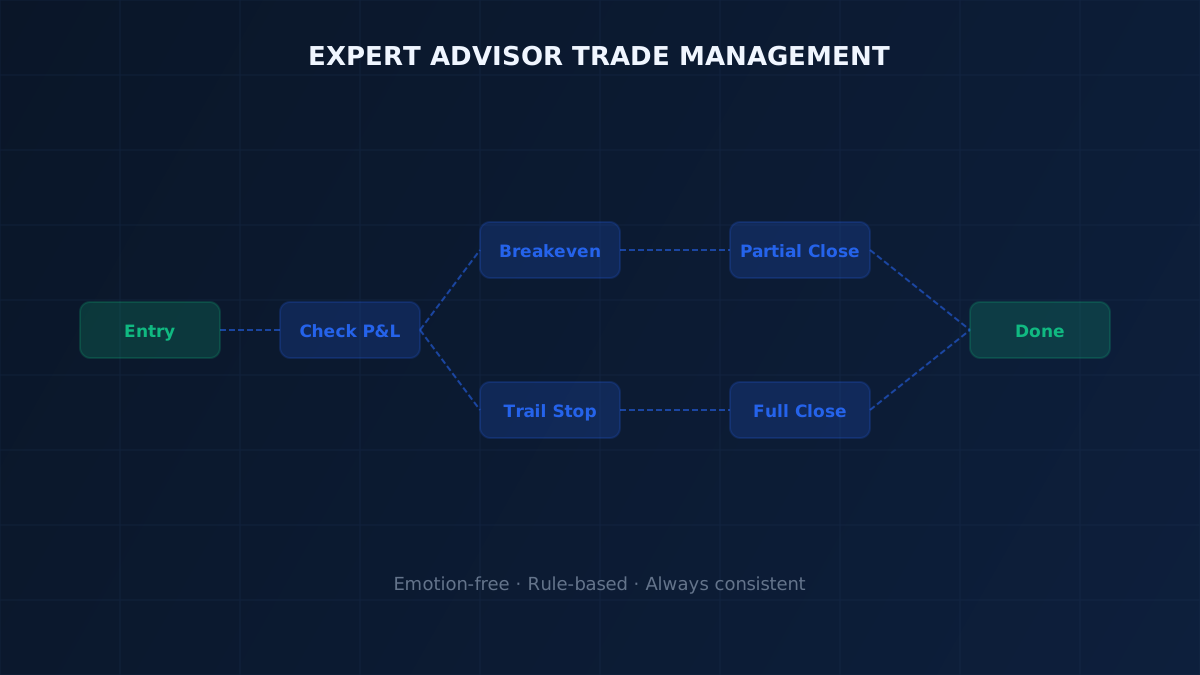
Trade management encompasses everything a trader does after entering a position:
- Where to place the initial stop loss
- Whether and when to move to breakeven
- When to take partial profits
- When to trail the stop to lock in gains
- When to close the entire position
Done well, trade management maximises the potential profit of winning trades while keeping losses small and predictable. Done poorly — which is almost inevitable when driven by real-time emotions — it destroys an otherwise profitable strategy.
The Emotion Problem
The challenge of manual trade management is not knowledge — most traders know what they should do. The problem is execution under pressure.
- A trade moves in your favour, you fear it reversing, you close it early
- A trade moves against you, you hope it comes back, you hold past your stop
- News hits during an open position, fear overrides your plan
These emotional overrides are universal. They are not character flaws — they are how human psychology responds to financial uncertainty. But in trading, acting on those impulses consistently destroys performance.
Expert Advisors are immune to these pressures. Once programmed, they execute the same rules every single time, regardless of market conditions, time of day, or how the last trade went.
Key Trade Management Features to Automate
Breakeven Stops
When a trade moves a defined number of pips in your favour, move the stop loss to the entry price. This eliminates risk from a trade that has already proved correct, allowing you to hold without fear of a loss.
// Move to breakeven when trade is +20 pips in profit
if (profit >= 20 && OrderStopLoss() < OrderOpenPrice()) {
    OrderModify(OrderTicket(), OrderOpenPrice(), OrderOpenPrice(), OrderTakeProfit(), 0);
}
Trailing Stops
A trailing stop follows price as it moves in your favour, locking in an increasing proportion of the trade's unrealised profit. If price reverses, the trailing stop triggers the close.
This is where Expert Advisors provide the most value. Manual trailing stop management requires constant attention — the EA handles it automatically in the background.
Partial Position Closing
Closing half a position at a defined target (say, 1:1 risk-reward) while holding the remainder with a trailing stop is a classic management technique. It secures partial profit while keeping exposure to a larger move.
An EA can execute this split-close instantly at the precise target price, without hesitation.
Position Sizing
Every trade's position size should be calculated relative to the stop loss distance and your defined risk per trade — typically 1–2% of account equity.
An EA can calculate this dynamically on each trade, ensuring position size adjusts as your account grows or shrinks, without manual calculation.
Risk-to-Reward Ratios
At a minimum, your take-profit target should be at least twice your stop loss distance (2:1 R:R). At 3:1 or higher, you can be profitable even if you win only 30–35% of your trades.
An EA enforces this ratio mechanically. In the heat of a trade, it is tempting to set a closer, "more achievable" target. The EA ignores that temptation.
The Result: Discipline Without Willpower
The real advantage of automating trade management is that discipline becomes the default, not an effort. The rules run the same way whether:
- You are tired
- You had a string of losses yesterday
- A news event just hit while your position is open
- You are watching the position tick-by-tick
This consistency is what separates traders who survive long term from those who blow accounts. The strategy is important, but how you manage open trades is often more important than when you enter them.
If you are still managing trades manually and notice that your live performance consistently underperforms your backtest results, inconsistent trade management is almost always the cause. Automating it is the most direct fix.