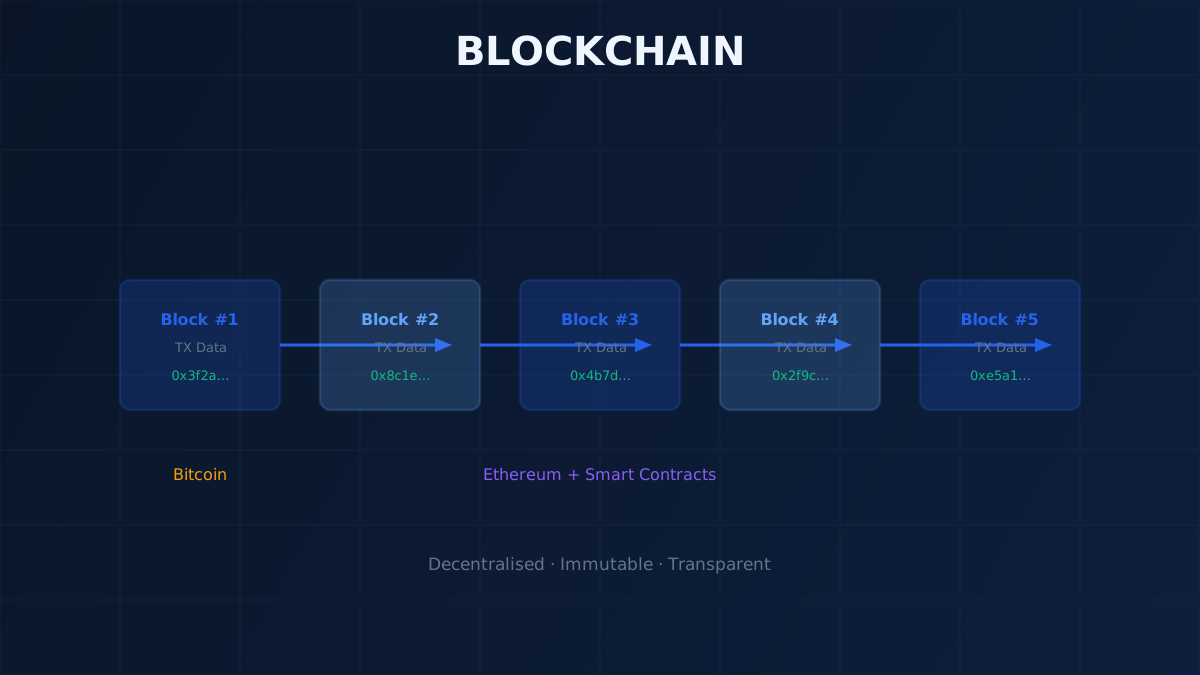
Blockchain emerged from relative obscurity to become one of the most discussed technologies of the past decade. The term gets used loosely in the media — sometimes to mean Bitcoin, sometimes to mean any distributed database, sometimes as a synonym for cryptocurrency generally. Understanding what blockchain actually is, and what it is not, clarifies both its genuine capabilities and its limitations.
The Core Definition
A blockchain is a continuously growing list of records (called blocks) that are linked together and secured using cryptography. Each block contains:
- A cryptographic hash of the previous block
- A timestamp
- Transaction data
Because each block references the previous one, the chain is tamper-resistant. Altering any historical block would invalidate all subsequent blocks — and the change would be immediately detectable by the network.
Unlike a traditional database controlled by a single company or institution, a blockchain can be distributed across thousands of computers simultaneously. No single party owns or controls the record. All participants hold a copy of the entire history.
Where It Came From
In 2008, a figure (or group) operating under the pseudonym Satoshi Nakamoto published a white paper describing Bitcoin — the first practical implementation of blockchain technology. Nakamoto's true identity has never been confirmed. Theories have pointed to cryptographers Nick Szabo and Hal Finney, among others, but none have been verified.
Bitcoin launched in 2009. It was the first system to solve the double-spend problem for digital currency without requiring a trusted central authority like a bank.
Bitcoin
Bitcoin is a digital currency that uses blockchain as its underlying ledger. Key properties:
- Decentralised — no government, bank, or company controls it
- Fixed supply — the maximum number of bitcoins that will ever exist is capped at 21 million. Traditional fiat currencies can be printed indefinitely by governments; Bitcoin cannot.
- Transparent — every transaction is publicly visible on the blockchain
- Pseudonymous — transactions are linked to wallet addresses, not real-world identities
The fixed supply and decentralisation are the properties that drive Bitcoin's narrative as "digital gold" — an asset whose value cannot be debased by monetary policy.
Ethereum and Smart Contracts
Bitcoin demonstrated that blockchain could work as a currency. Ethereum, launched in 2015, expanded the concept: it is a platform for creating decentralised applications (dApps) that run on the blockchain through smart contracts.
A smart contract is a self-executing program. It contains rules written in code, and when predefined conditions are met, it executes automatically — without any intermediary, counterparty trust, or human intervention required.
Examples of what smart contracts enable:
- Decentralised finance (DeFi) — lending, borrowing, and trading without banks
- NFTs — provable digital ownership of assets
- DAOs — organisations governed by code rather than by executives or boards
- Supply chain tracking — automated verification of delivery conditions
The key difference: Bitcoin's blockchain records only transactions. Ethereum's blockchain records and executes arbitrary programs.
Relevance to Financial Markets
Blockchain technology has several potential applications in traditional finance:
- Settlement — blockchain could replace the T+2 settlement cycle for equities with near-instant finality
- Transparency — trade history and ownership records that cannot be altered retroactively
- Tokenisation — representing real-world assets (real estate, commodities, shares) as blockchain tokens for fractional ownership and easier transfer
Many major banks and exchanges have run blockchain pilots. Adoption at institutional scale has been slower than the 2017 hype suggested, largely due to regulatory complexity and the difficulty of integrating with legacy infrastructure.
For traders, the most immediate relevance of blockchain is as an asset class. Cryptocurrencies exhibit price behaviour distinct from traditional markets — high volatility, 24/7 trading, sensitivity to regulatory news — and require their own analytical frameworks.