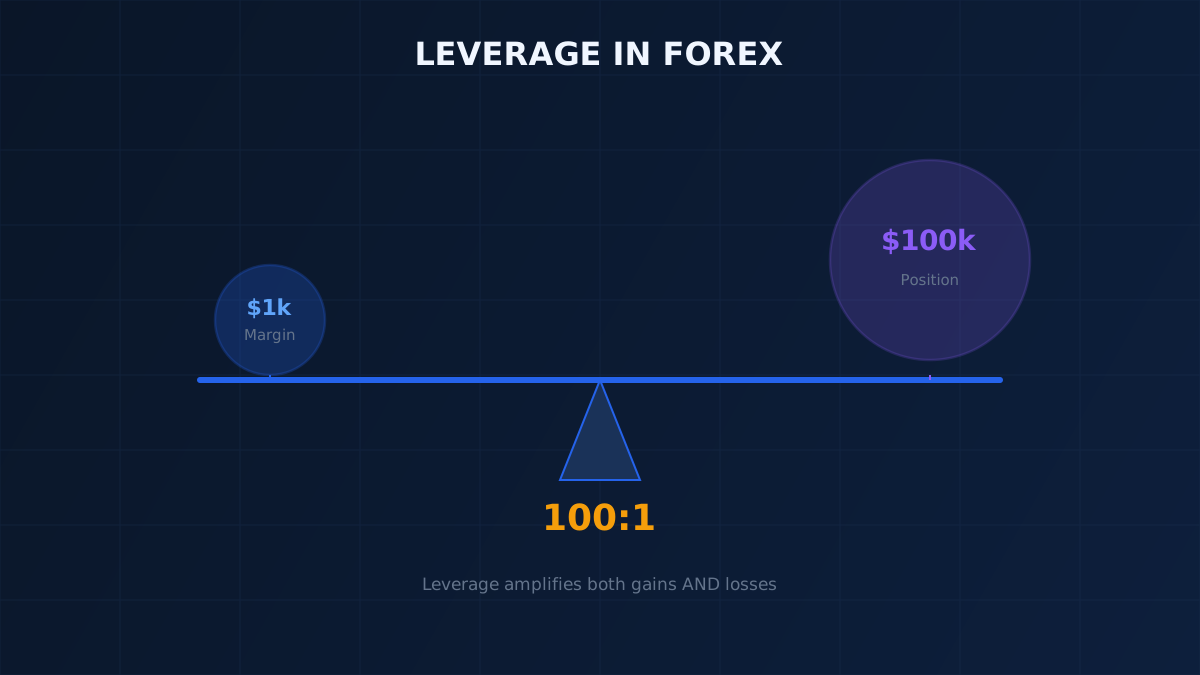
Leverage is one of the most powerful — and most misunderstood — concepts in forex trading. Used correctly, it allows traders with modest capital to access meaningful position sizes. Used carelessly, it can wipe an account on a single trade.
What Leverage Actually Means
Leverage is a loan from your broker. When you open a forex account and deposit $1,000, leverage of 100:1 means you can control a position worth $100,000. The broker lends you the difference, secured against your deposit (called margin).
Common leverage ratios offered by forex brokers:
| Leverage | Margin Required | Control on $1,000 deposit |
|---|---|---|
| 50:1 | 2.0% | $50,000 |
| 100:1 | 1.0% | $100,000 |
| 200:1 | 0.5% | $200,000 |
| 400:1 | 0.25% | $400,000 |
US regulations cap retail forex leverage at 50:1 since regulatory changes post-2008 financial crisis. European brokers under ESMA regulation are capped at 30:1 for major pairs. Offshore brokers may offer higher ratios, though with fewer regulatory protections.
How Leverage Amplifies Both Gains and Losses
This is the critical point that beginners underestimate:
Without leverage:
- You buy €10,000 worth of EUR/USD at 1.1750
- EUR/USD moves up 50 pips to 1.1800
- Your profit: $50
With 100:1 leverage:
- You control €100,000 worth of EUR/USD at 1.1750
- EUR/USD moves up 50 pips to 1.1800
- Your profit: $500
The same move in price produces ten times the profit. But the same logic applies to losses. A 2% adverse move on a fully leveraged position can eliminate your entire margin deposit — the broker will issue a margin call and close your positions if your account equity falls below the maintenance margin level.
The Reality of High Leverage
Experienced traders rarely use the maximum leverage their broker offers. Having access to 400:1 leverage does not mean you should use it.
A practical approach: even with 400:1 available, limit individual trade risk to 1–3x leverage combined with a stop loss that ensures a maximum loss of 1–2% of account equity per trade.
Worked example:
- Account equity: $10,000
- Risk per trade: 1.5% = $150 maximum loss
- Stop loss: 30 pips on EUR/USD ($10 per pip on a standard lot)
- Maximum lot size: $150 ÷ $10 = 1.5 mini lots (0.15 standard lots)
This approach means your effective leverage on that trade is roughly 1.5:1 in terms of risk, regardless of what your account's maximum leverage is.
This kind of disciplined position sizing is what separates traders who survive long-term from those who blow accounts within weeks of opening them.
Why Leverage Exists
Forex price movements are small. EUR/USD rarely moves more than 1–2% in a single day. Without leverage, a $10,000 account earning 1% on a daily move would produce $100. For most traders, that return profile would not justify the time and risk.
Leverage compresses the capital required to generate meaningful returns from small price movements. It makes forex accessible to retail traders who do not have hundreds of thousands of dollars to deploy.
Practical Rules for Using Leverage Safely
- Never risk more than 1–2% of account equity on a single trade — this is the universal rule of thumb
- Use stop losses on every trade — leverage without a stop loss is pure gambling
- Size your position based on where your stop is, not on how much leverage you have available
- Understand the margin requirements for every instrument you trade
- Check your free margin before adding positions — running too many leveraged trades simultaneously can trigger a margin call even if each individual trade looks reasonable
Leverage is a tool. Like any tool, its value depends entirely on how it is used.