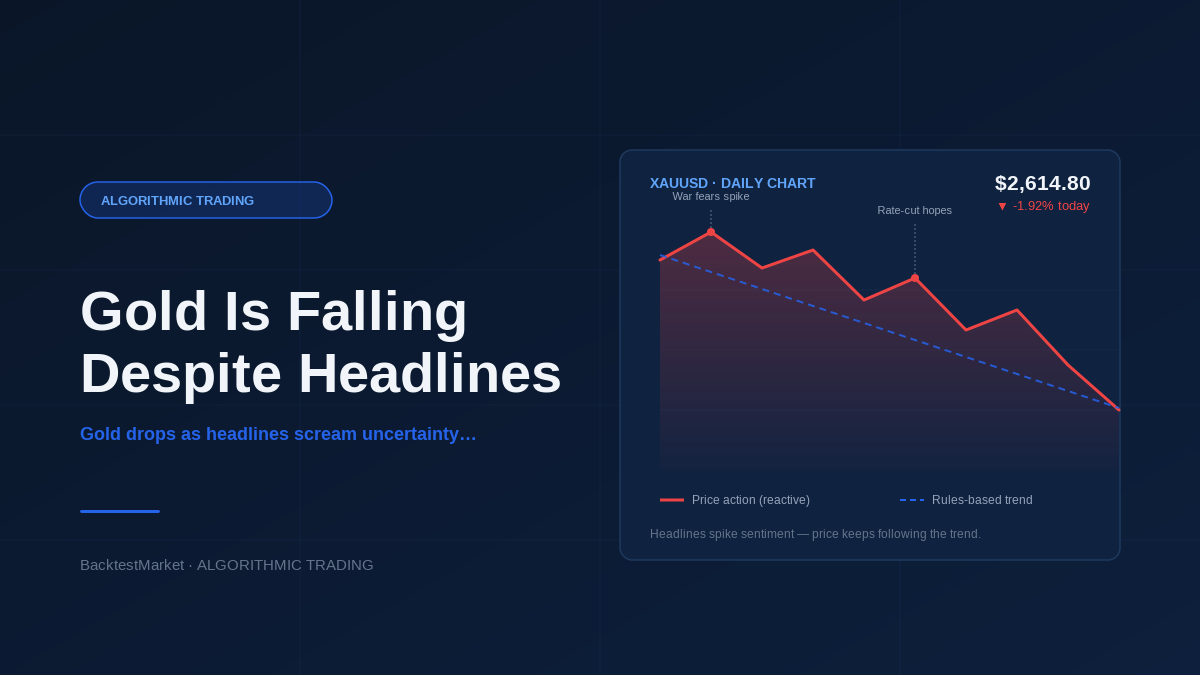
If you've been watching XAUUSD lately, you've probably noticed something that feels contradictory: the news cycle is full of uncertainty, geopolitical friction, and the usual "safe-haven" language — yet gold has been sliding. For newer traders, this can feel confusing, even unsettling. Isn't gold supposed to go up when the world looks shaky?
The honest answer is: not always, and not automatically. Gold's relationship with "safe-haven demand" is real, but it's only one input among several, and right now other forces are outweighing it. This article breaks down, in plain English, why that disconnect happens — and more importantly, how algorithmic traders can structure their thinking around it instead of just reacting to headlines.
The safe-haven narrative is incomplete
The phrase "gold is a safe haven" gets repeated so often that it starts to sound like a law of physics. In practice, it's a tendency, not a guarantee. Gold has historically attracted flows during acute crises — sudden shocks, banking panics, war outbreaks — because it's a non-sovereign, physically scarce asset with no counterparty risk. That part of the story is well documented.
But gold is also priced in dollars, carries no yield, and competes directly with interest-bearing assets. That means its price is simultaneously influenced by:
- Real interest rates — the yield investors can get on inflation-protected government debt. When real rates rise, the opportunity cost of holding non-yielding gold rises too.
- Dollar strength — since gold is dollar-denominated globally, a stronger dollar mechanically makes gold more expensive for holders of other currencies, dampening demand.
- Positioning and crowding — after a long rally, a market can become overcrowded with long positions. Any shift in sentiment can trigger unwinding that has nothing to do with the original "fear" narrative.
- Central bank and institutional flows — large, slow-moving buyers (or sellers) can dominate price action over weeks, independent of daily headlines.
So when headlines emphasize "uncertainty" but gold still falls, it usually means one or more of the other factors — rates, dollar strength, positioning unwinds — are currently dominating the price action. The safe-haven bid hasn't disappeared; it's just being outweighed.
This is a critical mental shift for new XAUUSD traders: gold doesn't react to the news, it reacts to the net effect of multiple competing forces, of which headline sentiment is just one.
Why "risk-off should mean gold up" is an oversimplified model
A lot of retail trading education boils macro behavior down to simple if-then rules: "risk-off = gold up," "rate cuts = gold up," "inflation = gold up." These heuristics aren't wrong, but they're incomplete models being treated as complete ones.
Consider two scenarios that look similar on the surface but produce opposite gold reactions:
- Crisis with falling rates and a weakening dollar — this is the textbook bullish setup for gold, and it tends to play out close to expectation.
- Crisis with rates staying elevated or the dollar strengthening because capital is fleeing into dollar assets — in this case, gold can underperform or even fall, because the "flight to safety" is landing in Treasuries and cash, not bullion.
The second scenario is closer to what newer traders often find confusing. The headlines sound identical ("uncertainty," "risk-off," "volatility"), but the underlying rate and currency dynamics are different, and that's what actually moves the price.
This is exactly the kind of nuance that's hard to hold in your head while watching a live chart, and it's one of the strongest arguments for building a more systematic, rules-based approach rather than trading off narrative. If you're testing ideas around rate sensitivity, dollar correlation, or positioning extremes, having clean historical data to work from matters a lot — this is where structured forex historical data becomes useful, since XAUUSD strategies often need to be cross-referenced against DXY and rate-sensitive instruments to see whether a rule actually holds up across different macro regimes.
What this means for how you test and trade XAUUSD
None of this is a call to predict where gold goes next — that's not the point of this article, and frankly it's not a productive way to approach the market as a retail trader. The more useful exercise is asking: how would a systematic approach have handled periods like this historically?
A few practical angles worth exploring if you're building or evaluating a gold strategy:
1. Separate your "headline risk" filter from your entry logic.
Many retail EAs trade purely on technical triggers — moving average crossovers, breakout levels, RSI thresholds — without any macro context layer. That's not inherently wrong, but it means the strategy has no awareness of whether it's operating in a "rates falling, dollar weak" regime versus a "rates sticky, dollar strong" regime. Backtesting the same technical rule across both regimes separately (rather than lumping years of data together) often reveals that performance is regime-dependent, not universal.
2. Respect that gold's volatility character shifts.
Gold during a genuine crisis spike behaves very differently — in terms of range expansion, spread widening, and gap risk — than gold in a grinding, positioning-driven decline. A strategy's position sizing and stop placement logic should ideally be stress-tested against both environments, not just whichever regime happened to dominate your most recent backtest window.
3. Don't let "it should be going up" bias your system design.
This is a subtle but common trap: traders who believe in the safe-haven thesis sometimes unconsciously build strategies that are long-biased, or that under-weight short signals, because it "doesn't feel right" to short gold during uncertain times. A backtest doesn't have opinions about what should happen — it only reports what historically did happen under a given rule set. That discipline is one of the main advantages of testing systematically rather than discretionarily.
4. Test across multiple historical regimes, not just the recent trend.
If your available data only covers the last rally, you're not really testing a strategy — you're curve-fitting to one trend. Gold has had extended multi-year periods of consolidation, sharp reversals, and crisis spikes that reversed just as fast. A strategy that only looks good on the last 12–18 months of an uptrend tells you very little about how it handles a genuine regime shift like the one many traders are currently confused by.
If you're working through this kind of regime-based testing in MT4 or MT5, it's worth making sure your platform setup can actually handle multiple data sources cleanly — our guide to importing historical data in MetaTrader walks through getting external datasets (like DXY or rate proxies) lined up correctly alongside XAUUSD so you're not accidentally misaligning timestamps across instruments, which is a surprisingly common source of false backtest confidence.
Building a rules-based framework instead of chasing headlines
The underlying lesson here isn't really about gold specifically — it's about how to think when a market's behavior contradicts the dominant narrative. New traders often interpret that contradiction as "the market is irrational" or "something must be manipulating price." In most cases, the simpler explanation is that the narrative was only ever telling part of the story, and the market is pricing in everything at once — rates, currency strength, positioning, and yes, some amount of safe-haven flow too.
For algorithmic traders, the practical response isn't to find a better news source — it's to build and test frameworks that don't depend on correctly interpreting headlines in real time at all. That might mean:
- Defining entries and exits purely on price action, volatility, or statistical thresholds that don't require a macro opinion
- Running the same rule set across historical periods with different rate/dollar regimes to see how robust it actually is
- Using clearly defined risk parameters so that if gold does something "unexpected" relative to the news, your exposure is already bounded by design rather than by discretion
If you'd rather start from an already-built framework than design one from scratch, browsing existing Expert Advisor robots can give you a sense of how different systematic approaches — trend-following, mean-reversion, breakout — are structured for an instrument like gold, which you can then backtest against your own data and risk tolerance.
Takeaway
Gold falling during "risk-off" headlines isn't a contradiction — it's a reminder that price is the net result of several competing forces, and sentiment is only one of them. Rather than trying to out-guess the next headline, the more durable approach is to test how a given strategy would have behaved across multiple historical gold regimes — rallies, consolidations, and sharp reversals alike — using clean, properly aligned data. That's a question backtesting can actually help answer, even if tomorrow's headlines can't.