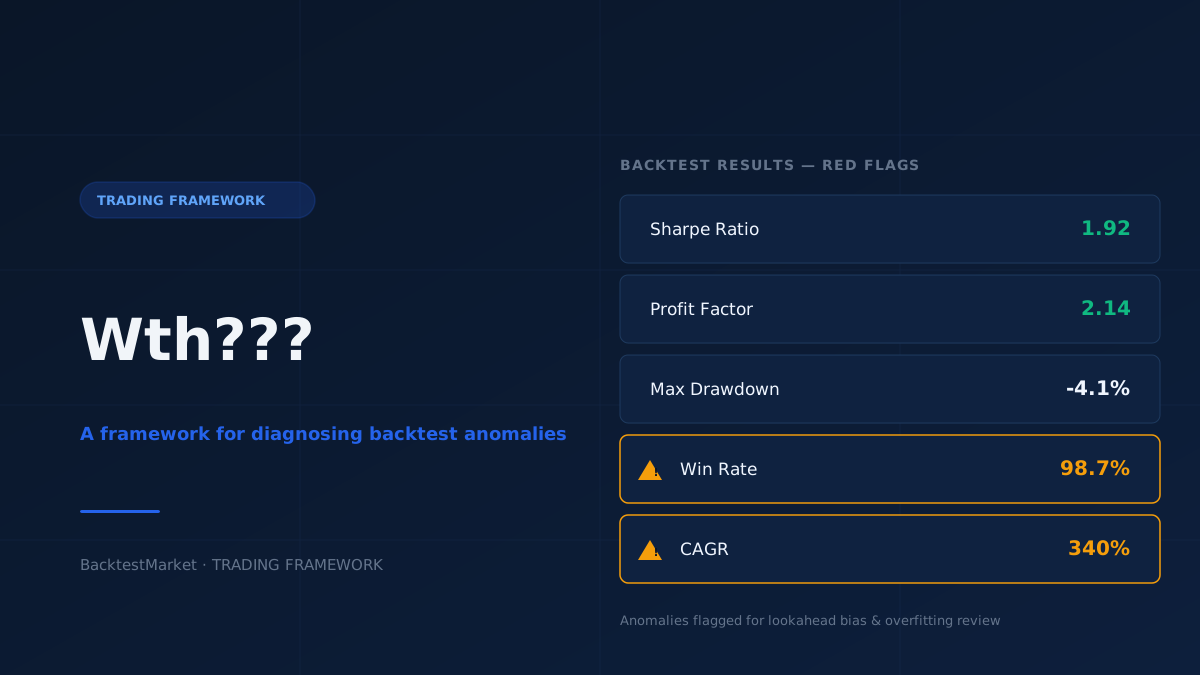
If you've spent any time in algorithmic trading forums, you've seen the post. Someone runs a strategy they've tested for months, tweaks one small parameter, re-runs the backtest — and the equity curve suddenly looks nothing like what they expected. The top comment is usually some version of "wth???"
It's a universal moment in this hobby/profession. You trust your process, you trust your data, and then the numbers do something that doesn't fit your mental model. The instinct for most traders is to either (a) panic and assume the strategy is broken, or (b) assume the result is real and get excited about a number that's too good to be true. Both reactions skip the most important step: figuring out why the backtest behaved the way it did.
This article isn't about any specific strategy. It's about the diagnostic process every algorithmic trader needs when a backtest result stops making sense — because it will happen, repeatedly, for as long as you build and test systems.
Why "Wth???" Moments Are More Common Than You'd Think
Backtesting feels deterministic. Same code, same data, same parameters should equal the same result every time. In practice, a surprising number of variables can silently shift between test runs:
- Data source changes. Switching brokers, re-downloading a data feed, or extending a history file can quietly alter spreads, gaps, or tick density for the same date range.
- Parameter interaction effects. Changing one input (say, a stop-loss multiplier) can interact nonlinearly with another (a trailing stop, a session filter) in ways that aren't obvious from reading the code.
- Platform quirks. MT4's strategy tester and MT5's tester handle modeling quality, tick simulation, and multi-symbol testing differently. The same EA can produce materially different statistics across platforms even with identical logic.
- Survivorship and continuation gaps. Futures and some CFD data feeds splice contracts together; a poorly stitched continuation series can create phantom gaps that your EA trades against — producing either phantom profits or phantom losses.
- Look-ahead bias creeping in. Indicators that reference "today's" high/low before the bar has closed, or custom functions that accidentally read future array indices, can produce results that look spectacular until you realize the logic couldn't execute in real time.
None of these are exotic. They're the standard failure modes of backtesting, and almost every serious systems trader has been burned by at least one of them. The "wth???" reaction is simply your brain correctly flagging that something in the system changed — even if you can't immediately identify what.
The Usual Suspects: A Diagnostic Checklist
When a backtest result surprises you — in either direction — resist the urge to immediately accept or reject it. Instead, work through a structured elimination process. Here's the order most experienced developers use, roughly from cheapest-to-check to most time-consuming:
1. Confirm the date range and symbol are actually what you think they are.
It sounds obvious, but mismatched date ranges or an accidentally selected wrong symbol (EURUSD vs EURUSD.a, for instance) is one of the most common causes of "impossible" results.
2. Check your data quality and source.
Gaps, missing bars, or inconsistent tick granularity between runs will change your results even with identical strategy logic. This is especially true if you've pulled data from multiple providers over time. If you're troubleshooting this, it's worth testing against a clean, consistent dataset — something like the forex historical data packs available on BacktestMarket, which give you a fixed reference point so you can isolate whether the anomaly is coming from your data or your logic.
3. Re-check modeling quality settings.
In MT4/MT5, "every tick," "control points," and "open prices only" modeling can produce meaningfully different fill behavior, especially for strategies with tight stops or that trade on sub-minute timeframes. A strategy that looks robust under "open prices only" can fall apart under tick-level simulation.
4. Isolate the parameter that changed.
If you tweaked something before the anomaly appeared, revert it and confirm the "normal" result returns. Then change only that one parameter again. This sounds slow, but it's the only reliable way to attribute the anomaly to a specific cause rather than guessing.
5. Inspect the trade log, not just the equity curve.
Aggregate statistics hide a lot. Pull the individual trade list and look for outliers — a single trade with an unusually large profit or loss is often the entire explanation for a "wth" result. If 80% of your net profit comes from one trade, that's not a robust edge; that's noise dressed up as signal.
6. Check for look-ahead bias explicitly.
Walk through your entry logic bar by bar and ask: "Could this condition actually have been known at the moment of entry, in real time?" This is tedious but it's the single highest-value check you can do, because look-ahead bias is the most common cause of backtests that look unbelievably good.
Turning "Wth???" Into a Repeatable Process
The goal isn't to eliminate surprising results — surprising results are often how you learn something real about your strategy or your data. The goal is to build a habit of treating every anomaly as a prompt for investigation rather than a reason for immediate excitement or despair.
A few practical habits that make this easier:
- Version your test configurations. Keep a simple log (even a spreadsheet) of date range, symbol, data source, platform, spread/slippage assumptions, and modeling quality for every backtest run. When a result looks odd, you can compare it line-by-line against the last "normal" run.
- Separate data problems from logic problems early. Before debugging your EA's code, re-run the exact same test on a known-clean dataset. If you're setting up MT4 or MT5 with external data, the guide on importing historical data into MetaTrader is a useful reference for making sure your import process itself isn't introducing inconsistencies.
- Treat single-trade outliers as their own category. If removing one or two trades flips your strategy from profitable to unprofitable (or vice versa), that's information about fragility, not about alpha. Report both numbers — with and without the outlier — when evaluating the system.
- Re-test across multiple data providers when possible. If a result only shows up with one specific data source, that's a strong signal the anomaly is data-related rather than strategy-related. This is one of the reasons many developers maintain access to more than one historical data pack for cross-validation, rather than relying on a single broker's export.
- Don't trust a single out-of-sample run either. One clean out-of-sample period that confirms your in-sample result is encouraging, but it's not proof. Rotate through multiple out-of-sample windows and different market regimes before drawing conclusions.
When the Anomaly Is in a Pre-Built EA
If you're testing a third-party Expert Advisor rather than code you wrote yourself, the diagnostic process is the same, just with one extra layer: you can't inspect the entry logic line by line unless the source is provided. In that case, lean harder on the data-quality and modeling-settings checks, and always re-run the EA's backtest yourself on your own broker's data before drawing any conclusions from a vendor-supplied report. A strategy's published statistics are only meaningful if you can reproduce something close to them independently.
The Takeaway
A "wth???" moment in a backtest is not a bug in your trading career — it's a normal, recurring part of the process. The traders who improve fastest aren't the ones who never get surprised by their results; they're the ones who've built a habit of methodically working backward from the anomaly to its cause, whether that's a data gap, a modeling setting, a parameter interaction, or genuine look-ahead bias in the logic.
Before you act on any backtest result that seems too good (or too bad) to be true, run it through the checklist above: confirm the data, check the modeling settings, isolate the changed variable, and read the actual trade log. If you can't explain why a result happened, you don't yet understand the strategy well enough to trust it — in either direction.