

The single most important practice to trust a multi symbol backtest is per-symbol state isolation combined with explicit cross-engine cost-model validation, run on clean, synchronized minute bars. Without isolated state, strategies leak information between symbols. Without a second engine to check your cost model against, you cannot tell whether your edge is real or an artifact of how one backtester handles commissions and fills.
TL;DR:
- Choose isolated per symbol runs to debug signal logic quickly; switch to portfolio simulation when shared capital, margin, or correlated drawdowns affect results.
- Use delisted instruments where relevant, align exchange calendars, and mark missing bars explicitly; applying today’s constituent lists to past dates creates survivorship bias.
- At zero costs, engines usually agree; under heavy cost assumptions, divergence stays below 0.75% for most benchmarks but reaches roughly 3.7% for high turnover strategies.
- Size positions across the portfolio when capital is shared, then stress test historical risk off periods because correlations can rise during market shocks.
Table of Contents
- Overview: architectures for multi-symbol backtesting and when to use each
- Coding patterns to implement multi-symbol backtests safely
- Data quality and bias controls for multi-symbol tests
- Costs, fills, and implementation risk: validate engines and sweep cost models
- Quick debugging checklist for the most common multi-symbol failures
- Why clean, ready-to-import minute-bar datasets speed multi-symbol validation
- Handling correlated symbol risk and portfolio effects
- Practical perspective from a developer: what changed after cross-engine validation
- How our data and bundles help you implement this checklist faster
- FAQ
- Sources
Overview: architectures for multi-symbol backtesting and when to use each
Two broad architectures handle multi symbol testing. The first runs each symbol through an isolated backtest instance and aggregates results afterward. The second simulates the full portfolio in a single pass, tracking shared capital, margin, and correlation effects as they happen.
Isolated per-symbol runs are faster to debug because a failure on one symbol never touches another, and you can parallelize across workers or cloud instances. Portfolio-level simulation is slower and harder to trace, but it captures capital allocation and cross-symbol interaction that isolated runs miss entirely.
Choosing between them comes down to scale and purpose:
- Use isolated per-symbol runs when you are validating signal logic, debugging data issues, or iterating quickly on strategy code.
- Use portfolio-level simulation when position sizing, margin usage, or correlated drawdowns matter to the result.
- Expect higher memory and I/O demand from portfolio engines, since they hold every symbol's state in memory simultaneously rather than streaming one symbol at a time.
Most development workflows start with isolated runs and move to portfolio simulation only once the underlying logic is proven stable.
Coding patterns to implement multi-symbol backtests safely
The backtest-kit multi-symbol design documentation lays out patterns that prevent the most common bug in multi symbol systems: state bleeding between symbols that never happens in single-symbol testing.
- Namespace every persistence artifact by both symbol and strategy name, for example using a key pattern like
${symbol}:${strategyName}, so no shared variable accidentally carries data from one instrument into another. - Memoize shared strategy instances to avoid rebuilding indicator caches for every symbol, while keeping each symbol's runtime state in a separate object.
- Run symbols in parallel using worker threads or
Promise.all-style execution, then aggregate results deterministically so re-runs on the same data always produce the same report. - Write a small reproducible unit test per symbol that feeds known inputs and checks for leaked state before you trust a full multi symbol run.
Pro Tip: Start every new multi-symbol strategy on a short, representative window with two or three symbols before scaling to your full universe; it isolates data and logic bugs long before they get buried in a large report.
This pattern set keeps the speed benefits of parallel execution without sacrificing the isolation that portfolio-level accuracy depends on.
Data quality and bias controls for multi-symbol tests
Clean data matters more in multi symbol testing than in single-symbol work, because errors compound across every instrument in the universe. A missing bar on one symbol can desynchronize your entire portfolio timeline if your engine advances all symbols on a shared clock.
- Use datasets that include delisted or expired instruments where relevant, since dropping them retroactively introduces survivorship bias into historical results.
- Synchronize timeframes across symbols, fill or flag missing bars explicitly, and align session calendars so a holiday on one exchange does not shift another symbol's bar count.
- Test for look-ahead and survivorship bias using constrained random portfolios or strictly ex-ante universes rather than today's constituent list applied to the past.
Research on look-ahead benchmark bias shows that using ex-post constituent lists instead of a true ex-ante universe can materially inflate both annualized returns and Sharpe ratios. Benchmarking against constrained random portfolios that mimic your strategy's turnover and leverage is a practical way to check whether your edge survives once that bias is removed.
Costs, fills, and implementation risk: validate engines and sweep cost models
Different backtesting engines agree almost exactly when transaction costs are set to zero. Once you introduce real commissions, spreads, and slippage, results diverge, and the divergence grows with how aggressively a strategy trades. A large-scale study of implementation risk found this divergence increases monotonically with cost intensity: it stays below 0.75% for most benchmark strategies but climbs to roughly 3.7% for high-turnover rotation strategies under heavy cost assumptions.
The same research uncovered seven undocumented defects across popular engines during forensic audits, including a Backtrader commission default that divided commission rates by 100, silently understating trading costs in any strategy that relied on the default setting.
| Validation step | What it catches |
|---|---|
| Zero-cost run on two engines | Logic or data bugs unrelated to costs |
| Cost sweep across a realistic range | Cost-model bugs and sensitivity to assumptions |
| Unit test on commission arithmetic | Unit-convention errors like misplaced decimals |
| Cross-engine check on final equity curve | Architectural or specification divergence |
Practical steps for your own pipeline:
- Run the same strategy at zero cost on two engines first; any divergence here points to a logic or data problem, not a cost-model one.
- Sweep commission and slippage assumptions across a realistic range and watch for discontinuities rather than smooth degradation.
- Prioritize full cross-engine validation for high-turnover, multi-symbol strategies, where the research shows implementation risk is largest.
Quick debugging checklist for the most common multi-symbol failures
When a multi symbol backtest crashes or produces results that look wrong, work through these checks in order rather than guessing at the cause.
- Confirm symbol mapping and timeframe alignment first: a mismatched ticker or an unaligned session calendar causes more false divergence than any logic bug.
- Reproduce the issue on a single symbol in isolation; if it disappears, the bug lives in your aggregation or parallel execution code, not your strategy logic.
- Check commission defaults and unit conventions in your engine's settings, since misconfigured decimals are a documented source of silent errors in several popular backtesters.
- After any platform upgrade, build a minimal reproducer with one symbol and a short date range, then inspect logs line by line before testing the full universe again.
Why clean, ready-to-import minute-bar datasets speed multi-symbol validation
A large share of the debugging time in multi symbol projects traces back to the data itself rather than strategy logic: gaps, misaligned timestamps, or formats that need manual reshaping before they load into a platform.
We built our historical data around removing that friction. Our minute-bar datasets have covered multiple instruments, including forex, metals, bonds, and stock indices, since 2014, and every set imports directly into MT4 and MT5 without reformatting. That ready-to-import structure cuts out an entire class of synchronization errors before a backtest ever runs. For readers building out the data-quality step of this checklist, our guides on running an MT5 portfolio backtest and completing a data audit before backtesting walk through the practical steps in more detail.
Handling correlated symbol risk and portfolio effects
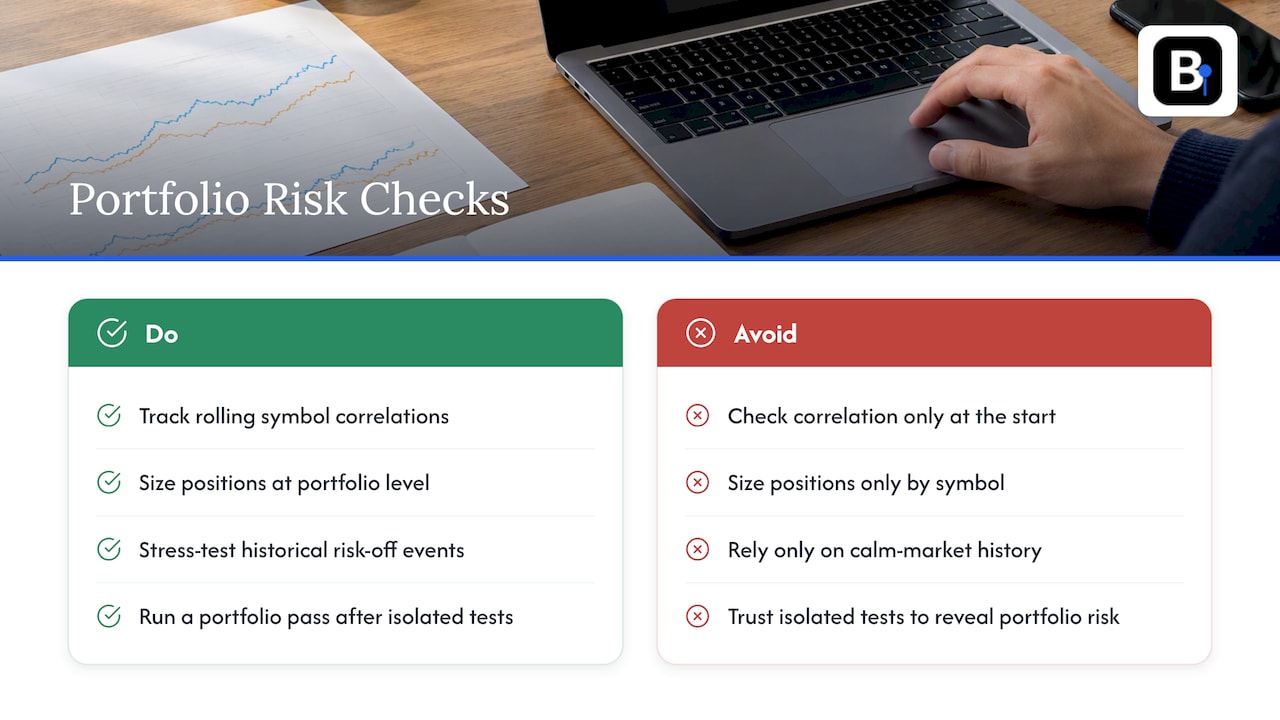
Testing symbols independently hides a risk that only shows up once they trade together: correlated drawdowns. Two uncorrelated strategies can each look solid in isolation, then lose money at the same time during a market-wide shock because their underlying symbols move together under stress.
A few practical habits reduce this blind spot. Track rolling correlation between symbol returns across your backtest window, not just at the start, since correlations shift during volatile periods and tend to rise exactly when diversification matters most. Size positions at the portfolio level rather than the symbol level when capital is shared, so the backtest reflects the same margin and exposure constraints the live account will face. Stress-test the portfolio against historical periods where correlations spiked, such as broad risk-off events, rather than relying only on calm-market history.
Isolated per-symbol runs are still useful for catching logic bugs, but they cannot reveal portfolio-level drawdown risk on their own. A strategy that passes every single-symbol test can still fail at the portfolio level if its symbols move together under stress. Running a portfolio-level pass after your isolated tests, even a simplified one that just aggregates equity curves with shared capital constraints, catches this class of risk before it reaches a live account.
Partner tools built for manual oversight, such as TradingView trade management setups, can help when you need to manually verify fills or test execution assumptions that a backtest alone cannot fully simulate.
Practical perspective from a developer: what changed after cross-engine validation
Adding a second engine as a cross-check caught cost-model errors that a single backtester's clean equity curve never would have revealed. Once cross-engine validation became a standard step rather than an afterthought, false positives in strategy selection dropped noticeably. Add an engine cross-check to your continuous integration pipeline before trusting any multi symbol result.
— Start
How our data and bundles help you implement this checklist faster
Getting the data-quality and synchronization steps right takes real setup time if you are sourcing and cleaning historical bars yourself. Some datasets arrive with the part already handled that causes the most friction in multi symbol projects.
- Clean minute bars across forex, metals, bonds, and stock indices.
- Ready-to-import format for backtesting platforms, with no reformatting step before you run a backtest.
- Support available related to the data and its maintenance.
Browse our historical data by instrument, or check the Annual Plan at €119 per year for continuous access to updated datasets.
FAQ
What is multi symbol backtesting?
Multi symbol backtesting runs a trading strategy across several instruments at once, either as isolated per-symbol tests or as a combined portfolio simulation. It reveals correlation and capital-allocation effects that single-symbol testing cannot show.
How do I synchronize data across symbols with different trading hours?
Align each symbol's bars to a shared timeline, mark missing bars explicitly instead of forward-filling silently, and account for exchange holidays that affect only some symbols. Mismatched session calendars are one of the most common causes of false divergence in multi symbol results.
Why do my backtest results differ between two engines?
Engines typically agree almost exactly at zero transaction cost, so divergence usually traces back to how each one models commissions, slippage, or fills. Research on implementation risk found this divergence grows with cost intensity, reaching a material percentage for high-turnover strategies under heavy cost assumptions.
What causes look-ahead bias in multi symbol backtests?
Look-ahead bias occurs when a backtest uses information that would not have been available at the time, most often by applying today's list of index constituents to historical dates. Studies on benchmark bias show this can materially inflate both returns and Sharpe ratios compared to a true ex-ante universe.
Does BacktestMarket data work for multi symbol strategies?
Yes, our minute-bar datasets cover multiple instruments including forex, metals, bonds, and stock indices, and import directly into MT4 and MT5 without reformatting. Pricing for continuous access runs through our Annual Plan at €119 per year.
Sources
- Implementation Risk in Portfolio Backtesting: A Previously Unquantified Source of Error | alphaXiv
- Look-Ahead benchmark bias in portfolio performance evaluation | ar5iv
- design/89_multi-symbol_strategies | backtest-kit
Recommended
- Three Ways to Run an MT5 Portfolio Backtest With Clean Minute Bars
- MT4 Portfolio Backtesting: Export Replay to Find Real Drawdowns
- How to Read a Backtest Report: Key Parameters Explained
- 99% Modeling Quality for Quants: MT5 Backtesting Data IS to WFA to OOS
Related resources
Explore BacktestMarket's historical data packs to put the ideas in this article into practice.