

The four forex sessions are Sydney, Tokyo, London and New York, and in UTC they run roughly 21:00–06:00, 00:00–09:00, 07:00–16:00 and 12:00–21:00 with US and UK summer time in force. The retail week opens Sunday at 5:00 pm New York time and closes Friday at 5:00 pm. The hours that matter most are the London–New York overlap, 8:00 am to 12:00 pm Eastern Time. Below you get every session in UTC and ET, the overlaps, the two weeks a year when the numbers shift, and what all of it means if you backtest on minute bars.
TL;DR
- The forex week runs from Sunday 5:00 pm ET (21:00 UTC) to Friday 5:00 pm ET. Within it, "open" and "close" are conventions based on local banking hours, not exchange bells.
- With London and New York on summer time, the sessions are Sydney 21:00–06:00, Tokyo 00:00–09:00, London 07:00–16:00 and New York 12:00–21:00 UTC.
- The London–New York overlap, 8:00 am to 12:00 pm ET, is the busiest window. It stays fixed in ET but moves in UTC when clocks change.
- The UK and the US change clocks on different dates, so in 2026 the overlap briefly stretches to five hours (25 October to 1 November).
- If your backtest data is not aligned to one consistent time zone and DST rule, session-based results will be wrong.
Table of Contents
- The four forex sessions at a glance
- When the forex week opens and closes
- The overlaps that move the market
- Daylight saving: why the numbers move
- What this means for your time zone
- Which session suits which pair
- Session times and backtesting: where tests go wrong
- Our view: sessions are a data problem first
- Test your session strategies on clean minute data
- If you trade futures too
- FAQ
- Sources
The four forex sessions at a glance
Forex has no central exchange. It is a network of banks, dealers and brokers, so each session simply reflects the local business day of a major financial hub. Alpari's trading schedule lists the four sessions as Sydney 21:00–06:00 UTC, Tokyo 00:00–09:00 UTC, London 07:00–16:00 UTC and New York 12:00–21:00 UTC, which corresponds to a standard 08:00–17:00 local business day in each hub, with the UTC figures shifting by an hour as clocks change.
Those UTC figures assume London and New York are on summer time. Here they are in both UTC and US Eastern Time, for the part of the year when both countries are on summer time (roughly mid-March to late October):
| Session | UTC | Eastern Time (EDT) |
|---|---|---|
| Sydney | 21:00–06:00 | 5:00 pm–2:00 am |
| Tokyo | 00:00–09:00 | 8:00 pm–5:00 am |
| London | 07:00–16:00 | 3:00 am–12:00 pm |
| New York | 12:00–21:00 | 8:00 am–5:00 pm |
In winter, when both London and New York are on standard time, the same hubs run Tokyo 00:00–09:00, London 08:00–17:00 and New York 13:00–22:00 UTC, with Sydney at 20:00–05:00. Tokyo does not observe daylight saving, which is why its UTC hours never move.
Two caveats before you rely on any session chart:
- Sessions are not walls. Banks and market makers drive liquidity, and "open" and "close" are conventions rather than enforced halts. Trading never stops mid-week; activity just rises and falls.
- Sydney is the hardest session to pin down, because Australia is in the southern hemisphere and changes clocks in different months than the US and UK. Check the current offset before trading around its open.
When the forex week opens and closes
The retail market is effectively open from Sunday 17:00 ET (21:00 UTC) to Friday 17:00 ET, measured in New York time. Because the reference is New York local time, the UTC equivalent moves by an hour with US daylight saving: 21:00 UTC in summer, 22:00 UTC in winter. Brokers differ by a few minutes on the exact moment quotes start and stop, and some close earlier on holidays, so confirm with yours.
The 5:00 pm New York cut-off matters for more than weekly hours. For standard pairs on institutional platforms, the trade date rolls over at 17:00 New York time, adjusted for daylight saving. That is why many data vendors and professional systems define a "day" as 17:00 to 17:00 New York rather than midnight to midnight. A daily bar built on midnight server time and one built on the 17:00 New York close will have different highs, lows and closes.
The overlaps that move the market
Sessions overlap because one hub is still working while the next arrives. Three windows matter.
London–New York: the busy one
For most traders, the London–New York overlap, 8:00 am to 12:00 pm ET, is when volume and liquidity usually peak. In UTC that is 12:00–16:00 while both are on summer time, and 13:00–17:00 in winter. Expect tighter spreads and larger moves in pairs such as EUR/USD, GBP/USD and USD/CHF.
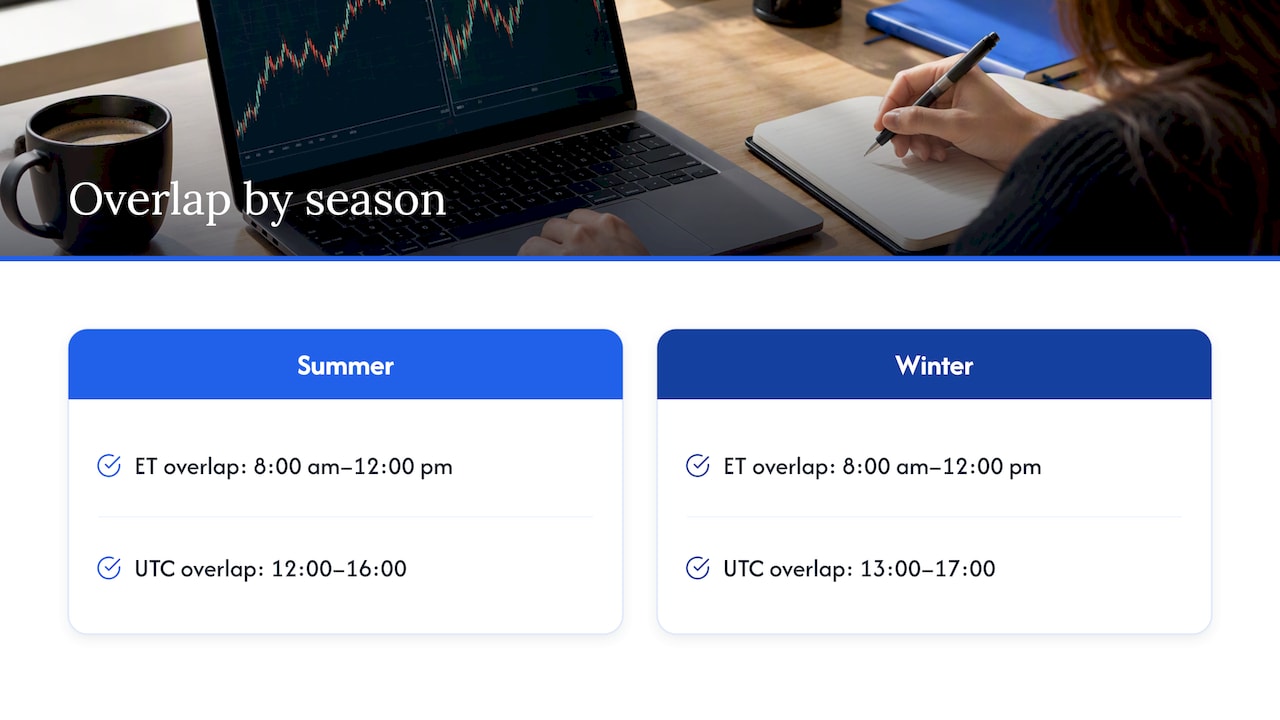
This window also carries scheduled US and Canadian data. Many releases land at 8:30 am ET, right at the start of the overlap, which is why it is central to news-driven strategies. If your system trades around releases, the spread and slippage assumptions in your backtest should be different for this half hour than for the rest of the day.
Tokyo–London: short and often misread
The Tokyo–London handover is brief. Many traders watch the 08:00 open in London, but the liquidity surge often begins around 07:00 UTC as London desks arrive while Tokyo is winding down. The overlap is about an hour long. It matters for EUR/JPY, GBP/JPY and the yen crosses.
Sydney–Tokyo: quiet, range-bound
The early Asian hours, when Sydney and Tokyo overlap, are usually the calmest part of the day for the majors. They suit pairs with an Asia-Pacific leg such as AUD/JPY, NZD/USD or AUD/NZD better than EUR or GBP pairs.
The thin hours
The stretch after New York closes and before Tokyo gets going is where liquidity is thin, which can mean wider spreads and erratic price moves. It is also the window around the 17:00 ET rollover, so spreads quoted by many brokers widen exactly when your daily bar closes. A backtest with fixed spreads will flatter any strategy that trades here.
Daylight saving: why the numbers move
Session hours are anchored to local time in each hub, so UTC offsets shift when that hub changes its clocks. Session times move relative to UTC whenever a specific financial center observes DST, not when your own country does. If you live in Arizona or Singapore, your clock never changes, but London's and New York's sessions still jump by an hour in your time.
The US and UK change clocks on different dates, so there are short windows when the gap between London and New York is not the usual five hours. In 2026, those windows run from 8 to 29 March and from 25 October to 1 November. During them, the London–New York overlap lasts five hours instead of four. The overlap runs 8:00 am to 1:00 pm ET in those weeks. With today being 20 October 2026, the next stretch starts this coming Sunday.
A quick reference by season
| Period | London (UTC) | New York (UTC) | Overlap (UTC) |
|---|---|---|---|
| Both on summer time | 07:00–16:00 | 12:00–21:00 | 12:00–16:00 |
| Both on winter time | 08:00–17:00 | 13:00–22:00 | 13:00–17:00 |
| UK on winter, US still on summer | 08:00–17:00 | 12:00–21:00 | 12:00–17:00 |
| UK still on summer, US on winter | 07:00–16:00 | 13:00–22:00 | 13:00–16:00 |
The third row is the late-October week: London has moved back, New York has not yet, so the overlap runs 12:00 to 17:00 UTC. The fourth row covers the spring weeks when the US has moved forward first.
What this means for your time zone
Convert once, then write it down. A practical way to do it:
- Pick the hub that matters for your pair (London for EUR and GBP pairs, New York for USD pairs, Tokyo for JPY pairs).
- Take its local business hours, 8:00 am to 5:00 pm, as the session.
- Convert to your own time zone using the current offset for that hub, not for your home.
- Re-check on the dates when the UK, the US and Australia change clocks.
For US readers the shortcut is simple: the London–New York overlap is 8:00 am to 12:00 pm Eastern, 7:00 to 11:00 am Central, and 5:00 to 9:00 am Pacific, and it is the same all year in each of those zones because they share New York's DST rules. Only the UTC numbers move. Live converters and session clocks, such as the one from Babypips, are handy for a glance, but they do not replace knowing which offset your platform uses.
Which session suits which pair
Session choice is mostly about where a currency's home market is awake.
- EUR/USD, GBP/USD, USD/CHF: the London morning and the overlap. Quiet in the Asian session, unless news hits.
- USD/JPY, EUR/JPY, GBP/JPY: Tokyo hours and the overlap, with extra activity around US data.
- AUD/USD, NZD/USD, AUD/JPY: Sydney and Tokyo hours, then again at US data.
- USD/CAD: the New York morning, especially around 8:30 am ET releases from the US and Canada.
- Gold and silver: they react to London and New York hours, with the heaviest action in the overlap.
This is a guide to where activity concentrates, not a promise of profit. Every pair can move in any session when a surprise lands.
Session times and backtesting: where tests go wrong
If you test strategies on minute bars, session times are not trivia, they are part of your strategy logic. Three mistakes are common.
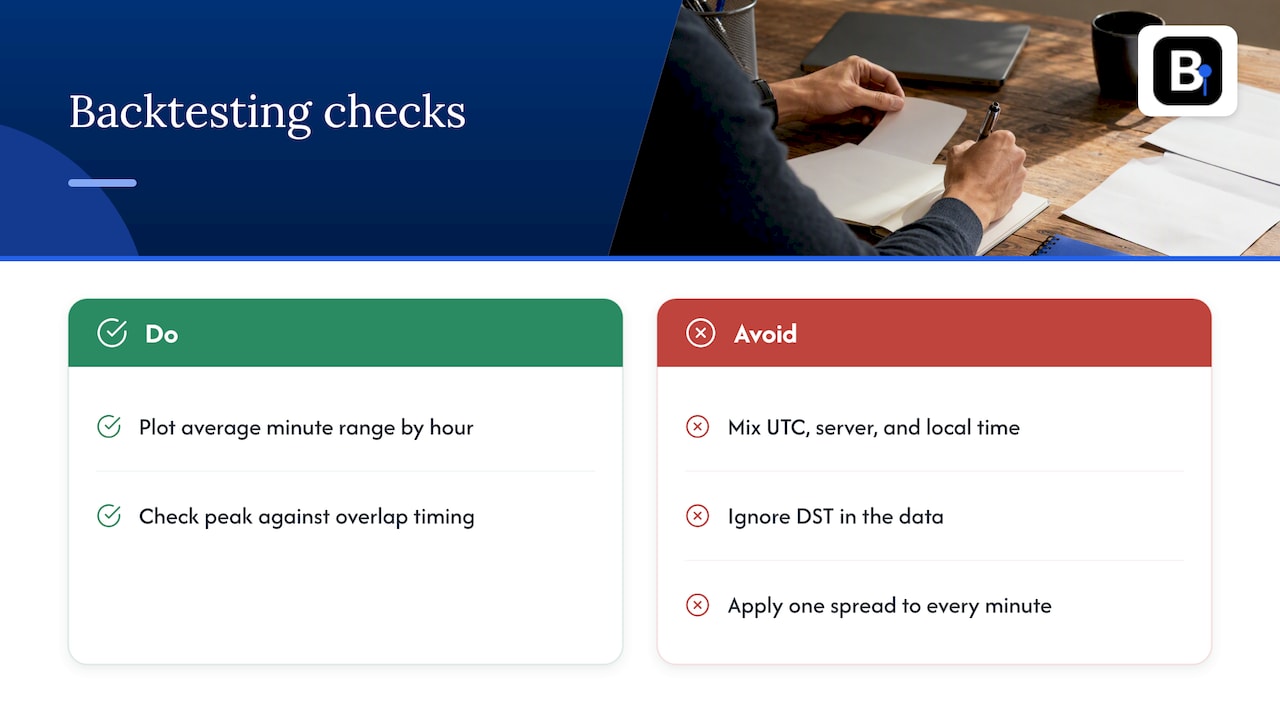
Mixed time zones. Many MT4 and MT5 brokers use a server time that follows New York closes, often GMT+2 in winter and GMT+3 in summer. Your data file might be in UTC, your broker's server in something else, and your session filter in your own local time. Any mismatch moves your "London open" by one or more hours. Our guide to fixing the MT4 GMT offset for accurate EA timing walks through how to check this.
Ignoring DST in the data. A session filter set to "07:00 to 16:00" is right in summer and wrong in winter unless the data and your rule both shift. Errors around the clock-change weeks are especially nasty because they are small, recurring and easy to miss. We cover the data side in Forex Daylight Saving Time: fixing DST errors in minute data.
Fixed spreads across thin hours. As noted above, spreads widen around the rollover and in the late New York to Tokyo gap. A test that applies one spread to every minute overstates results for strategies that trade those hours, and understates the benefit of avoiding them. Many quant desks and algorithms concentrate on the overlaps for exactly this reason.
A simple sanity check: plot average absolute minute range by hour of day on your own data. You should see a clear rise at the London open, a peak across the overlap, and a fall after the 17:00 ET rollover. If the peak is an hour off from where it should be, your timestamps or your DST handling are wrong.
Our view: sessions are a data problem first
We collect and verify minute-bar data every day, and the most common support question we hear is not about strategy. It is about time. A trader sees a backtest that works on the London open, then fails live, and the cause is usually a one-hour shift in the data or a session filter that ignored a clock change.
Our approach is to treat time as part of data quality. Bars are checked one by one, adjustments are documented, and files are built so they import into MT4 and MT5 without you needing to reconstruct the timestamps. That standard applies whether a human or an AI-driven system runs the test, because a machine will faithfully exploit an hour of misaligned data without ever noticing it.
Our advice: choose one reference (UTC, or New York time with the 17:00 rollover), apply it everywhere, and write your DST rule into the strategy documentation. Test the clock-change weeks separately. If results change materially in those weeks, you have found a timing bug, not an edge.
— Start
Test your session strategies on clean minute data
If you backtest session-based ideas, you need minute bars that are complete, consistent and ready to import. Our historical data sets cover forex, metals, stock indices and bonds since 2014 as a one-time download, with engineers on hand to answer timing and format questions. To start with the pairs most affected by the London–New York overlap, see the Forex Major Full Pack. If you prefer a plan, the Annual Plan is 119 EUR per year.
If you trade futures too
Session logic gets more complicated with futures, where contract rolls add a second timing layer on top of the daily rollover. Our articles on rolling rules for futures contracts and futures rollover methods explain how to keep session tests from being distorted by roll gaps.
FAQ
What are the 4 forex sessions?
The four sessions are Sydney, Tokyo, London and New York. With UK and US summer time in force they run roughly 21:00–06:00, 00:00–09:00, 07:00–16:00 and 12:00–21:00 UTC. In winter the London and New York hours shift one hour later in UTC.
What is the best forex session to trade?
Most traders find the London–New York overlap, 8:00 am to 12:00 pm Eastern Time, the most liquid, with tighter spreads on the majors. It is also when major US data often lands. The right session for you depends on the pair and your strategy, so test it on data rather than assuming.
What time does the forex market open and close each week?
The retail market opens Sunday at 5:00 pm New York time (21:00 UTC in summer, 22:00 UTC in winter) and closes Friday at 5:00 pm New York time. Brokers may differ by a few minutes, and holidays can bring earlier closes, so check your broker's schedule.
Why do session times change twice a year?
Sessions follow local business hours in London, New York and Sydney. When those cities change their clocks, the sessions shift in UTC. Because the UK and US change on different dates, the London–New York overlap is five hours long for a few weeks, including 25 October to 1 November 2026.
Does the 5-3-1 rule have anything to do with sessions?
It is a trading-style guideline some traders use (five pairs, three strategies, one trading time), not a session convention. The "one time" part does connect to sessions, since it asks you to trade a single consistent window, such as the overlap.
Sources
- Trading hours and market holidays, Alpari
- Forex market hours, Forexop
- Best time to trade forex: the London–New York overlap, Babypips
- Forex market hours converter, Babypips
- EBS value date calendar, CME Group
- Forex trading sessions explained: hours, overlaps and daylight saving shifts (2026), ePlanet Brokers
Recommended
- How to Fix the MT4 GMT Offset for Accurate EA Timing
- Forex Daylight Saving Time: Fixing DST Errors in Minute Data
- Avoid Hour Errors: Three Parts to Normalize Time Zones for Developers
Related resources
Explore BacktestMarket's historical data packs to put the ideas in this article into practice.