

Look ahead bias happens when a historical test uses information that would not have been available at the moment of the decision, which makes a backtest or forecast look far better than live trading will ever be. If you build strategies, train models on time series, or review financial research, you need to know where it hides and how to remove it before you trust any result.
TL;DR:
- Split time series chronologically and fit scalers, encoders, feature selectors, and other learned transformations on each training window only, never on the full sample.
- Use release dates rather than reference dates for economic and accounting data, and use vintage records when later revisions could change what was originally known.
- Rerun historical tests with truncated data or delayed inputs; earlier signals should remain unchanged, while genuine performance should weaken gradually rather than collapse.
- Log the newest input timestamp for each signal and assert it does not exceed decision time; keep the final test period untouched during model selection.
Table of Contents
- What look ahead bias is and how it shows up in a simple example
- Where leakage hides in backtests and machine learning pipelines
- How to detect look ahead bias in a backtest you already have
- How to prevent look ahead bias before it enters your pipeline
- An audit checklist you can run before trusting any backtest
- Why rolling buffers and published protocols make prevention structural
- Why this matters for research credibility
- Cleaner minute-bar data removes several look ahead traps
- FAQ
- Sources
What look ahead bias is and how it shows up in a simple example
Look ahead bias means a decision at time t quietly depends on data that only arrived after t. The strategy "knew" something it could not have known, so the historical result is fiction. Any input, transformation, or model choice that uses information unavailable at the forecast origin counts as leakage.
Picture an indicator built from a centered moving average. On Tuesday it averages Monday, Tuesday and Wednesday, yet your backtest treats that value as known on Tuesday morning. Every signal then appears to anticipate tomorrow's move.
These contrasts help you recognize the symptom:
- Versus hindsight bias: hindsight bias is a human error of memory ("I knew it all along"), while look ahead bias is a mechanical flaw in how the test is wired.
- Versus overfitting: overfitting tunes a model too tightly to noise in data it is allowed to see, while look ahead bias gives the model data it should never see.
- The telltale sign: results that look too clean, with smooth equity curves and almost no losing streaks, deserve suspicion before celebration.
Where leakage hides in backtests and machine learning pipelines
Most leakage is not exotic. It comes from ordinary conveniences in code and data handling, and it tends to cluster in the same places:
- Full-sample preprocessing: scaling, normalization or PCA applied before the train/test split lets test-period statistics shape the training features. Data leakage often arises when preprocessing steps are fitted on all data, so the safe habit is to split first.
- Forward-looking windows: centered smoothing, misaligned timestamps, and daily bars joined to intraday signals without respecting bar close times.
- Peeking during selection: choosing features or hyperparameters using the final test period, then reporting that same period as out-of-sample.
- Revised data: macro and accounting figures that were restated or backfilled after their original release. Accounting revisions and timing mismatches between infrequent fundamentals and daily prices create bias unless timestamps and adjustments are handled consistently.
- Indexing slips: vectorized pandas or numpy operations with an off-by-one shift that reads tomorrow's row.
Even careful practitioners fall into this. Well-meaning forecasters can unintentionally introduce look-ahead bias through intuition or patterns learned from the test sample, which inflates reported performance.
Statistic note: Random cross-validation folds on time series can leak future information and produce overly optimistic evaluation, which is why temporal-aware splitting is the standard recommendation.
How to detect look ahead bias in a backtest you already have
You do not need to rebuild everything to test for contamination. Start with these probes, roughly in order of effort:
- Truncate the history. Re-run the backtest on data cut off at an earlier date. Signals before the cutoff should be identical to the full run. If they change, the strategy is using later data.
- Shift and block. Delay your inputs by one bar, or blank out the next few days entirely. A real edge degrades gracefully. A leaked one collapses.
- Compare against a restricted run. Record indicator values and entry/exit timing from the full run, then compare them to a run where the engine can only see data up to each decision point. Any mismatch marks the exact line of code to inspect.
- Audit the preprocessing. Confirm every scaler, encoder, selector and imputer is fit on training data only. Fit on the training set, then transform the test set, never the reverse.
- Distrust uniform excellence. If dozens of strategy variants all perform suspiciously well, the common data or pipeline is more likely the cause than your collective brilliance.
Pro Tip: Log the timestamp of the newest data row used for every single signal, then assert in code that it never exceeds the decision time. One failed assertion beats weeks of doubt.
For structuring validation windows, our walk-forward guide on good backtesting practices goes through the mechanics step by step.
How to prevent look ahead bias before it enters your pipeline
Detection is a cleanup. Prevention is cheaper, and it comes down to a few habits you can build into every project.
- Split by time, not at random. Use walk-forward or expanding-window validation so each fold trains on the past and tests on the future. Temporal-aware splitting rather than random splitting is the recommended approach for time series.
- Fit on train, transform on test. Every learned parameter, from a mean to a PCA loading, comes from the training window only.
- Bind steps into a pipeline. Put scaling and feature selection inside the training fold so they cannot see outside it.
- Respect release lags. Align each predictor's availability date, not its reference date, to the decision time, and use vintage data where revisions exist.
- Make future access impossible. Prefer rolling buffers and warmup phases that expose only past ticks.
- Record the evidence. For each historical forecast, store the decision time, raw inputs and transformations.
| Practice | What it blocks |
|---|---|
| Walk-forward splits | Training on future observations |
| Fit on training only | Test statistics leaking into features |
| Vintage data | Revised figures used before release |
| Rolling buffers and warmup | Direct access to future rows |
| Decision logs | Unverifiable results |
Pro Tip: Treat your test period as a one-time resource. Every look at it that influences a decision spends part of its credibility.
Our guides on MT5 data from walk-forward to out-of-sample and data preparation with a per-year gap audit cover the data side of this work in detail.
An audit checklist you can run before trusting any backtest
Paste this into a repository README or a pre-release review. Every item needs a written answer, not a mental nod.
- Decision time: state when each prediction or trade is assumed to be taken.
- Target: define the exact future outcome and its horizon.
- Raw inputs: list which fields were actually observable by that decision time.
- Transformations: confirm every fit and selection step used training data only.
- Feature construction: confirm lags and windows never touch future rows.
- Model selection: confirm the test set was never peeked at or reused during tuning.
- Data vintage: document how revisions and backfills were handled.
If any answer is "I think so," treat it as a failure until you can show it. Our piece on checks quants need for backtesting data pairs well with this list.
Why rolling buffers and published protocols make prevention structural
Manual discipline fails under deadline pressure, so the strongest defenses are built into the system. A rolling-buffer architecture exposes only past ticks to each operator and uses automatic warmup, which makes look-ahead access structurally impossible rather than merely discouraged. Warmup also stops a strategy from trading before it has enough history.
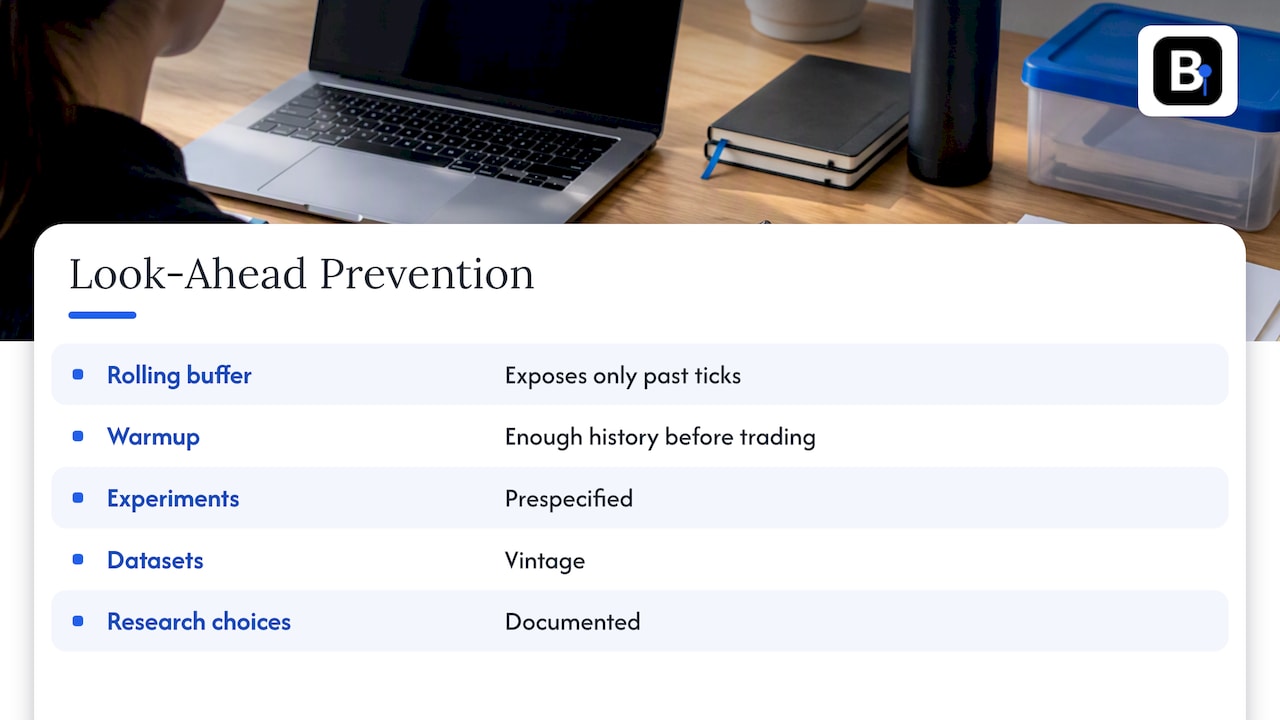
On the research side, a backtesting protocol for the machine learning era recommends prespecified experiments, vintage datasets and documented choices. Together these map directly onto the detection and prevention steps above.
Why this matters for research credibility
Leakage and repeated testing feed the same trap: the winner's curse. Try enough variants, and the best one looks brilliant partly through luck, and leaked information inflates that luck further. The same protocol work notes that true out-of-sample data is live trading, which should humble anyone holding a pretty equity curve.
My view is simple: prespecify your hypothesis, keep the model as simple as the problem allows, and spend engineering effort on structural controls instead of trusting yourself to remember every check.
— Start
Cleaner minute-bar data removes several look ahead traps
Many leakage problems start with messy inputs: misaligned timestamps, gaps and silent adjustments. Our minute-bar sets are cleaned, documented and ready to import into MT4 and MT5, so you can spend your effort on the strategy instead of the plumbing. Browse our Historical Data page, or look at the Annual Plan for ongoing access.
FAQ
What is look ahead bias?
Look ahead bias is the use of information in a historical test that would not have been known at the time of the decision. It makes backtests and forecasts look better than real trading can deliver. The Columbia data science poster on stock return predictions shows how models can appear to know returns that followed events.
What does "look ahead" mean in a backtest?
It means the test reads data from after the simulated decision point, such as a future bar's close or a later revision of a figure. The strategy then reacts to something it could not have seen. Any such read makes the result unreliable.
How is hindsight bias different from look ahead bias?
Hindsight bias is a psychological tendency to believe past events were predictable. Look ahead bias is a technical error where future data enters a calculation. The first lives in your head, the second in your code and data.
How can I stop look ahead bias in time-series forecasting?
Split data chronologically, fit all preprocessing on training windows only, and use pipelines so selection steps stay inside each fold. Forecasting toolkits such as sktime note the pitfalls of confusing forecasting with ordinary supervised regression.
Sources
- Lagged features for time series forecasting — scikit-learn 1.9.1 documentation
- Lookahead Bias Prevention - Clypt
- A Backtesting Protocol in the Era of Machine Learning
- 12. Common pitfalls and recommended practices — scikit-learn 1.9.1 documentation
- Look-Ahead Bias and Data Leakage – SlackQuant Research
Recommended
- Stop Fake Alpha: 5 Checks Quants Need for Hedging Backtesting Data
- Data Snooping Bias: How Researchers and Quants Catch It
- 99% Modeling Quality for Quants: MQL4 Data Prep Per Year Gap Audit
Related resources
Explore BacktestMarket's historical data packs to put the ideas in this article into practice.