Blog
Articles, guides and insights on algorithmic trading, backtesting strategies, quantitative analysis, and data quality.
1–9 of 134 articles
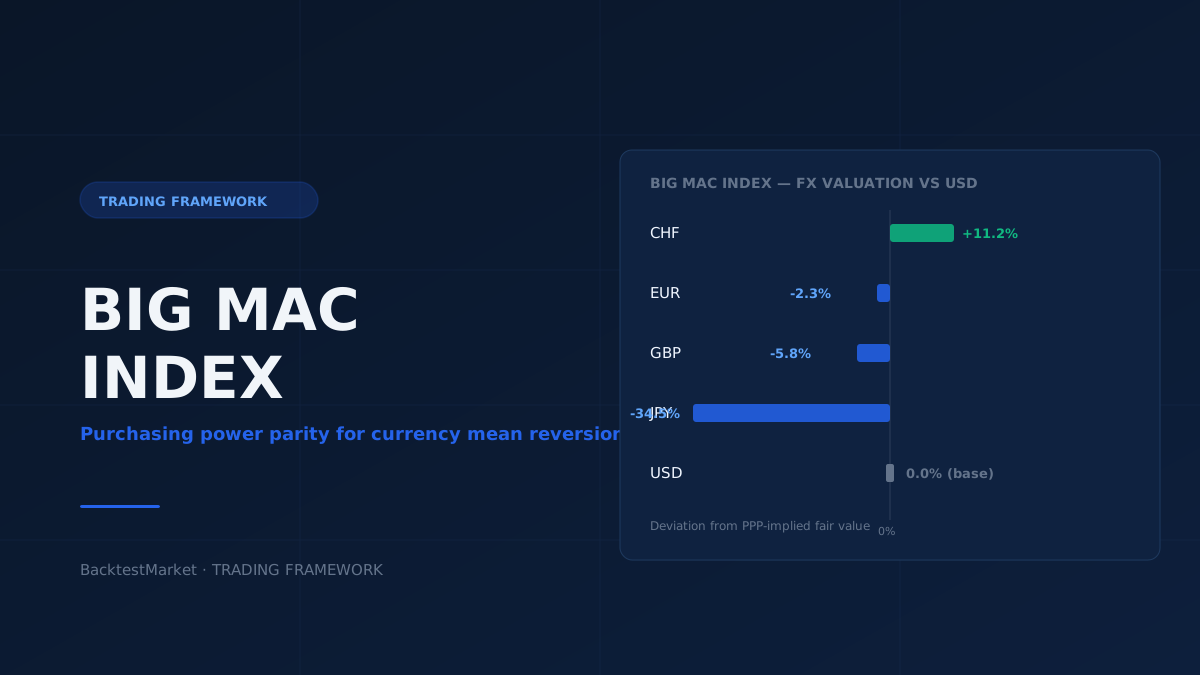
What the Big Mac Index Can Teach Algorithmic Traders About Currency Valuation
The Economist's famous Big Mac Index is more than a quirky economics lesson — it's a simplified purchasing power parity model that can inform how algorithmic traders think about long-term currency mean reversion and backtest design.

HST File Format: Structure, Versions and How to Use It
What an HST file is in MetaTrader, how the 148-byte header and 44- or 60-byte records are laid out, and how to import and check HST data safely.

Index Trading Hours: Cash vs. Futures Sessions, Explained
Index trading hours depend on whether you trade the cash index or its futures. See U.S. session times, holidays and what to check before backtesting.

Volume Aggregation Methods for Intraday Data and Backtests
How intraday volume is counted, summed into bars and daily totals, and checked for anomalies, so your backtests rest on volume you can trust.

Tick vs Minute Data: Which One Your Backtest Needs
Tick data records every trade or quote; minute bars compress them into OHLCV. See what each keeps, what it loses, and which one fits your backtest.

Volatility Regime Detection: Methods, Inputs and Pitfalls
How to detect volatility regimes: the inputs, the models (HMM, GARCH, clustering, change points), how to avoid look-ahead bias, and where detectors fail.

MT5 Custom Symbols: Create, Import and Test Your Data
How to create a custom symbol in MT5, set it up before importing, fix time shift and time zone problems, and backtest it in the Strategy Tester.

Position Sizing Backtesting: How to Test Size Rules Properly
Learn how to backtest position sizing: fixed, percent-of-equity and volatility methods, margin limits, costs, and the data quality that keeps results honest.

Rolling Window Backtest: How to Build One That Holds Up
Learn how a rolling window backtest works, how to pick window length and step, avoid look-ahead bias, and read results across overlapping periods.